Tomorrow Never Dies
January 14, 2012 2 Comments
 Title: Tomorrow Never Dies
Year: 1997. Tomorrow Never Dies was a breakthrough artistic achievement that forever changed pop entertainment. It’s been called “a masterpiece,” the producer declared it could “never be recreated,” and one of the two writers said it’s like “the Dalai Lama chanting from a hilltop.” Wait a second, Oh man, I got confused. I’m talking about “Tomorrow Never Knows,” the last track on 1966’s Revolver that broadcast an end to the mop-topped Fab Four and established the Beatles as true innovators of music. My bad, Tomorrow Never Dies is actually the opposite of all that and is in fact a step backwards for the Bond franchise. Yah, sorry to get your hopes up but mine were pretty high for this film as well coming off the superb GoldenEye (1995). Tomorrow Never Dies is not as dreadful as its title (which is bad even by Bond title standards) but more like a stopgap film. Picture an odds and sods record put out to keep the fans quite and fulfill contractual obligations and you get the idea. All the things we want to see Bond doing are here, they’re just not done all that well. It’s almost as if everyone at EON took a great deep breath after proving Bond could be relevant in the 90’s with GoldenEye and decided to coast. As plugged in as he was in the last movie, here Bond is out of sync with the world around him. I’m reminded of another film about a man out of time that came out in 1997, and I only mention it because sometimes there’s a man… I won’t say a hero, because what’s a hero? But sometimes, there’s a man. And I’m talkin about the Dude here. Sometimes, there’s a man, well, he’s the man for his time and place. He fits right in there. And that’s the Dude, or maybe His Dudeness, or Duder, or El Duderino if you’re not into the whole brevity thing. The running gag of The Big Lebowski (1997) is that The Dude, while appearing completely oblivious to everything going on around him, is in fact 100% tuned in, thanks mostly to keeping his mind limber. He is not the 60’s culture casualty that can’t function in the 90’s as he first appears to be (That would be Walter) but he is, as The Stranger said, a guy who fits right in there. And that’s the geniuses of the film, The Dude is so much a part of what’s happing while, Zen like, not actively participating that any lines between the character and the LA of the film are invisible. Dude and his world are in fact one while everyone he encounters is out of sync in one way or another and therefore become a complicated strand on old Duder’s head. The opposite can be said of the Bond character in Tomorrow Never Dies. He is a 60’s product who never feels like he’s part of the modern world he inhabits. 007 simply moves from point A to point B as dictated by the script. The plot, as it is, exists as an engine to move Bond forward while he is simply a passenger on the train, watching it all go past his window. This is the difference between “character driven” and “plot driven.” Both can be effective means of story telling. Hitchcock characters for example do what the plot demands because it demands them to, but if you’re going to go plot driven, you better have a damn good story. Sadly, for Bond’s 18th adventure, as Jackie Treehorn once lamented, “standards have fallen.”

Lebowski, Jeff Lebowski
Film Length: 1 hour and 59 minutes
Bond Actor: Pierce Brosnan’s early life is like something straight out of Dickens. Born in Ireland, Pierce moved to England at a young age (hence his accent) to live with his grandparents after his father left and his mother could not afford to keep him. When Pierce was 6, his grandparents died and the young boy floated between relatives and boarding houses until at 10, his mother was finally able to take him back. While a teen in London he became interested in acting and eventually moved to New York with Broadway dreams. He got some smaller roles and met his future wife, actress Cassandra Harris, who was in For Your Eyes Only (1981) and introduced Pierce to Cubby Broccoli. He then landed the lead on “Remington Steele,” a role that would make him known while costing him his first shot at playing Bond in 1987. Tragedy continued visiting Brosnan when in 1991 he lost Cassandra to ovarian cancer. (He was remarried in 2001 to Keely Smith.) Brosnan is undoubtedly an incredibly handsome man but he is far more then a pretty face. When called upon to do so, he can play hurt and vulnerable in ways that suggest he’s pulling from his difficult life. You got ta pay you’re dues to sing da blues and Brosnan has done so in spades. Tomorrow Never Dies gives him exactly one opportunity to do some dramatic acting and he makes the most of it. Circumstances are such that one of Bond’s old flames is now married to the main baddie. Having laid his cards on the table at a party earlier in the evening, Bond now waits in his hotel room wondering who will show up, the girl or an assassin. Or will they be one in the same? 007 sits in chair, facing the door, drinking straight vodka from a glass he re-fills with a bottle that rests at his side. This is not martins at a glamorous dinner; this is a man drinking for answers. When the lady does show up the two cut right to the case and old wounds are reopened. Pierce plays the scene as a man who has been hurt and has drank just enough to wash away the filters of politeness. This is not a shouting drunk but a confrontational one. Brosnan plays it perfect and it gives us a peak behind the Bond curtain. I wish we had more moments like this and as it turns out, so dose Pierce. That said, he’s a mixed bag for the rest of movie. He has a few great moments where he gives what I call the “Indy Smirk.” One of the best things about the almost perfect Raiders of the Lost Ark (1981) is all those little, subtitle smiles Indy allows himself in his prouder moments. Recall the “Throw me the idol, I’ll throw you the whip” scene. After Indy misses the jump over the pit he is hanging on the ledged when he finds some roots sticking out the ground. He grabs them, begins to pull himself up, and smiles. With this smile he seems to be thinking “Wow, I’m going to get out of this after all.” Then, the roots get pulled loose, he beings to slip, and the smile instantly becomes concern and panic. Ahhh, when Harrison Ford used to act. Anyway, there are moments here, like when Bond “returns” his rental car by smashing it through the front window of the Avis shop, where Brosnan embraces the absurdity of the moment gives himself the “Indy Smile.” But then there are other points where it is clear the actor is simply hitting his marks. Peirce was accidently hit by a stuntman during production resulting in a knee injury and a scar on his top lip. Perhaps Peirce was “playing hurt” but I think his flat performance is thanks to more then an injury. There is something about the role of James Bond that beats actors  down. You can see it on Brosnan’s face in his interviews on the DVD extras for this movie. All the enthusiasm from the last film is gone. He looks worn out and answers the questions like he’s giving the correct answers at a job interview. After only two films, the shine has worn off for Pierce. That all said, after we watched Tomorrow Never Dies the wife declared Pierce is her favorite 007 and a far better action hero then any previous Bond, so what the hell do I know? To quote my friend Brian Pappis, “It’s good if you like it.”
Director: Roger Spottiswoode. Who? Let’s look em up … Yikes. To glance at his IMDB director credits is to see a man hell bent on destroying A-List actors’ careers. He got his start as an editor for the late, great Sam Peckinpah and like John Glen before him Spottiswoode should have stuck with cutting. His directorial debut was the second rate John Carpenter rip-off Terror Train (1980) which even stared Carpenter’s “queen of scream” James Lee Curtis. Spottiswoode went on to firmly establish himself as a hack-for-hire and Carpenter sloppy second aficionado by directing Kurt Russell in Best of Times (1986). 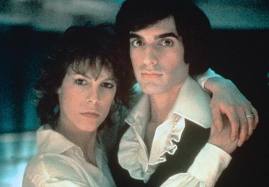 He helmed Turner & Hooch (1989) with a pre A League of Their Own (1992) Tom Hanks staring opposite a dog, the very definition of carrier suicide, the unwatchable Air America (1990) staring Mel Gibson and Robert Downey Jr., and he put the final nail in Sly Stallone’s career coffin with Stop! Or My Mom Will Shoot (1992). What did EON see in this cat? Martin Campbell was asked back but turned the job down not wanting to do two Bond films in a row. I suspect Barbara Broccoli and Michael Wilson weren’t necessarily broken up about his decision to not return. Everything I’ve read and seen about Campbell says he’s an incredibly strong personality with a stronger vision and not easily controlled. With Cubby gone, his daughter and her husband were now running the biggest and most profitable show in town, and I think they felt the need to flex their muscle. Take this quote from Brosnan. “That was always the frustrating thing about the role. Barbara Broccoli and Michael G. Wilson play it so safe. The pomposity and rigmarole that they put directors through is astounding…” Based on that and other things I’ve read, I’d imagine Broccoli and Wilson wanted someone they could push around and impose their own vision upon sitting in the director’s chair. All they needed was a guy who knew his way around a film set enough to not trip over the cables and deal with all that annoying “techie stuff.” Indeed, this is a Bond film with no vision at all except to promote “the 007 brand” and push products like BMW in the process. It a movie where the trailer plays better then the film. It hits all the marks but does so as an exercise in hitting the marks. OK, make sure Q makes the joke about getting the car back in one piece and perhaps we should make sure he says BMW again, just to make sure the audience gets it. I’m not sure how handcuffed Spottiswoode was but he’s managed to make a lower case “b” bond film. For a former editor its unreal how bad he is at creating a scene. Establishing shot is a dirty word to this man and pacing is non-existent. With few exceptions this is a film that gives the audience only what’s necessary, unless setting up a bad joke, and hurdlers gracelessly onto the next bit of business. I had no idea where I was or what was happening in the climatic boat battle. The set was black and everything is so dark that all sense of perspective is lost, a pity since everything is taking place on what is clearly a huge set.
  Stuff was just exploding everywhere, missiles were being shot into the deck of a boat, and yet not one leak was sprung. At other moments, in the middle of action, Spottiswoode would insert a slow-mo shot for no reason what-so-ever. I’m not taking about slowing the film down in an attempt to emphasize something; it was just random shots out of a sequence. This happens several times in the film with no continuity as to when or where it will happen. All I can think is the shots weren’t long enough to fill the hole so he simply extended them in edit. It’s like no one storyboarded this thing and if they did, they did so poorly or Spottiswoode didn’t stick to the game plan. The entire enterprise has a slapdash “lets fix it in post” feel, remarkable when you consider the budget. There are great moments in this movie and a few of the action set piece are quite well done but I can say without a doubt that this is the most poorly directed Bond film up to this point.
Reported Budget: $110,000,000 estimated. Wow, that would be nearly double the last film which was made just two years previous. This ridiculous jump, as far as I can figure out, was courtesy of billionaire Kirk Kerkorian, who had taken over MGM (for the third time) shortly after GoldenEye was released. Kerkorian’s dream was to get MGM listed on the NY Stock Exchange and he saw James Bond has one of his blue chip assets. In a move that could have been dreamt up by Elliot Carver, the billionaire media mogul baddie in this film, Kerkorian ordered that the new Bond film’s release coincide with his big IPO.  Kerkorian threw money at the project to rush it along and with the 9 digit budget came immense pressure on Broccoli and Wilson to deliver on time. Shit, as they say, roles down hill and Spottiswoode was handed a compressed production schedule forcing him and his crew to work quicker then they would have like in order to meet the tight deadline. “Ars Gratia Artis” indeed.
Reported Box-office: $125,332,007 USA and $335,000,000 worldwide. I’m not so sure the investors were doing cartwheels over this one. To be fare, Tomorrow Never Dies happened to open on the same day as Titanic (1997) so that little movie sucked up a bunch of the box-office. Good enough for #10 in the US, Bond was also good enough to fight off other Bondesque entries like The Saint #28, The Jackal #33, and The Peacemaker #55. However, take away the Bond name and I feel this movie would be just as forgettable as those other offerings. This movie is about branding and product, which is fine I guess but if you keep adding water to the martini, people will eventually notice the lack of punch. 1997 also saw the release of Austin Powers: International Man of Mystery. A dud at the  box-office (#36) the film gained a huge cult following on video and the rest, as they say, is history baby. Forget the two horrendous sequels for now, the first Austin Powers film is fantastic and a better made movie then Tomorrow Never Dies. That is to say, the Bond parody is better then the genuine article, providing the short and dirty answer for exactly where the Bond brand was in 1997.
Theme Song: “Tomorrow Never Dies” by Sheryl Crow. I feel for Sheryl Crow, I truly do. I’d imaging two days with Lance Armstrong would be the longest two months of your life. “Hi, I’m Texas born Lance Armstrong and your not. Let me first say I never did steroids. Indeed cancer ate away most of my lungs but I can still climb mountains and win Le Tour 37 times in a row. I, Lance Armstrong, am living proof you can beat cancer. If you want to help you can buy my armband to support cancer research and what? My girlfriend has cancer? Tell my press agent to tell Sheryl I’m dumping her. LIVE STRONG!” So yah, that’s terrible, truly sorry Sheryl. However, when it comes to Sheryl Crow as a performer I don’t particularly care for her brand of benign L.A. pop. I know she gets respect from everyone from Keith Richards on down but every time I hear her whine “All I want to do is have some fun…” I need to listen to Lou Reed’s “Berlin” just to cleanse my palette. So, with my personal taste in mind, this song sucks. Problem one is Crow who is doing her best torch singer impression and simply can’t pull it off. She also co-wrote the tune that I swear to God has the following lines “martinis, girls, and guns, it’s murder on our love affair. But you bet your life every night, while you chase in the morning light, you’re not the only spy out there.” It’s perfect in a way for this film; a checklist for dummies on what James Bond is all about. The end credit music manages somehow to be more embarrassing. It a remix of the classic Bond theme done by Moby which actually samples Connery saying “Do you expect me to talk?” and Goldfinger’s famous reply.
Opening Titles: Bond audience, meet CGI. Even the gun barrel looks all kinds of digital. The credits are kind of clever in that they embrace this new form of film making head on. The sequence starts with some binary code inside some circuitry that gives way to morphing women and black and white negative images. We get TV scan lines and x-ray images all layered one below the next implying we are going deeper, behind the tech, into the internet, pulling back the curtain to see what makes it all tick. Great idea but a false promise, the film that follows is all surface and gloss. Oh, and martinis, girls, and guns. Plenty of that.
Opening Action Sequence: Speaking of digital, the first DVD I ever saw happened to be this movie. My best friend growing up moved to Seattle and I went out to visit him. Let’s call him Tom. Tom had gotten a place in Capital Hill with another mutual friend who had been in Emerald City for a few years. Let’s call him Jonas. It was my first time in Seattle and it was one of those magical trips I’ll never forget. It had to have been 1999 because the Billy Bragg / Wlico record Mermaid Ave. had just been released and it became our non-stop soundtrack for the trip. Tom and I went out to The Comet and The Elysian my first night in town and proceed to limber our minds. When we returned to the apartment Jonas, who is one of the biggest movies guys I know, told me he had recently gotten a DVD player. Did I want to check it out? Hell and yah! He had a bunch of movies but said the best thing to watch to see the true superiority of DVD over VHS when it comes to both picture and sound was the latest James Bond. The opening alone he promised would blow my mind. The jump from VHS to DVD, and this was before HDTV, was truly life changing. When is the last time you’ve watched a VHS? The colors blur, blacks get crushed, any kind of background is non-existent, and the audio sounds like your listen to everything though a soup can string phone. As for the DVD, the shots of the missile screaming forward, the sound of the jet engine blowing over a jeep, the vivid red and orange explosions on the white snow covered mountain background; I couldn’t turn away. Needless to say the first two things I picked up when I returned to New York were a DVD player and Mermaid Ave. Thanks for the memories Tom and Jonas. As for that opening, Bond is spying on a “terrorist arms bizarre” which I picture would be something like “The Rockaway Flee Market” in North Jersey where as a kid I could buy anything from a butterfly knife to nun chucks to Chinese stars. M and her MI6 crew are watching the goings on from headquarters, which is nice because they can provide the commentary. Look, that’s the dude who was responsible for the Tokyo subway attack. And wow, that guy looks just like Ricky Jay, who according to MI6 “practically invented techno terror.” Henry Gupta is his name and he started as a radical at Berkeley in the 60’s now works for highest bidder which is perfect; he’s a sellout just like the rest of the baby boomer generation. Sorry Mom and Dad, you know its true; your generation ruined it all.  I digress, turns out Gupta is spotted holding a missing American encoder which controls this new fangled GPS. Yes, there was time when GPS was a military tool and not a toy used to check into Starbucks on Four Square. Enter Admiral Roebuck, one of the most annoying characters in a Bond film since Sheriff J.W. Pepper. We will get to him a moment but for now he decided to blow up the flea market and take out half the worlds terrorist in one shot. M protests, he ignores her, and well after the missile is launched, Bond sends back photos of a Russian jet with nuclear warheads on it sitting right in the middle of the targeted zone. “Can’t your people keep anything locked up?” the Admiral asks a Russian who happens to be in the war room (But he’ll see the big board!!!) So, Bond must get in the plane and take off before the missile hits the sight. This involves him getting into the cockpit and destroying half the base before he even takes off. It’s exciting and well edited but it also never quite gets going because we are constantly cutting back to M and crew watching on the monitors like a room full of fans waiting to see if the game winning felid goal is good. Bond ends up playing chicken on the runway with another jet and the two take off, just missing each other, as the entire bizarre goes boom. It’s a good thing Bond knows how to pilot a Russian MIG because he instantly finds himself engaged in a dogfight having to not only deal with his enemy but also the surrounding mountains and Oh, that guy in the back of his plane who just woke up and is strangling Bond with some kind of lanyard. Making like Jack Nicholson’s least favorite waitress, Bond holds the yolk “between his knees” to keep flying while he fights the backseat dude. It’s around this time Bond remembers the “look at the birdie” scene from Top Gun (1986) and flies his plane directly under the second MIG. A quick hit of the eject seat and his passenger flies up into the other plane’s back seat and then the plane spins off and blows up. “Ask the Admiral where he’d like his bomb delivered.” If the writing here feels a little passionless and utilitarian that is by design, it’s what this sequences feels like as well. The open stands on its own rather well and works on an action level but it fails to bring us into Bond’s world. The GoldenEye open had amazing stunts but more importantly it transported us to the time and place where the action was happing. Here we feel like M, removed and just watching it all on the big screen. But damn does that DVD look good.
 Bond’s Mission: We join the HMS Devonshire, a British frigate dealing with two MIG’s they believe to have hostel intent. Jesus, this is Top Gun. Anyway, the Chinese MIG’s insist the ship is in the South China Sea while the boat’s radar shows them to be in international waters. The Brits are mistaken but since they have a satellite fix telling them otherwise they continue to rattle the saber. See, if just one of these alleged “sailors” knew basic seamanship he could break out his sextant and put the whole matter to rest. Alas, standards have fallen in the Royal Fleet. Turns out Henry Gupta escaped the missile attack on the terrorist swap meet with his decoder (How? We have no idea) and is now helping an Aryan named Mr. Stamper screw with the GPS system on the Devonshire. Stamper and Gupta are not far off the bow of the Devonshire aboard a “stealth boat,” kind of a catamaran crossed with the Bat-plane. True, it’s the most astatically unpleasing mode of transport since the AMC Pacer but it allows the baddies to lurk about in the dark seas undetected. The stealth boat then launches a torpedo that looks more like one of those tunnel digging rigs with the several spinning rock cutters on the front and sinks the Devonshire. We are treated to all the Hollywood sinking boat shots that truly terrify me but amidst the exploding bulkheads and trapped crewmen drowning we get our first of the random slow-mo shots for no reason. Kind of sucked me right out, reminding me I was not on a sinking ship but sitting in my living room so I took another sip o Yuengling. Meanwhile these poor bastards are drowning and even worse they radio back the wrong position thanks to the tomfoolery with the GPS so any chance of being saved is erased. Not that it would matter; Mr. Stamper shoots and kills all the survivors with “Asian ammo,” whatever the hell that is, so that the Brits would think the Chinese sunk the ship and killed the sailors. Stamper works for a media mogul who set the Brits and Chinese against each other with the hopes of starting WWIII.
  Back at the Bat-cave, M has this all pretty much figured out, well at least the “who” bit, and here comes Admiral Roebuck. The first issue is the MI6 war room. So effective in the last film, here the space works against the M scenes. Throughout the movie Spottiswoode proves he has no clue how to shoot large spaces and since the MI6 room is very big and very dark the characters just kind of float in a limbo. The scene would be so much more effective if taking place in say M’s old office, with M behind the large desk giving the proper weight to what’s being disguised, mainly should they start WWIII. Instead the players look like four co-works standing outside a freight elevator taking a smoke break. So, England is on the brink of war and the PM has M, the head of MI6, and Admiral Roebuck, some kind of military muckety-muck, standing before him in this void of a space. M wants to investigate further and Admiral Roebuck wants to drop the bomb. We remember how well Roebuck’s “drop the bomb” strategy worked out at the terrorist bizarre five minutes ago but somehow no one in the film recalls the Admiral’s colossal blunder. No matter, the Admiral’s function in the film is to make the wrong decision every time. He is a useful idiot (useful as far as creating easy if unnecessary tension) who is one of the laziest of lazy plot devices. I became keenly aware of this character thanks to Siskel & Ebert’s review of Die Hard (1988). A split, Gene liked the film’s action well enough but Roger couldn’t get past the police chief played by Paul Gleason. Ebert’s point; how did this guy get to be in charge? All he does is make wrong choice after wrong choice putting everyone in further danger. He ignores Sgt. Al Powell, who’s been on the scene from the get go, and blindly plows ahead when all evidence suggests he ought to do the opposite. Now, it is true M can’t give up the name of the media mogul she suspects is behind everything because of his ties to the PM.
  I also like the idea of the military and MI6 chafing when it comes to dealing with an extremely volatile situation but none of those arguments are made here. Instead, we get chirping and snipping until the Admiral calls M out for not having “the balls for the job.” She and Bond just bailed you out ass hat! And besides, we got the M-doesn’t-have-balls-joke in the last film and that time it was, you know, funny. So now we have an exasperated PM delivering a line out of countless Dirty Harry rip-offs, “Tell your man he has 48 hours.” So, Bond has two days to prove M’s theory and stop WWIII. Giddy up.
Villain’s Name: Elliot Carver AKA The Emperor of the Air. The first time we see him is in an extreme close-up, only one of his eyes is visible. The other is hidden behind the reflection of a newspaper headline on his spectacles. Indeed, Elliot Carver is the kind of guy who doesn’t wear glasses. He wears spectacles. He is an all powerful media baron capable of “swinging an election with a single broadcast” and now he needs a big ongoing story for the launch of his new 24-hour news network. A war would do nicely. Much like Charles Foster Kane, Carver has the power to tell people what to think. Carver, like Kane, is said to be based on William Randolph Hearst who Carver even quotes at one point “You provide the pictures, I’ll provide the war.” Hearst said his famous line during the build up to the Spanish-America War, a war many feel was pushed along by Hearst and his main competitor Joseph Pulitzer in 1898. I remember when Tomorrow Never Dies came out one of the criticisms was a media CEO is not a diabolical enough villain for a Bond picture. I don’t think that’s the issue, I think the problem is Michael Wilson, to quote Admiral Roebuck, doesn’t have the balls for the job. To use a 100 year old war started by newspapers in the age of 24 hour news cycles is disingenuous at best when you consider the fact that a real life, living, breathing, Elliot Carver was controlling the media in the UK as the film was being made. Elliot Carver should be Rupert Murdoch. If anyone who was making this film was honest with themselves, Elliot Carver would be Rupert Murdoch. Indeed, in 1997 Murdoch’s FOX News had yet to sway the 2000 U.S. Presidential Election when candidate Bush’s first cousin, John Ellis, the “freelance political advisor” at FOX, called Florida, a state where his other cousin Jeb Bush was governor, a win for Bush when every other network had given it to candidate Gore or saw it was too close to call. Also true Murdoch had yet to be exposed for the vial phone tapping scandal that very well may have cost a kidnap victim her life. (The investigation is still on going as of this writing.) But in England, where Murdoch and his minions openly pulled the strings of members of British Parliament and had a standing invitation to 10 Downing Street, the head of News Corp. was known to be a villain, and a powerful one at that. Perhaps EON, like the PM standing before M in the war room, couldn’t take on Murdoch head-on. In fact, Michael Wilson casts himself in the film as one of Carver’s puppets (“consider him slimed sir”) making it almost too easy to see the producer as fearful of Murdoch’s wrath. This is a franchise that prides itself on up-to-the-minute ripper-from-the-headlines plot points (Bond was the first movie to ever show a laser!) yet here they go back to a war most people have never even heard of for their inspiration?

Fair & Balanced
Why go after someone that can really hurt you, much easier to pick on a guy who’s been dead for 75 years. The idea of Murdoch as a Bond villain is spot on, but Carver is no Murdoch and I can’t help but see the character as an opportunity missed. Taking it the next logical step, I can’t help but see the opportunity being missed because of a lack of courage … and balls.
Villain Actor: Jonathan Pryce. For me, Price will always be Sam Lowry lost and losing it in Brazil (1985). He’s a fantastic actor who does what he can with the role, like when he mocks an Asian woman’s kung fu, but ultimately he’s flat. I can’t pin it all on Price, the script doesn’t help and unfortunately for him, Carver is one of the less memorable Bond villains. Not because the idea of a media mogul is a bad one, but because the film refuses to pull the trigger and make him a compelling villain with true motives.
Villain’s Plot: Carver (like Murdock) is a newspaper man at heart. Even at his elevated position, Carver e is constantly writing and rewriting headlines. Now, he is launching himself into the 24-hour cable news world and that is given as his reason for starting the war. I don’t buy it. Yes, he wants eyeballs on his news network and indeed, ratings are nice. After all, the first Gulf War put CNN on the map in 1991. However, it’s not really about ratings for guys like Murdoch or Hearst or Carver, it’s about power. It’s not about delivering the news but shaping a worldview. I’m a Mets fan….done laughing? No really get it out, it’s cool. OK, so as a Mets fan I hop the 7 train to Citifield as often as I can. Like most ballparks there are a bunch of advertisements hanging all over the outfield. One of the ads is for FOX Business Network. The only other word on the billboard other then the name of the channel is POWER. Not information, not accuracy, not timeliness, but POWER, in huge letters right over Jason Bay’s head. Carver talks about ratings, saying he wants exclusive TV rights in China for the next 100 years so he can have one billion people watching and he stops there. This is 100% wrong. It’s the fact that those one billon people live in a closed society with a government controlled internet and will have no choice other then to believe everything Carver tells them. The China deal is about having a pipeline to control the country that controls the largest Army on earth. It’s about being a modern day Joseph Goebbels. It’s about having absolute power. The film only needed to go half a step further to say all of this. Shit, Bond films love to have the villain make grandiose speeches. All you would need is a little something like “Ratings Mr. Bond? Ohhh, I’m afraid you’re thinking too small. The problem with the press is we are given too much freedom. Freedom to say whatever we want! Freedom to control the message and to control the message is to control the people. Say, I want to cover up Golden Saks shady sales of toxic loans. Done and I get a little kickback for my trouble while the people do their business as usual. Or, say I want to suppress that nasty torture bit at Abu Ghraib, claim global warming is a hoax, or even declare evolution itself is a myth, all I need to do is say it enough times and people will accept it as fact. If I want people to think Kim Kardashian is happily married and doing charity work in Calcutta, so be it! I can make the sky green and the grass blue and everyone of those people out there will not only believe me, they act according to my whim whhahhahhha!” Done and done. With a little bit of dialog Carver is a king maker and a Kardashian defender; in other words a true threat to the free world.
Villain’s Lair: I have never seen a TV studio that looks like Carvers. He hold his opening party in space that is the most “set” looking set in a Bond film since Blofeld’s volcano in You Only Live Twice (1967). The place looks like a Euro-trash disco which is OK I guess, this is after all Hamburg, but later when everyone clears out Carver is in this space with absolutely no one. Have you ever seen a 24-hour news gathering operation? It makes those shots they show of traders on the floor of the NYSE in films look organized. In fact, no one works at Carver’s TV station, the paper, or anywhere in  Carver’s empire, unless they are employed in security. It’s one more example of the film beginning lazy, not well thought out, and once again exposes our director as unable to handle the large sets that dominate Bond films. Take the other space where Carver spends his time, the stealth boat. The interior is again a dark, huge, soulless room but at least there are a few people turning knobs to give the appearance of a crew. By the by, we are told the boat can hit 48 knots which is 55.2 MPH. Not bad for a craft with no discernable propulsion system.
Villain’s Coolest Accessory/ Trait: I like his smugness. He not only assumes he is the smartest guy in the room; he disregards everyone, including his wife, unless he can use them for something. His arrogance is boundless “I will reach and influenced more people on this planet then anyone in history save God himself, and all he managed was a sermon on the mountain.” That’s good stuff and something that Carver no doubt believes. Indeed, his company is not only run as a dictatorship, it looks like one as well, what with his image everywhere, looking down on his kingdom like big brother. It’s a little odd, I can’t picture Les Moonves draping a 20 story banner of his face on Black Rock but then again, he is the boss of the extremely Bond villain sounding company Viacom so it might happen one day.
Badassness of Villain: Citizen Kane (1941) is essentially about a quest to find out why newspaper baron Charles Foster Kane did what he did. Kane is a villain who ruined many lives but he wasn’t a bad man as much as he was misguided and empty. Kane didn’t realize he was destroying everything around him to fill the large emotional void left by his father until it finally destroyed him. Carver on the other hand is the boy running around on his sled. He’s got a toy, this media empire, and man wouldn’t it been neat to start a war. He does it because he can. We over hear him delivering an amusing anecdote at his party where he denies spreading the rumors of mad cow disease to get back at a beef baron who stiffed him 100,000 pounds at a poker game. However, he didn’t dispute that he received 1,000,000 from a French cattleman to keep the stories going for another year. I guess he’s saying he’s for sale for the right price? I’m not sure. He displays such detachment I don’t know if he is so much badass as much as soulless. He orders 17 British sailors to be shot as you or I would order a ham sandwich. He barely blinks after having his own wife killed and is more concerned with writing her obit. 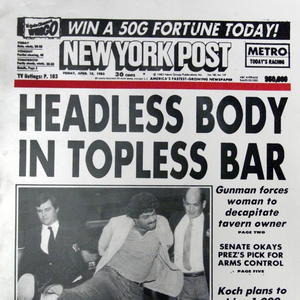 The only moment we see a hint that perhaps this man is human is when Bond breaks into his safe to steal the American decoder. There, locked up with this most powerful tool, are baggies of dope, a few syringes and some porn. What does this man do when he’s alone?
Villain’s Asides/ Henchmen: Someone like Carver needs a good #2, a buffer between him and his evil deeds. Murdoch, for example, has Roger Ailes. I know for a fact that when Ailes had his office on the second floor of the FOX News building in Manhattan it was encased in bomb proof glass and was as accessible as Ft. Knox even for his own employees. (He has since moved to higher floors in the same 6th Ave. building.) The man has several security men as well as members of the NYPD walk him to his car parked in the underground garage and he is never, ever seen in public, especial in New York City. He fears not only al-Qaeda but, and I’m not making this up, the homosexual plot against him. If that’s not a Bond villain then I don’t know what is. Mr. Stamper is no Roger Ailes. He functions in the Jaws role as a henchman; an enforcer who gets physical while the villain waxes philosophical. He’s fine but not all that memorable. The other two henchmen on the other hand are by far the best things about the movie. The underused Ricky Jay, who is hands down the most interesting man in Hollywood, plays Henry Gupta. His credits and accomplishments are so vast I will not get into it here but only to say that in the same year this film came out he also played the porn film cameraman in Boogie Nights (1997). His bitching about the integrity of his shot and lighting to Burt Reynolds “there are shadows in life babe” is movie magic. Please allow me once again give an example of Spottiswoode’s complete lack of understanding of what makes a good film. On the DVD extras there are some outtakes. One of them features Ricky Jay, as Gupta, doing his famous trick where he throws playing cars so hard they slice fruit and even become imbedded in hard surfaces. The scene is a visual nod to Oddjob’s hat trick. It also adds a human level to Gupta, despicable baby boomer that he is. It lasted all of 15 seconds. It was cut…for time. Thank God for Dr. Kaufman played by Brooklyn born character actor Vincent Schiavelli. In a film allergic to detail and nuance, Kaufman embraces both. Dressed in a suit two times too big, wearing a wispy mustache, and speaking in a cartoon evil German accent, he is a hit man of the highest order. He enters Bond’s hotel room and sits in a chair. A dead woman is on the bed next to Bond. Kaufman killed her and now plans on framing Bond after he kills him to make it look like a murder/suicide. “I am an outstanding marksman’s take my word, yah?” Bond points out the hit man is standing in the wrong spot, it will not look as if Bond killed himself due to the trajectory of the built. “Believe me Mr. Bond I could shot you from Stuttgrad un still create ze proper effect.” Just then the doctor gets a call on the radio. It turns out Stamper and his goons are having trouble breaking into Bond’s BMW which contains the decoder. “Did you call ze auto club? OK, ya I ask. This is very embarrassing, they want me to make you unlock ze car, I feel like an idiot. I don’t know what to say.” It’s fantastic, a professional being thrown off his game by incompetent accomplices. Of course this gives Bond an opportunity to turn the tables and in short order he is pointing the gun at the doctor. “Please, I’m only a professional doing a job.” “Me too” says Bond as he pulls the trigger. Kaufman is only on screen for about three minutes but he absolutely steals the show and goes down in the annals as one of the best Bond villains.
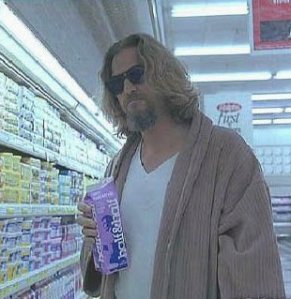
Bond has his tux, Dude has his robe
Bond Girl Actress: Michelle Yeoh. I instantly recognized her as Yu Shu Lien from the wonderful Crouching Tiger, Hidden Dragon (2000), one of the best films of that year. Already a star in Asia, this was one of her first English roles and as many times as I write that for various Bond women, I never tire of it. Bond films catch a lot of flack, more often then not deservedly so, for being misogynist. Fare enough, but then they must also be praised and given credit for going out of the way to cast different nationalities and different forms of beauty in the Bond girl role. At least a dozen actresses have waltzed through Hollywood’s front door on a red carpet thanks to being cast as the Bond girl. The other lady in Bond’s life in this movie is Terri Hatcher who unlike Yeoh is right off Hollywood’s A-list.
Bond Girl’s Name: Colonel Wai Lin of the Chinese People’s External Security Force outranks Commander Bond of the Royal Navy. In the press materials for every Bond film someone, typically the director or leading lady, says something like “This time it’s not your typical Bond girl.” This maybe the first time they are correct. Yes, Triple-X was a Major in the Russian military and Dr. Goodhead was a CIA agent but they always kind of took a back seat to Bond when the bullets starting flying. Not Wai Lin. She has a hand-to-hand combat scene all to her own in which she kicks some serious baddie ass before Bond waltzes in at the very end. She also has her very own Q lab, a Saigon bicycle shop that with a few key strokes on her Chinese character keyboard (red of course) turns into a spy’s paradise complete with a fire breathing dragon statues that could double as Benihana lobby décor, a fan that sprays deadly darts and more guns guns guns then the parking lot at a Virginia NRA convention. Much like 007 and XXX in The Spy Who Loved Me(1977), Bond and Lin are forced to overcome the political divide between their two governments and work toward the greater good. In one of the few displays of wit in the movie, Bond and Wai Lin spend a good portion of the film literally glued together at the hip thanks to a pair of handcuffs. The central set piece of the film involves the two escaping Carver’s men on a motorcycle. They are cuffed left hand to right so in order to operate the bike Bond has one hand on one handle while she controls the other. “Pop the clutch.” The motorcycle chase thorough the market streets of Saigon starts out exciting enough but by the time it was halfway over I started thinking about video games. Now, I hate when someone says an action sequence or a movie is like a video game. Typically what they mean by the criticism is to say the movie is all action and no soul. This is very unfair to video games as anyone who has ever played Portal or Bioshock or Red Dead Redemption or Mass Effect or countless other video games will tell you.

Big Daddies and Little Sisters
At this point, technology is such that video games are able to create worlds and characters as rich as any found in film or literature. When I say I was reminded of video games during the chase I’m referring to the “structure” and “build” of the sequence. Form the days of Pac-Man and Donkey Kong until now, video games have worked best when they incorporate some kind of leveling up as the player progresses through the game. Complete level one and the level two may be faster, the enemies may be more powerful, the environment may throw you a few more curve balls, or maybe all three. The idea is that as you advance, things get harder. This is done to avoid repeating the same thing over and over and keep the player involved. This form of storytelling of courses goes back to the Greeks, with each increasingly difficult trial the hero proves his worth and gets closer to the goal. Films build to the final showdown between the protagonist and the antagonist so this is not new. But this leveling up typically walks hand in hand with another video game staple, which is the game will provide the solution to any problem, always. Otherwise, you couldn’t finish the game, which is designed to be played and eventually won. (That is unless you’re playing Dark Souls in which case all bets are off and you’re on your own.) So, if you need a gun, look around the board long enough and you will find a gun. Need to cross that river, sure as shit you will find something in the environment you can fashion into a bridge. Back to the motorcycle chase, the whole thing happens on city blocks that look like they were designed for Mario Cart. There are ramps and levels and pop up obstacles that exist only to make Bond and Wai Lin deal with increasing difficult driving conditions. But whenever they need to get up onto a roof, there is a board perfectly positioned to act as a way upward. They need to jump from one roof to the next and there is a ramp for their convenience. When they need to take cover to hide from a helicopter, there is hut they can drive right into. All of this of course builds up to what in video game speak is called a “boss battle.” Everything you do in many games is a warm up to prep you for the finally show down with the baddest of badass baddies. This will at first seem to be an unwinnable fight, until you find the bosses weakness. There is always one. So here the motorcycle chase all builds up to the point where Bond and Wai Lin are trapped in an ally with nowhere to go. The helicopter is at the other side of the street and the two face each other like gunfighters in the streets of Tombstone. The helicopter pitches forward and starts to move in on Bond and Wai Lin, the blades making minced meat of anything they come in contact with. “Trapped” says Wai Lin, “never” answers Bond as they look around the environment and find the exact thing they need to beat the boss, a clothesline. Our two heroes grab the line, gun the bike toward the helicopter, slides under the blades and once safely on the other side, toss the line into the blades. As the chopper spins and explodes the environment once again proves the ideal solution, a washbasin large enough to fit two people. Our heroes jump in and hide safely underwater as the chopper explodes in a fireball overhead. To top it all off, none of this was necessary. Now in the clear, Wai Lin picks the handcuff lock with her earring, and she’s off and running. Like Dorothy, she had the power to go home the whole time. Then there is Paris Carver, I can only assume the long suffering wife of Elliot. She and James have a past that is wisely kept opaque.  We do get a sold hint that way back when she was quite a handful. “He will have a vodka martini, shaken, not stirred…” “…and the lady will have a shot of tequila.” “Mrs. Carver will have some champagne from Mr. Carver’s cellar.” Perhaps they met on spring break. As discussed earlier, Bond’s best bit in the film is his drunken bedroom meeting with Mrs. Carver. But like almost everything in this film, what starts as interesting ends in cliché as these two talented actors have to deliver dialog like “Did I get to close?” as the music swells.
Bond Girl Sluttiness: This is one of the stranger films when it comes to Jimmy B’s sex life. First off, he not only sleeps with Carver’s wife, it’s an encounter that means something to both of them. They make love as opposed to have sex, if you will. Bond has banged the baddies babe before but (alliteration rocks!) sleeping with a man’s wife is a little different. Particularly if you care for his wife and you know he’s going to find out and more then likely kill her. Take For Your Eyes Only (1981) where Bond sleep with the baddies mistress, Countess Lisl von Schaff who was played by Brosnen’s future wife Cassandra Harris. She is killed by Locque and when Bond finally gets his revenge, he kicks Locque over a cliff in one of the more memorable moments in Bond history. Here in Tomorrow Never Dies, the grim reality of what Bond did and the outcome, a dead woman, is never dealt with in a direct way. Why not? Because that would require some work on the filmmakers’ part, so like so many other things in the movie, it’s glossed over and then dropped entirely. As for Wai Lin, she is all business and in a rather refreshing fashion, spurns every advance by the spy from the corrupt capitalist nation. Bond in fact never sleeps with his leading lady, which if I’m not mistaken is a first.
 Bond’s Best Pick-up Line: Bond to Paris Carver when they first come face to face “I always wondered how I would feel if I saw you again…” smack to the face. “Now I know.”
Bond Girls Best Pick-up Line: Paris Carver to Bond shortly after the slap “Do you still sleep with a gun under the pillow?”
Number of Woman 007 Beds: 2. Since he doesn’t get to have the Bond girl I guess they needed to throw in a blond at the top. The first time we see James after the open he is “brushing up on a little Danish” with his language tutor Prof. Inga Bergstorm at his alma mater Cambridge. Then there is the Paris meeting in Hamburg, which leads to her death. That’s it. True, after the stealth boat is distorted Bond and Wai Lin share a kiss while floating on wreckage but there is no position in the Karma Sutra that Bond and his marshal arts expert partner could pull of without end up at the bottom of the sea.
 Number of People 007 Kills: In the days of yore, Bond had his trusty Walther PPK and we could keep track of where his bullets landed. Now, Bond prefers picking up a machine gun from a downed baddie and going to town. This is surely much more effective for the agent but its hell on the body count department. We will, in the interest of accurate reporting, do our best. In the open Bond gets into a cockpit and lets loose with both bullets and missiles. Many trucks, planes and crates of weapons are destroyed and our spotter counted three terrorist killed. Once airborne, Bond’s little ejector seat trick takes out two more baddies. After getting Paris killed, all be it indirectly but I think 007 bears some responsibility, he puts a single bullet into Dr. Kaufman. Bond breaks into Carver’s TV station where he gets his hands on a machine gun and shoots down at least one guy while escaping. This maybe a good place to note that Carver’s men have the aim of drunken imperial storm troopers on ice skates. Watching them shoot at Bond I was reminded of the scene in The Dead Pool (1988) where Harry and his lady are in a glass elevator, literally fish in a barrel. Two baddies with machine guns open fire on the elevator and unleash 300 or so bullets, not hitting either of the people trapped in the glass box. Harry then fires off three bullets to kill both men. We counted four guys in the chopper that Bond downed with the clothesline leading us to the climatic battle. While running around under the stealth boat (it’s like a catamaran) he knifes one baddie and once inside he once again gets an automatic weapon and takes out five. Another aside if I may, I don’t know much about guns. The last time I pulled the trigger on one I was 10-years-old shooting a .22 at Boy Scout camp. I was not very good at it. Anyway, my understanding is guns, automatic weapons in particular, have what is called a kick, or recoil, in which the gun moves backward with some force as the bullet leaves the chamber. This is why, I’m told, guns have a shoulder stock, so the shooter can steady the gun and absorb the kick with his body. Right. While ripping apart the stealth boat with bullets Bond waves the gun about this way and that as if he were Gene Kelly twirling his umbrella in Singing in the Rain (1952). Would this not at the very least hamper his aim and more then likely rip his arm off? Please feel free to comment if you are in the know. Anyway, when it comes to what weapons can do we should really be discussing missiles. Bond gets behind a missile launcher on board the stealth boat and starts to fire missiles at baddies who are on the boat. This causes them to jump off the catwalks they were perched on while large red fire balls flair up but no holes are ripped in the hull, no water comes rushing in, and in fact, the boat suffers little. Now, I know this is a movie but it must be consistent. Earlier we saw the Devonshire go down
  thanks to one projectile hitting it. We saw water rushing in and sailors getting blasted around thanks to the force of incoming water. Here, a piece of piping falls with loud clank. Mr. Stamper is undone by a missile but not as you would imagine. Bond traps the henchman behind a missile that’s about to launch and when it does Stamper disappears in a great ball of fire. Goodness gracious.
Most Outrageous Death/s: I couldn’t decide so we’ve got a tie. Turns out Carver’s got a huge printing press, not far from his TV studio which I’m sure annoys the audio engineers to no end. Bond is above the whirling LOUD machinery as reams of paper fly by underneath. He is struggling with a baddie who … $5 dollars to the one who gets it first! Right, falls into the press. The only reason this press exists, in a location it never would, is so we can see paper turning red with a man’s blood and hear Bond say “They’ll print anything these days.” For the other outrageous death we get the worst head villain demise since Mr. Big got really big in Live and Let Die (1973). Carver is on the bridge of his sinking ship. Bond physically confronts him and the two are struggling when Bond hits a switch to starts the tunnel digging torpedo a-whirling and heading for them. Both men turn around to see the torpedo coming. Bond holds Carver and himself in front of the approaching blades. “You forgot the first rule of mass media Elliot! Give the people what they want.” Bond then jumps out of the way of the torpedo, which is still coming. Cut to the torpedo still coming. Cut to a close up on Carver’s face as he looks at the torpedo, still coming. If the close up shot had been an extreme close up showing only one eye and the reflection of the approaching torpedo in his spectacles that would have been something. Not only would it reference the first time we saw the villain creating a nice little bookend but it would also indicate that Carver is so accustom to watching things happen on a screen that he is unable to react to events that are actually happening to him. A simple shot choice would have gone miles, however, no one involved with the production was thinking in cinematic terms so no, we get none of that. What we do get is Carver screaming, then raising his hands in front of his face, then another cutaway to see the torpedo finally reach him and cutting him up. We are left wondering why he didn’t step to the side.
 Miss. Moneypenny: I really don’t enjoy continuing this negative tangent but here again I must. Moneypenny and M both are robbed of any humanity and function only as the plot requires. It’s incredibly frustrating because we’ve spent so much time with these characters at this point we want more from them then just function. Add the fact we have in Moneypenny and M two incredible actresses who are new to the series and showed such promise in GoldenEye and it all the sadder. Here poor Samantha Bond is reduced to chiding Bond over the phone for his sexual exploits. When she hangs up Judy Dench is standing behind her. “Don’t ask” says Moneypenny “Don’t tell” responds Dench. I can only imagine both women returning to their trailers depressed after that exchange.
M: M has one scene outside of dealing with the pain the ass Admiral and it’s a rather enjoyable one. Since Bond has only 48 hours to get his mission accomplishes he receives his briefing on the way to the airport. Bond and M get a full police escort through the streets of London which is super crazy cool. The two sit in the back of the car and discuss how to proceed as they wiz through the city, M with drink in hand. Awesome.
Q: Tomorrow Never Dies, the one where Major Boothroyd becomes a walking, talking billboard. He approaches 007 at the Hamburg airport dressed in a red Avis jacket. The gag, which wears thin before it even starts, is Q is a car rental rep. “Would you be needing collision?” horn blast in the sound track. “Accidents do happen.” “Fire?” Another horn blast. “Defiantly.” And so on. When they reach the garage Q becomes a used car salesman on Northern Blvd. “The BMW 750, the finest in automobile technology.” And if you put 20% down right now I can throw in the headlight stinger missiles free of charge. Some other stuff happened but I missed it, I was to busy wondering why a caged tiger was in the background of the shot.

Phones ringin' dude
List of Gadgets: Phish once sang “with the right device you can make a pattern grow, or you can tune up your car.” Or in the case of Bond’s new phone, drive your car. Way before Steve Jobs dreamt up the iPhone, a device that makes everyone James Bond, 007 had a mobile with a fingerprint scanner, a 20,000 volt security system and “this I’m particularly proud of, a touch pad remote control used to drive the car.” At least that’s what Q shows us, but say Bond needs to pick a lock? There’s an app for that. Bond also has a lighter that doubles as a detonator for a magnetic grenade, which is pretty cool.
Gadgets/British Government Property Bond Destroys: The BMW 750, the finest in automobile technology.
Other Property Destroyed: At one point Ricky Jay is walking through Carver’s media complex and for no reason at all points to a satellite sitting in what appears to be a lobby. “That’s a $300 million satellite so be careful. You break it you bought it.” The plot’s ludicrous, you can guess what happens next. Bond fixes the cable? In the open alone Bond destroys more military equipment then in any previous film including one truck which he blows over with a jet’s afterburner, which I thought was inspired. Carver has a room in his TV station set aside to beat people up in which is actually quite realistic. Bond trashes the room much to the delight of several Carver News associate producers. Half of a neighborhood in Saigon is wiped out during the motorcycle chase including one block lost to a fire works mishap and a shopping district chopped up by a falling helicopter. Bond and Wai Lin also rip a 20 story banner that must of cost a small fortune right down the middle. He also blows up the stealth boat. Something of an error on 007’s part considering the Chinese and British governments were both hip to Carver’s scheme and working in concert to get him. Also, I’m sure Q would have loved to get a look at the stealth boat to figure out the technology. But you know, the villain’s lair must be blown up and so it is. There is also an Avis rental shop and parking garage in Hamburg, which we needs to look at more closely.
Bond Cars: BMW 750. Before he picks up the baby blue beamer from Q we get a glimpse of the classic Aston Martin. But it’s really all about the BMW and the car chase in the Hamburg parking garage. After Bond kills Kaufman he enters the garage to see half a dozen goons milling about the car. Her breaks out the remote control phone, drives the car to him, jumps in the back seat and navigates through the multiple levels of the garage while being chased. The idea of a car chase that goes nowhere is a good one. So good, in fact, that one of the greatest films of all time is about just that, the classic The Fast and Furious: Tokyo Drift (2006). I have never seen a frame of any of the other 27 Fast & Furious films and I hope I never will. That said, I could watch Tokyo Drift 100 times it still wouldn’t be enough. I’m not kidding, I adore that film. Anyway, back to the “Hamburg Slide,” a compromised second draft of the “Tokyo Drift.” The car chase is a microcosm of why this film is ultimately flat. It starts with a great premise; have Bond driving, from the backseat, getting chased in a parking garage. We see the gadgets that Q pointed out perform as we would expect, the missiles take out the baddies and the guns do the same. The spikes getting dropped out of the back, while not pointed out by Q, work in the grand tradition of the oil slick/smoke coming out of the back of the Aston Martin. But then when Bond ends up running over the spikes, his tires self inflate.  Then, the baddies put a chain up in front of the car, which suddenly becomes a Swiss Army knife. Bond pushes a button and whala, the hood ornament pops up and a cable cutter is underneath. Back to the video game thing; throw an obstacle out there and the environment, in this case with no context, will provide the answer. What purpose other then cutting the cable would the devise serve? Did Q sit up late and night and consider what would happen if say a dead elephant was in Bond’s way? Just as likely a scenario. Everything in this film exists in the moment it is needed and has no context to the rest of the goings on. Now if you’ll excuse me, I’m off to move Tokyo Drift to the top of my queue. After all, If You Ain’t Outta Control, You Ain’t In Control! Freaking geniuses.
Felix Leiter: Jack Wade is back and this brings a smile to my face. What started as a gag in the last film here becomes a running joke that I rather enjoy. That is, Wade just kind of appearing, unannounced, out of nowhere, ready to assist in anyway he can while at the same time taking pains to let Bond know he’s “not really here. The CIA has no involvement or official position in this matter what-so-ever.” It’s also cool that Wade’s wearing an even more obnoxious shirt then he had in the last film while Bond is in his dress blues. Wade and Bond quickly figure out the location of the sunken Devonshire, and since it’s in the South Sea of China, Bond has a little favor to ask Wade. In this situation Felix would have shook his head and said something like “ohhh no James, you remember what happened last time.” Wade on the other hand has our man suited up and jumping out of a plane in the very next scene. “He didn’t even say good-by.” I rather like Jack Wade.
Best One Liners/Quips: “I wonder if the CIA will be more upset that they lost it or that we found it.” M on discovering GPS decoder.
Bond Timepiece: Looks to be the same Omega model from GoldenEye which is handsomely displayed on the DVD cover.

Caucasian, shaken not stirred
Other Notable Bond Accessories: Nothing really of note but it’s cool to see Commander Bond in uniform on occasion.
Number of Drinks 007 Consumes: After his vodka martini at the party he hits a bottle of Smirnoff in his hotel room for some serious soul searching. By the time Paris shows up the bottle is half empty so whatever the math is on that, there you go.
Bond’s Gambling Winnings: Nope, and you can’t win lest you put your chips in.
List of Locations: In the open, the French Pyrenees stood in for the unavailable Afghani location. London plays London as well as the parts of Hamburg that were not shot in Hamburg, like the parking garage and the exterior of Carver’s media complex. One of the most interesting shots in the film shows the waterways of Saigon while Bond and Wai Lin fly overhead bound for Carver’s CGI created tower. Ho Chi Minh City fell through so producers used Bangkok as a stand in for the Vietnamese local. Indeed, we go to these places but it’s all perfunctory. None of the locations feel real or lived in. Instead, I feel like I’m on vacation with Clark Griswold. Kids, look. The Grand Canyon, OK let’s go.
Bonds Special Abilities Displayed: He can expertly pilot a MIG through the mountains while engaged in a dog fight and holding the stick between his knees. The fact that he can drive the BMW with the remote expertly on his first try is fine; the banter between he and Q while he does so is not. The motorcycle skills have been well covered by this point, which leaves the Halo Jump. Halo, or High Altitude Low Opening jump, is a way to get into a hostile location while avoiding radar. The jump is from 29 thousand feet, the top O Everest for those keeping score, and requires a 5 mile freefall during which the jumper reaches a speed of 200 MPH before opening his chute as close to the ground as possible. I don’t know if people do this for real but if so it’s very, very James Bond.
 Final Thoughts: The finally credit on screen for Tomorrow Never Dies says the film was done “In loving memory of Albert Cubby Broccoli.” The old man deserves much better then this, one of the weaker entries in the Bond cannon. I found this film to be the most frustrating Bond film yet. All the pieces were in place, and yet it never worked. While writing the review I often thought back to an episode of “The Office.” In the episode, Andy Bernard was contemplating becoming a critic. “Perhaps I could be a food critic. These muffins are bad. Or an art critic, that painting is bad.” My intent was not to be negative for the sake of being negative, but to explore why this film didn’t work. The point of this blog from the get go was to look at Bond films, which more or less have the same ingredients, and figure out why sometimes they work and other times they fall flat. I think Tomorrow Never Dies is a failure with many architects. The movie is Bond paint by numbers, checking off the boxes listed in the song, “martinis, girls, and guns.” I often think about the people working on bad films, at what point do they realize they have a turkey on their hands? “I remember starting the first day on that film in an aircraft, flying a jet and it was 102 degrees, and I’m wearing a helmet and sweater, and then I’m being strangled over and over again, and I thought, ‘Oh my God, this bloody character is going to kill me.’ The press tour for that film was 22 countries. When I did it I knew the movie wasn’t up to speed; it wasn’t as good as GoldenEye (1995) and you have to bang the drum loudly to get the attention.” I found that quote by Pierce Brosnan on IMDB. He had given it after he was more or less fired from the James Bond role so perhaps there are some sour grapes delivered along with the quote but I have a feeling he’s being 100% honest. I’m reminded of a story George Clooney tells about promoting his 1997 film, Batman & Robin. He was sitting backstage waiting to go on Letterman when he realized he had to go on TV and lie. He had to talk about how great the film was to promote a product he knew to be garbage. He decided he never wanted to have to stand behind a project he didn’t believe in again. Take a gander at his IMDb page post 1997 and while you may not love all those films, this is not the trajectory of someone making easy choices. This is someone doing what they want and what they believe in. However, when you’re the lead in something so much bigger then you, like Batman or James Bond, you’re at the mercy of a large machine that creates such an inertia that the show, as they say, must go on, regardless of quality. I believe even EON, like Brosnan, knew the movie was not up to snuff. Roger Spottiswoode is a one and done Bond director. The DVD extras, typically packed with great insight into the thinking and techniques that went into the making of the Bond film, are quite sparse for this outing. (But we do get a Moby music video, so we’ve got that going for us.)
 Maybe part of GoldenEye’s greatness can be attributed to the six years of prep time. This movie feels rushed and incomplete and perhaps the every other year schedule for Bond releases works against the creative process. Add the fact the studio brass was forcing the issue with an accelerated production schedule and the problem becomes compounded. The film simply doesn’t come together even on the most basic level. Bond had 48 hour to prevent a war, yet we saw many nights and days pass and more front page headlines; the Devonshire sinking incident, Paris’s obit, the “Empire Will Strike Back,” Bond’s obit, etc., then could ever be written in the given news cycle. Bond runs around at the climax trying to prevent what? The missiles have been launched and the British government and Chinese governments are working in concert to get Carver. Bonds job was done, yet he hangs around and almost gets Wai Lin killed in the process. Everything done in this film, with a hand full of exceptions, has been done better in previous Bond films. It’s one of the worst directed Bond films to date (that damn slow-mo!) and everything is backed by wall to wall, over the top, thumping music broken up by poorly written one liners. I could go on and on but I already have. The movie has its moments here and there and is therefore not a total failure but to take a page out of Andy Barnard’s book, this film is bad.
Martini ratings:
 Title: GoldenEye
 Film Length: 2 hours 10 minutes
 Director: Martin Campbell. The great purge continues behind the camera with a new director and for the first time ever, no Cubby Broccoli. Barbara Broccoli, Cubby’s daughter and her husband Michael Wilson, who has been increasingly involved since the mid 1970’s, are listed as the Executive Producers. They worked “under the supervision of Cubby” which I read to mean Cubby was present in name only. Indeed, GoldenEye would be Albert “Cubby” Broccoli’ last film as one of the men most reasonable for the Bond films passed away on June 27, 1996 at age of 87. Campbell, who was well known in the UK for his work on the BBC show “Edge of Darkness,” brought a modern sensibility to the Bond franchise. More importantly, unlike Glen, he is a capital “F” Filmmaker. On the DVD extras, the Kiwi director is painted as a precise craftsman and a tough love taskmaster. The cast and crew talk about how intense Campbell is on set and “There is lots of yelling…” is a familiar refrain but across the board everyone agrees he’s “sharp as a knife” and “keeps your head in it.” Pierce in particular talks about how Campbell pushes but keeps the energy up and can be trusted. Listening to this stuff reminds me of the classic baseball scenario where a “player’s manager” is sacked after losing 90 plus games to be replaced by a spitting-from-the-mouth-screamer who drops F bombs and throws the occasional chair. The players all snap to and in the end are a much better team for it. This is exactly what the lazy Bond franchise needed, a new guy to take over the clubhouse and kick some ass. The #1 best thing about this film, and this goes back to Campbell, is balance. The director seamlessly balances the classic Bond conventions we love with a new modern flare he brings to the picture. The humor and action play together like rhythm and melody in a well crafted pop tune. The use of the old school filmmaking, stunts, miniature models, and actual locations are mixed in effortlessly with minimal, tasteful CGI and quick cut modern editing. The film simultaneously plays out as a 50’s spy noir and updated post cold war thriller. The script even expands on James Bond character, dropping nuggets like the fact Bond was orphaned when both his parents died in a climbing accident. Most importantly the romance is back, and I’m not talking about Bonds relationship with women. I’m talking about the romance of going on an epic adventure with a spy who is out to save the world. From the get go, I couldn’t believe how much more juicy and enjoyable the action sequences were and how everything fit together organically, one moment rolling into the next with expert pacing and seamless ease. Add the numerous nods to James past and winks to long time fans and Campbell delivers everything you want in a Bond film and then some.
 busting flops of all time which was also the most expensive film made at the time, Waterworld ($175M estimated). Now here’s the kicker; only two of the above films made more money then Bond.
 the sequence) GoldenEye’s credits have upped the ante considerably. When you look at the actual credits themselves; Famke Janssen, Sean Bean, Alan Cumming, Robbie Coltrane, and Judi Dench as “M”, it would appear that Bond 17 has the cards to win back anything 007 lost in his six year absence.
 gun is just good old 006. “For England James?” “For England Alec.” As the two break into the main generator room it quickly become clear they have worked together before. Like a QB needs to be in complete sync with his star receiver in order to orchestrate a 2 minute drill, James and Alec work the room as tightly as a Swiss watch; that is until James peeks out to see Alec on his knees with a gun to his head and 50 or so Ruskie soldiers. “Come out with your hands up.” “How original.” It’s all pearls with this Brosnan fellow. Before 007 obeys the clichéd order he resets the timers on the explosives he and 006 planted from 6 minutes to 3. Make note of it, it becomes important later on. The man holding the gun to 006’s head by the by is wearing possibly the best police state military uniform since Ralph “don’t call me Ralph” Fiennes stomped around in Nazi boots in Schindler’s List (1993). He is General Arkady Grigorovich Ourumov and his name says it all. Ourumov is a deliciously evil cartoon military tyrant who would fit seamless in with the cast of Dr. Strangelove (1964). Just to prove how nasty he is, he puts bullet in 006’s head when it didn’t quite seem necessary to do so. Make note of it, it becomes important later on. Like every room in warehouse looking structures in Bond films, this room is filled with vats of nasty chemicals and explosives but since this is a Chemical Weapons Facility I guess it’s understandable. Perhaps they ran out of room in the pantry and the just stacked the stuff on empty shelves, like the one above everyone to the left. A quick gun blast from Bond and the canister come pouring down upon all the soldiers’ heads. As the fire starts Bond blots out the door mowing down machine gun toting baddies like he’s a 15-year-old boy on Red Bull playing “Call of Duty.” As Ourumov and half the Soviet army chase him down, Bond jumps into a plane which is headed toward the edge of a cliff. At this point, we expect him to fly off into the night but the film, not for the last time, sweeps the carpet out from under our expectations. When Bond goes to toss the pilot out the door, the pilot grabs Bonds arms and pulls them both out onto the tarmac. Always a great improviser, Bond grabs a Russian motorcycle and jumps on to chase the pilotless plane that’s continuing down the runway to the cliffs edge. While Ourumov looks on with more admiration then disappoint at loosing his prisoner, Bond guns the motorcycle and like he did 18 years earlier on skies, jumps off the cliff into the void. Kicking the bike aside and turning himself into a missile, Bond, Superman like, flies through the air to catch up with the plane, makes his way into the cockpit, grabs a hold of the yolk, and pulls up before going head on into the mountain to cap off what is hands down the most exciting open since The Spy Who Love Me.
 Bond’s Mission: After the credits we learn the events in the open happened 9 years earlier, and now we are in the present, 1995. We join James as he is engaged in some high-speed road flirting a al Chevy Chase and Christie Brinkley in National Lampoon’s Vacation (1983). The girl is still in a red Ferrari and the guy still needs to peer over a more conservative woman in his passenger seat to catch the red Ferrari girl’s eye however, this time the part of Clark W. Griswold is played by Bond, the green wood paneled family truckster is now the classic grey Aniston Martin DB5, and the flat highway of the American Midwest is replaced by a mountain road in the French Alps. The conservative woman in Bond’s passenger seat (on the left side of the car, though the girl in the red Ferrari is driving from the left. Europe is just crazy…) has been sent by the new M (who we have not met) to observe Bond in the field. She’s a one-dimensional prop who I immediately pegged as a misstep in the film. That was until Bond slams on the breaks to stop the car in the middle of the mountain road, produces a bottle of Bollinger (chilled), and gets an “Oh James…” all in 15 seconds. Ahhh, I get it now. This is silly and outrageous. With this 15 seconds all the ill will of the PC uptight Dalton Bond is erased and we are once again allowed to not take it all so seriously. Not for nothing is 007 in a grey Aston Martin; this is the return of the rakish hero we all know and love. The Bond who drives fast and chases skits is back and not a moment to soon. Need more proof? In the next few shots we see Bond in a tux, entering a casino, drinking a martini made to his liking, and playing baccarat with the girl in the red Ferrari, one Ms. Xenia Onatopp. “On a top?” The first 10 minutes of GoldenEye firmly puts us back into the proper Bond world of hyper-realty where the cars a little faster, the drinks a little stronger, the stakes at the table are a little higher and women …ahhh the women. If Bond’s your bag, you’re in clover. 007 movies generally work best as elaborate case films with twist and turns along the way. GoldenEye, like the classic From Russia With Love (1963), is essentially Bond and the baddies both trying to get their hands on the same technological dingus with the fate of the world hanging in the balance. The MacGuffin this go around is the French prototype stealth helicopter TIGER. Not only is it invisible to radar, it can still fly after a magnet pulse from a nuclear blast, an event that would render every other electronic device useless. Not two seconds after we learn how kick-ass the TIGER is Onatopp and her accomplice, General Ourumov, committing Grand Theft Huey. But in a classic film noire twist, the MacGuffin is a red herring! The real MacGuffin, like the Lektor before, is much more sinister and dangerous. Ourumov and Onatopp (not to be confused with Bonnie and Clyde) stole the TIGER to be used as a getaway car in the theft of the Goldeneye.
  The dingus, named after Ian Flaming’s Jamaican home, is a space-based magnetic-pulse weapon that simulates the shutting-down-all-electrical-devises havoc of a nuclear blast without all the messy fallout. You now see why they needed the TIGER. All of this business is handled in an entertaining and efficient manner that’s on par with mid 90’s pacing but also in a way than demands the audience keep up to speed. In other words, it’s a smart film that treats you, the viewer, as an equal, unlike its predecessor, which fed us garbage and told us it was a gourmet meal. Anyway, now the baddies have the Goldeneye and Bond must get it.
 Villain Actor: Sean Bean, a perfect choice to play Alec Trevelyan. As he proved playing Boromir in The Lord of the Rings: The Fellowship of the Ring (2001) six years later, even when he is the good guy, he’s still got the coiled up intensity of a baddie. You just feel like he could jump over the line at any moment. I hear he’s also fantastic in “Game of Thrones” but I have yet to dive into the series. Hey back off, the wife is reading the books and wants to finish them first. Shesh. Gottfried John, who plays General Ourumov, was born in Berlin and after a quick glace at his IMDB page I think we can official name him the Samuel L. Jackson of Germany for his unwillingness to turn down any role offered to him. He is not pretty man but I just love his look. He looks like he would be at home in front of the local OTB picking up half smoked butts off the sidewalk and finishing them off. He would have no problem hanging out with those dudes who watch old boxing matches on the TV’s at Record Mart in the Times Square subway station. He has a face that just says Character. He’s seen it and you can tell just by looking at em.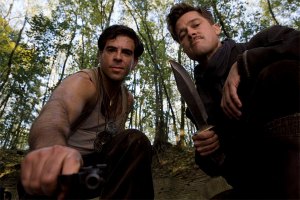
 But back the impending destruction of London at the hands of old Alec. In Alec, we have a villain of Shakespearian scope, a man who literally has spent his entire life planning and scheming to visit tragedy upon many innocents all in the name of vengeance. What more motivation do you need? To add bank robber to Alec Trevelyan’s résumé cheapens it.
 bombs. This base is essentially one huge parabolic dish built into the side of a mountain and hidden under a lake. This is similar to the trick Blofeld pulled with the volcano crater in You Only Live Twice (1967) but Bond is still slow to recognize it. When Bond finally does uncover the base and sets about to stop the Goldeneye, there is a nice bit of fun in 007 stymieing the entire deal by literally shoving a pipe into the gear works; an old fashion low tech solution to disable the most advanced weapon in the world.
 Badassness of Villain: General Ourumov, head of the Russian space division, betrayed and killed the best and the brightest under his command. He marched into the bunker where the Goldeneye was hidden and asked the man in charge to fetch the device. “I’m timing you” he announces as the poor bastard scurries off, grabs the dingus, and hand delivers it to the thief. For his trouble, he and (almost) everyone who works at the base get mowed down in a spray of machine gun fire. And Ourumov is just the opening act. For the main event Alec has mastered the mind screw. Both Bond and he were orphaned and adopted by MI6, so Alec is able to call out Jimmy B as only a sibling who is out for blood can. (To continue the analogy, that would make M the dad, regardless of gender, Moneypenny the mom and Q the crazy, drunk uncle.) Yes, Alec knows how to turn off Q’s hidden detonators but it’s when he calls Bond out for using martinis and one night stands to wash away the guilt he feels for all the men he’s killed that he hits a nerve. He is, in fact, one of the few villains to actually rattle Bond and it’s a thrill to see the unflappable 007 become flapped. All Bond can do is raise an eyebrow, curl his lips knowingly, and look to the ground as if to say “well played.”
 It seldom works. Cumming does all he can, spitting out “I spike dem, Slugheads” like a rabid weasel with Tourette’s and while it’s over the top, he is still entertaining at points, like when his jittery persona sets up a great gag involving his nervous clicking of a pen.
 Bond Girl Sluttiness: There is a scene on a Cuban beach that could have been something more. Natalya calls Bond out in a way no Bond girl ever has. He’s distant and she chastises him for not letting her in. Bond then feeds her a line about needing to keep his angst close and inside. “It keeps me on the edge, sharp, where I got to be.” Actually, that was Pacino in Heat (1995) which I’m sure was playing across the hall when I saw GoldenEye in the theater but you get the idea. And besides, Al says it better. Anyway, Natalya takes this macho posturing and throws it back in Bond’s face “No, it’s what keeps you alone.” This one exchange hits harder and is more “dark” then anything Dalton ever did with the character. Sadly, it’s also totally undercut by the fact that (a) Natalya enters the scene wearing a white bikini that (b) we see in a close up crotch shot. One of the few missteps in the film.
 Number of People 007 Kills: Classified. Or more accurately, the official Blog, James Blog spotter can’t confirm an accurate number. Such was the killing in GoldenEye that our official body count man not only lost track but curled up into the fetal position and begged for Ben & Jerry’s. Needless to say we wish him well and hope he recovers in time for Tomorrow Never Dies (1997). And with that, onto the carnage! In the open Bond gets his hands on a machine gun (you already see the spotters issue) and did in at least five Ruskies while running about with his finger firmly on the trigger. Then, after he jumps off the cliff to catch the plane to pull up and fly away the entire base explodes. We know Alec made it out with roughly 90% of his face intact but as for the others? Bond again gets a hold of an automatic weapon when fleeing a St. Petersburg jail and mows down at least ten more. He then manages to use the machine gun like a snipers rifle and shoot old Ourumov in the head while missing Natalya who the General was using as a human shield. He kills a helicopter pilot while someone is tied to said chopper (that someone to be revealed below!) and shoots at least three guards while escaping the Cuban dish base; a base that yes, gets blown up and unlike the Dr. No (1962) lair destruction, we don’t see any baddies running out before the big boom. So yah, countless folks met their end at James’ hand including one Alec Trevelyan. I’m happy to report that the final battle between 006 and 007 lives up to its billing as the title bout. The hand to hand feels tougher then some fights we’ve seen in Bond films which is to say when the punches land, they hurt. Yes, by the time the two combatants end up hanging on the end of the satellite antenna like Luke under Cloud City it’s a bit much and your right; Natalya showing up in the helicopter to scoop up James as Alec falls to his death is a huge cheat but since our official spotter had his face in a pint of Chunky Monkey by this point we missed it and just enjoyed the whole rig falling on Alec’s crippled body stuff. “For England James?” “No, for me.” Kick ass!
 Q: When Pierce walks into Q’s lab it’s like Norm walking into Cheers after he’s been gone for two weeks. He looks around and exhales; even though he’s been gone everything is in place and as it should be. This is Desmond Llewelyn 15th Bond film and at 82 years old he is absolutely thrilled to be back after 6 years. Showing more energy then he has in years, Q jokes (“Sorry about the leg Q, skiing?” “Hunting”), makes like its 1964 and breaks out Goldfinger (1964) era lines (“I’m particularly proud of this, headlight singer missiles!”) and even turns his cranky character upside down. When Bond reaches out to touch a sandwich on a plate, Q scolds him as he would if Bond were about to touch an explosive device. “Don’t touch that!” He then picks up the sandwich adding “It’s my lunch.”
 Gadgets/British Government Property Bond Destroys: Bond manages to get both cars, the Aston Martin and the Beamer back in one piece. However, the French owned multi-million dollar prototype TIGER does not make it back. This is huge lose when one considers the never previously, and never will again, develop a weapon.
 But Bond still has one more trick up his sleeve for the encore. Ourumov and Natalya join Alec and Onatopp on board Alec’s iron plated missile train. Like Alec did twice before, Bond appears from the shadows to surprise his former comrade, only this time the shadows are the mouth of a railroad tunnel the train is rushing toward and the gun is the barrel of a tank. James jumps clear before the unstoppable train hits the unmovable tank and while not as thrilling at the train derailment in The Fugitive (1993), it’s a hell of a wreck.
 Best One Liners/Quips: Valentin Dmitrovich Zukovsky, mulling over why he should help Bond; “He stole a helicopter? I have 6.” “Three” Bond corrects him, “and none that fly.”
 agreement from Bond and a nod from the pit boss and the next hand is double or nothing. Bond takes the pot down and Onnatop storms off. Bond catches up to her and wonders why she’s so sour. After all, “One rises to meet a challenge.”
 Are we still to this day not continuing to rocket forward with this failed system under the false idea that this is what capitalism is a about? Heavy stuff for sure but this Bond movie has a thought or two in its head and as much as it tied to a time and place, the newly free Russia of the early 90’s, the timeless theme of governments collapsing under their own hubris then needing to reinvent themselves hangs over everything. So we have that, plus a rock ‘em sock ‘em, gadget filled, sexy, slick Bond film; everything humming along in perfect balance. In the past, I’ve complained about Bond filmmakers feeling the need to go big, and here, from the first shot, everything is big. The difference, it not just the explosions but also the themes and ideas that are big and thanks to the balance between all these moving parts, it all works. As for Pierce’s debut, I will say this; in GoldenEye, he gives the best Bond performance since Connery. I know I’m touching the third rail here but please understand, I am not saying Pierce is the second best Bond (working on the assumption Connery is the best), but simply that in this film, taken as a single entry, Pierce’s performance as Bond is better then any of the previous entries going back to the Connery days. Let’s put it another way. If a 12-year-old boy came up to me today and asked “Who is James Bond?” out of all the 17 movies up to this point, GoldenEye is the film I’d show him. Is it the best one yet? No. Maybe not even top 3. But the 17-year-old and counting GoldenEye still feels up to date enough to hold the attention of a kid raised on Harry Potter and “Halo” while also laying out all the classic elements that define Bond and Bond films. While watching the helicopters fly off into the sunset in the final shot, I did think of Pierce and Campbell and Wilson and Lamont and everyone else involved in this project as heroes. With GoldenEye, they made the movie that saved the franchise.
 Title: Licence To Kill


 Reported Budget: $32,000,000 estimated. This too is an issue. To keep the budget about where it’s been for the last five or so films, producers were forced to abandon their beloved Pinewood Studios. New tax codes in England would have pushed the cost of filming up by an estimated 10%. So, the entire cast and crew relocated to Mexico where a majority of the surrounding country was used for location shoots and Churubusco Studios in Mexico City served as the sound stage and home base. While the last few films weren’t the run away spending spree that the earlier Bond films where, they never felt like they were cutting corners to make the film on the cheep. In the Licence to Kill, the lack of funds can be seen on the screen. This hurts the film in countless ways and further degrades what we have learned to be Bond’s world.
 Opening Action Sequence: The first shots of Bond in the last film featured him all in black. His feet having barley touched the ground he went sprinting into action. The first shot in this film features Bond and two other tuxedo clad men sitting three abreast in the back seat of a car. The tuxes are a tip that a wedding is in the future. The fact they are driving on the Seven Mile Bridge in the Florida Keys is a tip that cars will flying off the bridge and sinking in the wet in the future. Indeed, its Felix’s wedding day and the three men are trying to get to the chapel on time when they are interrupted by Felix’s “partners at the DEA.” The feds have the notorious drug dealer Franz Sanchez in their grasp and they need Felix’s help to nab him before he makes it into Cuban air space. Felix jumps on their helicopter and brings James along “strictly as an observer.” However, he does give James a gun “just in case.” We then cut Sanchez, who has risked stepping foot on U.S. soil for a woman; a woman he finds in bed with another man. “What did he promise you, his heart?” Sanchez asks while his men hold the guy at knifepoint. “Give her his heart” Sanchez says as they drag the man out. He then proceeds to whip the woman with a stingray tail. This would be the most badass intro of a villain ever, except the scoring is so ridiculous as nearly ruin the scene. Nearly, but it still manages to work and in a bigger sense sets a precedent that will play out for the entire film. Mainly, the bad guys are the only thing in this movie that’s any fun or works well. Bond villains are always a blast but this is the first film where I found myself enjoying the villain stuff so much that when the film goes to the Bond stuff, I couldn’t wait to get back to the villains. Case in point, when we rejoin Felix and Bond they are screaming at each other in the copper to be heard over the motor. It is jarring and simply bad sound editing. Then, when the chopper lands we are presented with a shot that would be embarrassing in the Bad Boys 2 (2003) trailer. Felix, in his tux, carrying a machine gun, runs straight at the camera, flanked by DEA agents on either side doing the same … in slow motion. I literally couldn’t believe it but I swear it happened (I watched the film twice, I didn’t dream it.) I could be wrong, but I think this is the first slow motion shot in all of the Bond films, and yes, it further destroys the world of Bond. Speaking of, I love when Bond does outrageous shit that works within the rules we have so firmly established. Hell, it’s why we watch Bond in the first place. But nothing, nothing has set up a universe where a helicopter can catch up to a crop-duster plane, have Bond repel out of said helicopter and land on the tail of said plane, hook a cable to the tail, and the helicopter then takes off with the plane dangling under it like a cowboy that has just lassoed a bull. Well, that’s how they get Sanchez as he’s trying to escape and “oh look, it’s the wedding down there. And it’s yours Felix! What say we … drop in?!?!” I wish, but that would be too Moore. Now I want to pause at this point and make this about me, if you will indulge such a detour. I enjoy the hell out of this blog. It’s also a lot of work. It’s work I enjoy or I wouldn’t do it but it consumes a ton of time to come up with different angles and a bunch of tweaking of ideas to make them fit into the context of the big picture. Anyway, some stuff I think works OK and other stuff I’m really proud of. One of the things I thought was quite good and fairly witty was my parachute principal for Bond openings that I came up with for
 Villain’s Name: Franz Sanchez. If you haven’t gathered yet, Bond sucks in this film. Thank EON for Sanchez. It’s only while sharing the screen with slippery snake that the Bond character is elevated to the Jimmy B we know and love. Our baddie is all you want in a Bond villain; he’s sinister, scary, shrewd and charming as hell. Whether he’s feeding CIA men to sharks, beating his girlfriend with a dead animal part, or schmoozing investors to get them to come in on his cocaine empire, he always has the same calm exterior that almost succeeds in obscuring his steal-eye intensity. While Bond spends the film flailing about and getting his friends killed, Sanchez is always in control, until he’s not. While the press material says Sanchez was based on Manuel Noriega but he’s more of a Pablo Escobar like figure, a man who is simply more powerful then the government of his nation. His coke operation basically makes up the bulk Isthmus’ GNP and he therefore has every pol, policeman, and peasant in his hip pocket. He ruthlessly rules through fear, intimidation, and insistence upon loyalty. The first two serve him well but it’s his high ideal of honor among thugs that proves to be his downfall and not coincidentally, the only hook in the film on which we can hang our hat. Take Ed Killifer, the CIA man who sells his buddy Felix out for $2 million. Sanchez uses such a man while finding him despicable exactly because he does sell his friend out. Then, he pays him anyway. Sanchez did after all give his word. The reason Sanchez whips his woman while his flunkies get all Mola Ram on her lover’s chest? Not because of the physical act of sleeping with another man, but because she was unloyal. This character trait is the only thing in the movie that allows Bond to shine and be Bond. In an expertly executed bluff, Bond, Jiu Jitsu like, turns Sanchez’s code of loyalty against him. By sowing seeds of doubt about his trusted henchmen, Bond twists Sanchez in to such a state of distrust that while Sanchez never gets high on his own supply, he still ends up just as paranoid as Tony Montana in Scarface (1983). And like Pacino’s South Florida coke baron, Sanchez ends up imploding and killing everyone he once trusted. (Side note: In another reference to Brian De Palma’s llello opera, one of the CIA guys figures Felix’s missing leg was thanks to a chain saw “They sell more then they do in Oregon down here.” Good stuff)
 about a baron of blow building a home where everything from floor to ceiling in bone white. Also, let’s take a moment and silently bow our head’s for the poor cinematographer who had to figure out how the hell to shoot this place. Cameras and white don’t get along at all and add the sun reflection off all that water…well lets just say I hope our DP has recovered from the stress nightmares that most certainly plagued him during production. Well done good man, and know it was worth it; the place is simply breathtaking. The same cannot be said for deep forest hideout. After all the talk of a new, dark, Bond that audience will barely recognize, Glen and Co. rely on the most tired and boring of all Bond clichés for the films third act. Everything comes to a head at the villain’s ultra modern over-sized lab (in this case, a coke possessing plant) that is hidden in an agent over-sized wonder of the world (in this case, a faux Aztec temple that is also the home to a Jonestown like cult) that inevitably catches fire and explodes moments after Bond, with girl in tow, escapes. At least in the past with the volcano lair de Blofeld, or Drax’s temple come lunching pad or Scaramanga’s sea side cliff/solar power plant or Stromberg’s octopus garden or even Dr. No’s shanty nuclear powered fishing wharf rocket jamming digs, we had a sense of the place. (Not so with Mr. Big’s voodoo shark aquarium but hey, the graveyard was cool!) Sanchez’s joint just seems to have random rooms that kind of pop up just to serve out whatever purpose the film demands. It has a TV studio with a lion head waterfall, an underground helicopter parking garage, a cocaine-refining assembly line, a huge trucking doc, and a soundproof rape room cheekily referred to as a “meditation chamber.” None of these locations has any relation to the other and the rooms aren’t even visually consistent enough to be close to existing in the same space. But it all blowed up real good, which I guess, is the point.
 agent, suspended over a shark tank, asks about his new bride, “we gave her a nice Honey mooooon” with his voice rising to emphasize “oooon.” Even his wardrobe, which looks like something one of the dancers from Michael Jackson’s “Bad” video would wear, he somehow makes cool. He’s the perfect man behind the man, always present and ready, but also fading into the background when not needed. Next we get Milton Krest who is the only non-reoccurring character in the film to come from Fleming’s pen (the short story “The Hildebrand Rarity.”) Krest is a rich American though how he made his money is unclear. Now, Krest earns a living using his fleet of boats and submarines as well as his Florida Key warehouse to smuggle Sanchez’s blow to a beeper carrying street level pusher near you. One more note about his warehouse, it holds every variety of aquatic life imaginable (sharks, electric ells) for no real reason and has a variety of containers that say ACME on the side. Perhaps Krest makes his money selling gadgets to Wile E Coyote? Anywho, as played by Anthony Zerbe, a character actor who has earned “Oh, that guy!” status, Krest is one smarmy guy. He gets one scene that is absolutely riveting and more frightening then the Sanchez woman whipping incident. In both scenes, Sanchez’s lady, Lupe Lamora, is in bed, this time on board Krest’s boat. Sanchez is not on board and Krest has been drinking. Because Zerbe plays the scene like he is truly inebriated and not like a cartoon stumbling drunk, he gives off the unsettling feeling that he is capable of anything, at any moment. So when his mood starts to sour Lupe is justifiably terrified. She attempts to defuse the situation by playing her ace and threatens to tell Sanchez if Krest touches her. This backfires horribly as Krest moves in for the kill. “I’ve known Sanchez a long time…. And I’ve seen girls like you come, and I’ve seen girls like you go.” Mercifully, he is interrupted by the ships captain before things truly take a turn for the worse. I wanted to know everything about Milton Krest. Who is he? How did he get involved in this business? How did he and Sanchez meet? What’s his drink of choice? Who is his favorite baseball player? Before we can learn such things he ends up loosing both the shipment of coke AND the money and scratching his head looking for excuses when Sanchez comes calling. I have a feeling this will end badly for old Milton… Between Dario and Krest, we would have had two classic henchmen. But then we get, and I must admit, I somehow forgot he was in this film, Mr. Las Vegas himself, Wayne Newton!!!!!!! Forget everything you know about this movie. Now, picture yourself sitting in a bar, waiting to meet a friend. That friend enters and says, “I just heard the craziest thing.” “What?” you ask. “OK, Wayne Newton just came out with a movie where he plays a character named Professor Joe Butcher. Professor Joe is a preacher who has a Pat Robertson’s like TV show but it’s really the front for a cult in Mexico somewhere. Everyone in this cult walks around in white robes. As initiation, all the women are taken to a sound proof room when Newton has sex with them. Oh, and Newton drives around this place in a golf cart. OK, to get money, he sells a book he wrote which has a photo of a half naked woman in a yoga posses on the cover and is titled “The Secretes of the Cone Power Reviled.” The other way he makes money is by selling cocaine over the air but only a few distributors in the states know this.” “Wait, what?” you ask.
  “Shut-up, I’m telling you” your friend answers. “Newton goes on his TV show and sets a goal for pledges. Like he will say on the air he needs to raise $18,000, and then that’s the price for the shipment of coke. So say you’re the Chicago supplier, you call in, pledge, send the check, and then that’s the payment for the coke. He then ships it out of his temple where he also processes the stuff. And here is the best part about all of this, it’s a Bond movie!” Wouldn’t you spit your Anchor Steam on the floor, throw a $20 on the table, and run out to the nearest theater to buy a ticket that second? Hell yes you would and I would be right behind you. And that’s not to all; Newton totally nails the part! I’m not kidding. At one point, the Bond girl shows up at the compound, dons the white robe and pretends to be a fawning follower. Prof. Joe takes her to the pyramid like bedroom, which is decorated with copies of his book, to make the moves. When she pulls a gun on him, is he upset? No. He loves it! As she is locking him in this room, a sound proof room (all the better for raping), he smiles at her and says “Bless your heart!” the same way he says it to the dups on his TV show. Even later, when his temple is blowing up and his entire lives work is literally going up in flames, he is fleeing with a bag of money, the last thing he has in the world. The Bond girl comes up behind him, riding in HIS golf cart, and swipes the money. He stops running and looks at her with a smile of deep admiration. “Bless your heart!” It is a part and performance for the ages and you know what, it still gets buried by this shit pile of film. Honestly, it takes a special kind of suck to blow Wayne Newton’s Professor Joe Butcher.
 Bond Girl’s Name: Pam Bouvier. Despite how stunning Ms. Bouvier is, Bond doesn’t recall the first time he met her at Felix’s wedding. At least when they meet up again at the ZZ Top redneck bar he doesn’t let on that he remembers. Strange. Bouvier is some kind of mercenary, its never really clear, who partnered with the CIA on the Sanchez missile sting. She can suck down a martini, handle herself in a barroom brawl and bails Bond out of trouble more times then I can count, including one hell of shot to take out Benicio who literally had Bond dangling over a barrel. Her thanks? Bond screams at her. At another point she somehow resists the temptation to smack Bond when three seconds after lecturing her about her professionalism, his getaway boat runs out of gas. “They must have shot the fuel line.” Uhhuhh, that’s what they all say. Yet, despite the fact that Bond treats her like yesterday’s papers through the entire film, like say when he takes too much pleasure putting her down in front of people while she is playing his assistant, she still falls for him. This isn’t the usually babe in the woods Bond girl who would be wowed by the spy. Nor does he give her the respect of treating her like an equal. So why would she fall for him? And this just adds to the Dalton problem, his Bond is a jerk, and not a fun one. And to a larger extent, the film as a whole is kind of mean to the women, perhaps thinking “dark” means “cynical.” How else can you explain Glen’s choice to make Bouvier weep when she learns Bond is messing around only to be won back after he throws her in a pool? Cynical.
 Bond Girls Best Pick-up Line: “Why don’t you wait until you’re asked?”
 M: Robert Brown. I always felt Brown was a dick as M and he absolutely confirms it here. In the past, M would “officially” dismiss Bond when the political heat was coming down and then support him on the sly. Not here. Universal Exports commandeers the Hemingway House, a fact I enjoyed immensely. While several six towed cats and armed men watched, M dresses Bond down for undermining the CIA’s case on Sanchez by going on his “personal vendetta.” The thing is, M is kind of right here. But now, see if you can follow this. Bond says he will resign if not permitted to stay on the case. “This is not a country club” M hisses at his best agent. I guess what he means by that is one can’t just walk away from being an agent, you know kind of like “No one leaves the KGB!” (I miss General Gogol) Fine, but then in the next breath M tells Bond to hand over his gun and 00 licence to kill. Is this some kind of “Oh you can’t quit because your fired” argument? I don’t get it. Then, Bond takes a swing at another agent, steals his gun, and jumps off the balcony. There are several MI6 dudes who have a clear shoot at this man who just committed treason against the crown. But then M tells his people “Don’t shoot.” If he said so because he trusted Bond or didn’t want his best agent to get killed or anything other then “there are too many people around” it might have worked. But here’s the thing, they are at the Hemingway House which is walled and cut off from the
  public. They could shoot all they want in the courtyard and the only causality other then Bond would be a few six toed felines. It’s 100% M’s fault Bond got away so what does he do? He takes it out on poor dear Moneypenny. “There are five typing eras on the first page alone” he barks before literally throwing the paper at Moneypenny. What a dick.
 Gadgets/British Government Property Bond Destroys: His career, future pension and possibly the James Bond franchise.
 Look, these two men now have both been widowed on their wedding day thanks to the violence that comes part and parcel with their chosen professions. Is that dark enough for yah? Think there are some larger ideas that can grow out of this? Do James and Felix form a bond over this incredibly traumatic event in both of their lives? Nahhh, they don’t even discuss it. Felix’s bride is given just enough screen time to smooch Bond and then get killed off so the plot can get rolling and then she’s forgotten. Again, I can’t decide if this film is just super lazy or so cynical as to not even care about her or Felix or the audience. I suspect all of the above. Felix by the way was played by David Hedison who becomes the first and to this point only actor to reprise the Felix role. For those keeping score, he was Moore’s NYC docent in Live and Let Die (1973).
 Number of Drinks 007 Consumes: One of the other things is Bond’s drinking. I tipped my hat in admiration when Bond checked into his hotel and ordered a case of Bollinger for his room. While depositing millions into Sanchez’s bank, Bond enjoys a glass of bubbly. He has another when touring the coke bottling plant with the Asian inverters. Bond orders his signature drink, a medium dry martini shaken not stirred, but he must leave before he gets to enjoy. No worries, Bouvier downs it in one slug. I also loved that while in the ZZ Top bar, Bond is served a Bud with a lime and he doesn’t even consider soiling his pallet with such swill. Flashes of the Bond we know and love.
 It’s a shame because hustling at blackjack is a rather novel idea. While tanking on purpose is rather straight forward, going on a $500,000 plus run is not easily engineered. I’m not sure how you can do it without cheating so I would have liked to have seen how Bond pulled it off. However, the only way we learn about what Bond is doing at the table is from other characters dialog breaking one of the cardinal rules of filmmaking; don’t tell it, show it. We have no idea of how Bond switched gears to go on a ½ million dollar positive swing simply because the film finds it unimportant. The blackjack game is an excuses to get Bond in a tux, two ladies in evening gowns and then it’s simply a bridge to get Bond though Sanchez’s door. As a result, this is the most disappointing 007 gambling scene to date.

 Title: The Living Daylights
 Film Length: 2 hours 11 minutes
 more than one observer found themselves asking if EON was truly ready to let Bond trade in his cuff links and tails for a leather jacket that to quote Chill Palmer is “like the one Pacino wore in Serpico.(1973).” This is after all, the most successful film franchise of all time (and reminded so until this year when a little punk named Harry Potter took the lead) and Hollywood’s first rule is you don’t mess with success. So, are the guys in charge going to let the new guy just waltz in and do his own thing?
 Reported Budget: $30,000,000 estimated. Same as Glen’s previous film but the money is much better spent here. Instead of rampaging through the streets of San Francisco in a fire truck and blowing up blimps, Glen puts the budget toward create a world of shifty Eurotrash types playing a high stakes game. The gritty look is consistent with these characters and frankly, I was surprised by how “right” the atmosphere in much of the film felt. There is a whole lot of screen space delegated to military iconography giving the film an overall feeling of occupation which is appropriate. The Eiffel Tower of the last entry gives way to remote airstrips in the Afghani mountains where horses (beautify shot in the desert land scrape) are ridden by hardened Arab rebels; not privileged breeders. Sure, we still get planes flying into the sides of mountains, but not before a hand to hand battle takes place on a cargo net hanging out of the back of said plane to give us one of the tensest Bond moments in a long time. EON even put a few bucks down on a brand spanking new Aston Martin. Smiles all around.

 oriented Bond. Further, the fact that a paintball exercise becomes a real fight with real bullets is a clever device. It’s a signal to the audience, letting us know that before it may have been a game but this time it’s for real. That said it’s still a Bond picture so of course Jimmy B must get the girl with a cheeky remark. Bond checks in with headquarters, informing them “I’ll report in an hour.” “Won’t you join me for a dink?” “Better make that two.” Dalton’s smirk when he delivers the line is as close to Connery as you can get without being the genuine article. We are off to an excellent start.
 “I only kill professionals, that girl didn’t know one end of a rifle from the other.” It was this decision to trust his gut that eventually allows Bond to unwrap the villain’s scheme. If Bond killed the woman, as Saunders points out he was order to do, the baddie would have succeeded and Bond most likely would be rotting away in a Gulag camp. Stuff my orders indeed. It’s a neat trick to play on the audience, taking our perception of Bond and his known soft spot for the fairer sex and turning it upside down. It’s also a sly and engaging way to reinvent Bond. A lesser film would have had an over written and awkward scene to tell us “this is a new Bond,” but here it’s seamless woven into the story.
 going to bump-off. MI6 buys the lie and Bond is ordered to bump off Pushkin. No sooner is Georgi’s plan set in motion then he is immediately “kidnapped” by the KGB but not before the kidnapper and a faceless MI6 guard get into an amazing fight in the kitchen. Everything from an electric knife to a flaming grill to a scaling hot pot of water comes into play. It’s the best hand to hand fight scene in the film and Bonds not even in the building. It’s a strange choice and it’s also the point in the movies where things start spin a little out of control. Sadly, the film makers never quite catch up.
 Villain’s Lair: Georgi is on the run and unable to return to the Soviet Union until his plan plays out so he spend most of his time at Whitaker’s compound lounging around the pool. This Moroccan base of operations is hidden in plain sight in the middle of the bustling city of Tangier. The massive building, situated on a cliff overlooking the sea, was actually owned by billionaire and motorcycle enthusiast Malcolm Forbes. Forbes housed his collection of 120,000 lead soldiers in the spacious home and was kind enough to let Bond producers use them in the film.
 Badassness of Villain: Setting up your girlfriend to be killed by the Brits to legitimize your apparent defection is not a nice thing to do. Dealing weapons and drugs to finance freelance assassinations of high level government officials on both sides of the cold war certainty ups ones bad boy cred. But you want true badassness? Check this out. You know those big ass military cargo planes that can open up in the back so you can drive a dozen tanks onto the thing? There are big. I’d also imagine when they come in for landing they would be moving at a pretty good clip. Right, so if you put one of those planes coming in for a landing on one side of a runway and you had a Jeep speeding toward it from the other side of the runway, who do you think would win this game of chicken? Well, I don’t know who was piloting the plane but Georgi was driving the Jeep and the two hit head on. This would most likely reduce the Jeep to a grease spot but at the very least it would stop the Jeep dead in its tracks. However, the Jeep as driven by Georgi somehow goes through the cargo plane. I say somehow because we never see it happen but as the two collide we see an explosion the next shot shows the Jeep continuing forward but on fire. A dazed Georgi with a little dirt on his face is still at the wheel and jumps out of the Jeep which continues to roll along and then explodes. So yah, defying every law of physics to survive a head on collation with a plane while suffering not a scratch is rather badass … and bad directing. I’m calling you out here Glen. You had the dude jump out of the Jeep after he hit the plane. Why not have him jump out of the Jeep before the collision? A simple flip-flop of shots in the edit room would have done the trick.
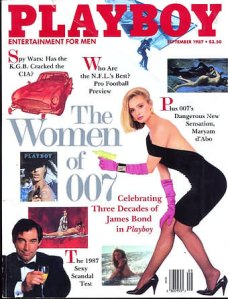 Bond Girl Actress: Maryam d’Abo. A former model of French and Dutch decent Abo parleyed her Bond girl role into additional “exposure” (wink, wink) in the September 1987 Playboy. In the issue she and other “Women of James Bond” take off all their clothes in a celebration of what it means to be a Bond girl. D’Abo can be seen posing with a white cat and cello. She also hosted a 2002 TV show called “Bond Girls Are Forever.” I love the idea of exploring what it means for actresses to be a Bond girl and the impact it had on their carrier etc. but the parts of the special I watched on Youtube don’t gets past the whole “I always dreamed about being a Bond girl” sound bites. I feel like the Playboy issue was more reveling. Thank you and good night! Don’t forget to tip your bartender. You don’t have to go home but you can’t stay here. Thank you!
 Bond Girls Best Pick-up Line: “Don’t. It’s impossible. I’ve known you only two days and all I can think of is how we would be together.” Bumper cars will do that to a woman.
 hanging out of the back of an airplane that is (D) being piloted through the Afghani mountains by Kara who (E) doesn’t know how to fly. This is so much cooler than fighting on top of a Lear jet as Bond and Gobinda did in Octopussy. It’s also 1000 times more terrifying. The long shot shows the net bouncing up and down behind the plane like a tube being dragged behind a boat. At any moment the net could smack the fuselage and by-by buddies. And yes, they did indeed stick two stuntmen on a net hanging out of the back of a plane. After going at each other and dumping the net’s cargo Necros finds himself hanging onto Bonds boot for dear life. In a water torture moment Bond takes a knife and slices his shoe lace ever so deliberately until final his footwear comes off and Necros is sent hurling earthward still clutching the boot. Freaking awesome. Finally, Bond appropriately employees a gadget to take out Whitaker. Bond is pinned down in the toy soldier wing of the faux General’s lair. Whitaker is spraying the room with bullets while Bond takes cover behind a statue. “I should have known you would hide behind that vulture Wellington” Whitaker bellows. I know nothing of Wellington’s military exploits but I find his beef to be most enjoyable. Anyway, Bond puts his key ring, which is ridged with an explosive, on the back of Wellington’s head and when Whitaker gets close enough “BOOM!” The statue smashes down on Whitaker who crashes into one of his glass cases. Busted by a bust.
 This proves to be the bit of info that Bond needs to link Georgi and Whitaker. Well done and all that but really, Moneypenny in her new capacity (More on that below) could have just as easily provided this info. Anyway, Saunders gets up to exit and thanks to a Necros booby trap is wacked with the sliding door which kills him instantly. This is actually a lot cooler than it sounds and not at all what is outrageous about this death; its Bond reaction to the death by door that makes this murder noteworthy. Now remember, Saunders sucks. He’s been all problems few answers. But when Bond sees Saunders has been killed, he flips. I mean he gets crazy pissed and completely looses his head. So bonkers and blind with rage is Bond that he recklessly runs out into the amusement park and accidently pulls his gun a 10 year old kid. Jesus man, you’re a pro, keep it together. And by the by, why weep for this incompetent douche? In researching the movie it’s clear that the whole “Bond gets angry thing” was very important to Dalton and that’s fine but he needs a reason to get mad. If Kara was wacked I would get it. But this jerk? And then to go and pull a gun on a kid? It’s a choice that backfires badly. Instead of making Bond look harder and darker it makes him look unfocused and unusually vulnerable.
 I’m over the moon that it was Moneypenny who broke the glass ceiling. Who knows, maybe one day a woman may sit behinds M’s desk? When searching for female KGB assassins Q comes up with Helga who uses her thighs to strangle and a girl who uses teddy bears to bomb. However, it’s Moneypenny who IDs the cellist Kara Milovy. Not only is she now contributing in a more productive way, I dig the new look. The whole deceptively shy eyeglass wearing librarian with the guarder hidden under her skirt thing works quite well. Keep up the good work Moneypenny.
 Gadgets/British Government Property Bond Destroys: The paint job on the Aston Martin didn’t survive the self destruct.
 Bond have a drink together and then…Felix says something about working the same case from different angels and … oh screw it. Nothing. There is no reason, at all, to even remotely include Felix. He contributes zip, zero, nada. His return, after six films and 14 years means absolutely less than nothing. Have I mentioned how it’s time for Glen to be shown to the door, impolitely if necessary?
 Not quite as strong as say Don’t Look Now (1973) or the underrated Munich (2005) or the incredible The Third Man, but Glen does a very good job of using cold war Europe to establish a tone which keeps the audience aware that no one is to be trusted. This film is at its heart a first class cold war thriller and therefore unlike any other Bond and the intrigue is heightened by locations both grand and simple. The apartment where Bond first encounters Kara is everything I would think of a European city flat. From the height of the ceilings to the tiled floors to the long windows and wall paper between everything feels right. I was reminded of Krzysztof Kieslowski “Three Colors Trilogy” which simply blew my mind when I fist saw it. Red (1994) in particular just grabbed me an put in Europe unlike anything else I had ever experienced and while The Living Daylights doesn’t come close to that, it has shades of it. Glen, as much as I’ve been dumping on him, deserves great praise for making me feel like
  I’ve stamped my passport in a way that only From Russia With Love, Thunderball, and On Her Majesty’s Secret Service have when it comes to past Bond films. It just a shame he couldn’t hold this sense of place for the entire film like in the fairgrounds or the final joke of a scene. The Afghani desert stuff is first rate and the Tangier scenes are equally strong making it all the more disappointing that the illusion was crushed by a few missteps. I also feel the need to point out, for no reason at all, that whenever I hear mention of Tangier I immediately begin to sing “If you see her say hello…” If you understand, you are indeed a fellow traveler.
 However, John Glen doesn’t do his new leading man any favors. Let’s once again return to the idea of timing. Take the scene where Bond fights Necros on the cargo net. Earlier, Bond had set a bomb to go off on the plane. Now that he finds himself and his lady on that plane, he must disarm the bomb. Bond gets up to leave the cockpit and Kara asks “Where are you going?” “To defuse a bomb” Dalton replies in an over delivered line straight out of the Bill Shatner playbook. He then encounters Necros in the back, they fight, and Necros falls out of the plane clutching Bond’s boot (which is freaking awesome.) When 007 returns to the cockpit, Kara asks “What happened to Necros?” This is a Bond staple that has been used in at least half of the films up to this point; Bond kills bad guy, Bond girl asks what happened to bad guy, Bond gives a piffy, punny response. But Glen steps on the punch-line. Dalton’s delivery of “He got the boot” is literally cut into so as to bury the line and kill the joke. Then, Dalton goes to leave the cockpit again and Kara once again asks “Where are you going?” “To drop a bomb.” Dalton delivers the nearly identical line in a nearly identical situation with the same urgency he used not 5 minute previous. Yes, Dalton oversells the line but make no mistake; this was not Dalton’s fault. Glen has his actor running around the plane like he’s Benny Hill chase women around a park bench and the director has no apparent interest in beating out the scene. It’s like he said “Oh man let’s just get thought this so we can watch the plane blow up, OK?” This is not Glen’s first rodeo; he and the writers need to support their new guy. Making him do all this unnecessary business, stepping on his lines, making him fall in love, having him pull a gun on a kid, putting him on freaking bumper cars… it’s no good. As I pointed out above, everyone working on the movie needs to be in the same ball park and at times it feels like Wilson, Glen and Dalton aren’t even playing the same sport. I can’t emphasize enough how much of a drag this is because Bond 15 does things no previous Bond has, does them well, and when it works, it’s enthralling. Glen actually manages to create atmosphere at points and individual scenes and sequences, especially at the top and in Afghanistan, are fantastic. The problems is other scenes are complete off tonally and as the movie progresses it looses focus until it’s one big mess. By the end the film has no clue what it wants to be. I’m reminded of a line from Roger Ebert’s (in my opinion overly positive) review of You Only Live Twice (1967). He called the film a “million-dollar playpen in which everything works but nothing does anything.” The Living Daylights is the other side of that coin. It’s a multimillion-dollar playpen which tries to do everything and in the end it doesn’t work. Timing.
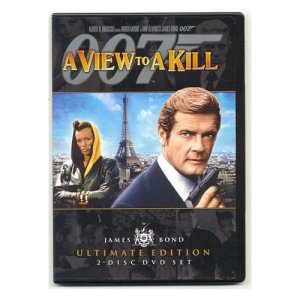 Title: A View to a Kill
 Above all, he represents the crown with dignity and is a natural ambassador for all the ideals England holds dear. In 1985, the States too had an action hero who represented everything Americans wanted to be in their wildest fantasies; Rambo from Rambo: First Blood Part II (1985). This John Rambo was very different than the one we met three years earlier in First Blood (1982). While that film was ham fisted and leaned too heavily on stereotypes, it was none-the-less an attempt to explore some heavy ideas. In the movie, Rambo is a Viet Nam vet who returns to find a very different America then the one he thought he was fighting for. Yes, the film finds him running around the North Western woods killing off redneck cops but he was also a deeply conflicted man who was at war with himself, unable to come to terms with being treated like an obsolete tool of war. The film was critical of our treatment of the men and women who served bravely in that controversial war and it didn’t paint the good old US of A in the best light. Rambo 2.0 on the other hand was a recruitment poster boy. He practically had “Be all that you can be!” tattooed across his six pack, a red, white, and blue propaganda action-figure selling Reagan’s vision of America. First Blood Part II gave us a steroid jacked, monosyllabic, one-man army recruited to single handedly correct the history books. (He even gets the line “Do we get to win this time?”) For $2.75 moviegoers got more explosions than the Fourth of July and as much nuance as you find at the bottom of a Bud pounder. Rambo was ugly, loud and carried a big stick called a freaking M60E3. He was the anti-Bond. (See also Schwarzenegger in Commando (1985)) Perhaps feeling their man could use a 1985 update, Cubby and Co. decided it was a good idea to shoehorn Bond (the film more so than the character) into this mold of the Ronald Reagan era action hero. It didn’t work out so well.
 Film Length: 2 hours 11 minutes. It feels like 5 and change.
 Director: John Glen, at the helm for the third time with 007 License to Dangle officially became the incredible shrinking director. After bursting out of the gate with For Your Eyes Only (1981) and hitting a triple with Octopussy, Glen himself admits on the DVD extras to having used up all his good ideas. He talked about how hard it was to “scour (his) brain” to come up with things for Bond to do that “we haven’t seen before.” His solution? A fire truck. “I mean, what little boy doesn’t love a fire truck?” he chuckles. Perhaps, but I think you’ll find, Mr. Glen, that you are not making Goonies, Police Academy II or Back to the Future, all 1985 films aimed at a younger demographic that, incidentally, beat your movie at the box office. I mean, what little boy doesn’t love pirates, cops who make funny noises or time traveling Delorean? Never the strongest director when bullets weren’t flying, Glen was always extremely talented when it came to putting together action set pieces. While there are strong moments in this film, most notably the base jump from the Eiffel tower and the brief shot of horses racing though the woods, these moments are swamped by what comes before or after. Most of the action sequences make absolutely no sense (the horse jumping bit) or are meant to play for laughs and are simply unfunny (the fire truck chase.) This is a movie where a woman is running on the ground and manages to get scooped up by baddies chasing her in a freaking zeppelin. A bit of free advice; if you find yourself on foot being chased by a zeppelin, a quick step to the right or the left ought to do the trick. Zeppelins are not known for their ability to corner tightly. Glen gives us detours involving Russians and audiotapes that take forever to develop with minimal pay-off. There are clichés from an elevator crashing to the ground seconds after characters escape to a drawbridge that is jumped by the chased but foils the pursuers. All the while Bond is dangling off this and that like a ragdoll in the wind. An example off all of the above rolled into one ugly mess; Bond has to save the girl from San Francisco’s City Hall before it’s burnt to the ground. Carrying her fireman style slung on his back, Bond makes his way to the roof as fire trucks arrive and a crowd gathers. We get a shot of a park bench across the street from city hall and see a drunk bum out of central casting. Bottle in hand, he is awaken by the chaos and looks across the street. As we cut from shots of Bond carrying the woman down a ladder on his back to fire fighters fighting the blaze to on lookers gasping and ohhhhing and ahhhing, we for some reason keep coming back to this drunk, watching the goings on in wide eyed amazement. At one point, Bond slips down one rung and the drunk drops his bottle. When Bond finally gets to the bottom, the faceless crowd cheers over the Duran Duran theme song being played triumphantly on horns. We never see the bum again. Why was he the surrogate for the people of the Bay Area? Was the experience mean to change his life? Did he run out and join the San Francisco Fire Department? Did he move into the burnt down city hall where he squatted for the next few years? Did he piss on a fire fighters leg? Did he drop to his knees and praise Jesus? We have no clue. This bum was made to be a big deal and literally zero happens with him. This is a microcosmic of the entire film. There are several characters that are introduced and dropped with no real flow or pacing. All they do is break up the action and then disappear without any real meaning for their existence. It’s like the editor traded in his Steenbeck for a blender.
 Reported Box-office: $49,667,000 USA and $152,400,000 worldwide. Not a bust but down considerably from the $57,403,139 USA $187,500,000 worldwide numbers for Octopussy. While Sly Stallone was redefining what it meant to be an action hero in Rambo II and Rocky IV (#2 and #3 at the box office in 1985) Bond found himself sandwiched between Chevy Chase in Fletch (#12) and European Vacation (#14) for good old lucky #13. No mater how you slice it, this was the worst return on investment in Bonds 23 year history. In fact, the past few films have been soft at the box office and getting worse. Like many icons from the 1960’s, Bond was lost in 1980’s and didn’t truly rediscover his stride until the 90’s. (See also Neil Young, pre Untouchables (1987) Sean Connery, women who don’t shave, Charles Manson) One last note, Dolph Lundgren, who played Ivan Drago in Rocky IV has a blink and you’ll miss it role as KGB agent Venz in this movie.
 sport of skiing that didn’t come ONLY in neon. You absolutely had no chose if you hit the slopes between ’84 and ’89 than to have some neon somewhere on your body. Anyway, a woman unzips her shirt to revile the films title which is clever I guess, and then amongst the neon is a fire and ice motif as chicks with Gene Simmons eye make-up (in neon) dance and do their thing.
 loud, EON has a hit song full of energy from a super popular band that was record for this movie! Stick the Duran Duran tune in there if you need something. I think, think, this was all supposed to play has funny, and perhaps 1985 moviegoers were slapping their parachute paint cover knees, but I seriously doubt it. It’s simply not funny. So, to recap; we have third rate rip off performing a reference that makes no scene and stops the film dead while simultaneously sucking all the cool out of anything Bond maybe doing and is so unfunny as to be cringe worthy. Sadly, you can take the last sentence and apply it to 85% of this film. The one thing this open got right; it lets us know exactly what we’re in for.
 entire film unfolds, which is to say it goes all over the place while standing still. Wouldn’t MI6’s equestrian expert, one who can quickly get himself and Bond an invite to this exclusive auction, have known about said event? This means Bond traveled all the way to Paris for nothing. Well, not nothing. If he didn’t go to Paris we wouldn’t get the fishing hook murder, the Eiffel Tower base jump, or the split car case scene. And why the hell do we care about the horse racing mystery in the first place? This is a very long walk away from that whole Russian’s steeling microchips thing that got 003 killed wouldn’t you say?
 British secrete service … license to kill … extremely dangerous; Walken puts forth a little snort and giggle as if he can’t believe his good fortune to have been matched with such a skilled adversary. He has one more scene with Grace Jones that is note worthy but that’s kind of it. Much hay is made about Walken being the first Oscar winner (Best Supporting Actor for Deer Hunter) to play a Bond villain but they don’t do much with him and his talents are pretty much wasted. Perhaps because of Max’s ridiculous back-story, the writers had no idea who Zorin was or what to do with him. I’m sure Walken had no clue. It’s just one more missed opportunity in a film chock full of em.
 Villain’s Coolest Accessory/ Trait: You mean besides being a steroid pumped, psychotic, KGB, capitalist, Jewish, billionaire, jockey? Well, I’d go with the hair. That blond dye job just screams “I’m crazy!” If you saw this hair on the subway, you would think “that’s something,” and then say something. The other interesting thing about old Max is he has more gadgets then Bond. He retrofit his 17th century stables with a huge cargo lift; good for transporting horses underground to conduct steroid experiments in private. The way the drug gets into the horse is thanks to an implant that holds the drug until it’s administered by the push of a button hidden a jockey’s whip or a gentleman’s cane. You would think the two devices would be able to talk to each other via a simple radio wave an you’d be correct, but somehow a microchip is involved and waalaa, the horses and Silicon Valley are connected. Weak sauce. Zorin, mad genius that he is, had the forethought to rig his steeple chase course with gates that can be raised and lower at the push of button in case, say, he’s ever on the course and being chased by a British agent. Zorin also has a camera hidden behind a gorgeous mirror in his office. This camera is hooked up to a device with advance face recognition software that reminds us how cool it is when stuff in Bond movies that seemed outlandish is commonplace 25 years later. Much ink has been spilled pointing out how similar Zorin and Auric Goldfinger’s plot for taking over the world are but I see the two as kindred sprits when it comes to large three-dimensional maps. Both baddies just can’t wait to get a room full of men to watch as they pull the maps out of the floor and dramatically spell out their plans for world domination. In fact, both men as so proud of these maps that if someone in the room doesn’t care for the presentation, they are killed off immediately; Goldfinger’s detractor in a industrial car compactor, Zorin’s by being dropped from a blimp via a trick staircase. The blimp itself is quite a nifty gadget that when deflated can look just like a run-of-the-mill-motor-home and with one push of a button becomes a high speed air-to-ground kidnapping device.
 over the top and leading to this moment. The graphic slaughter in the first act of Saving Private Ryan (1997) brings home the horrors of D-Day and in a larger scene, war. Seeing Zorin kill hundreds by drowning and shooting has zero value and is beyond gratuitous. It draws attention to itself for all the wrong reasons because it has no context within the film and even less in the James Bond canon at large. It doesn’t even add to Zorin’s badassness, it’s just shoves more garbage into this ass bad film.
 Not because helium is flammable you see (it’s not) but because it a bad idea to fumble dynamite when your in a enclosed container a few hundred feet off the ground. Lastly there is Scarpine who besides having a neato scar, looking like a soccer hooligan, and shooting up rooms full of men really serves no purpose.
 Bond Girl’s Name: Stacey Sutton. What? We go from Octopussy to Stacey Sutton. There’s not middle ground here folks? As we discussed above, she took over an oil company from dear old granddad, studied geology in college and then…Zorin! Despite her credentials she spends the entire film saying the most moronic things and is not one bit of help in cracking the case. When she isn’t talking she’s simply a girl on Bonds arm and not the sexiest one at that. With her blond feathered hair she looks like every girl I went to school with in the 1986 or every housewife in the greater Milwaukee metro area in 2006. Considering the devastatingly sexy Grace Jones is over on the other side I’d say Bond got the short end of the stick in this adventure.

 M: M and his Soviet counterpart, General Gogol get some of the best lines in the film. After briefing Bond on the microchip deal, M looks at the three piece suit sporting 007 and tells him to “get properly dressed.” A funny line because he his always so. General Gogol gets to yell at Zorin “nobody leaves the KGB!” and also gets the biggest laugh in the film. After all is said and done and Bond is still thought to be dead, Gogol shows up at Universal Exports to present “The Order of Lenin for Comrade Bond. The first time ever awarded to a non-Soviet citizen.” M seems perplexed “I would think the KGB would applaud the destruction of Silicon Valley?” “On the contrary Admiral” the giggle Gogol responds “where would Russian research be without it.” This is funny, and we could have cut to Bond in the bath here keeping Moneypenny out of it. There is also the MI6 equestrian expert Sir Godfrey Tibbett who is an interesting enough character and presents a good comic foil for Moore. And for the record, when he was running around the stables at night in a black leather jacket I was reminded of John Belushi sneaking around campus in Animal House (1978).
 Felix Leiter: Having given up on Felix after his rather sold performance in Live and Let Die the CIA sent Chuck Lee who was played by David “I go first Indy” Yip of Temple of Doom (1984) fame. Since it’s not Felix we can assume the CIA agent will serve the same purpose as a red shirt on an USS Enterprise away team and sure enough poor old Lee gets it before we really got to know him. As always, the rules from Zombieland (2009) are wise to keep in mind at all times and not just during the end of days. After all, if Lee followed rule # 31 (Check the back seat) he would still be with us today. And that goes double for Sir Godfrey Tibbett.
 Bond Timepiece: None which is better than the digital crap we’ve dealt with the last few films.
 Every story point, location, character, line of dialog, costume, etc. etc is a choice. And then within those choices there are hundreds of more choices made by hundreds of very talent people working very hard to put out a film that they will be proud of and that audiences will enjoy. I have such appreciation for everything these craftsmen and women do. Added to which I have a nearly bottomless reservoir of good will for James Bond. I’m willing to overlook a lot, especially when everyone involved is working to get it right. But here, the entire crew just made bad, lazy, and all together wrong choices across the board. It gives me no pleasure to rip this thing up, but ripped up it must be. Octopussy may have been lacking on the plot front but it was fun as hell and everyone involved seemed to be having a blast. A View to a Kill is dreary drudgery that’s as much fun as the debt ceiling debates. No one involved seems to give a toss, almost like they are punching the time clock and looking forward to time off. Let’s just stick Bond on the screen, have him do something outrageous, and call it a day. The audience will feast on anything we feed ‘em. How else can you explain a movie where a cat food bowl with “pussy” written on it passes as wit? And I didn’t even get into the fifteen minutes of painful keystone cops antics. It was right about the point when half a dozen cop cars were falling off a rising draw bridge that I called bullshit on the entire affair. I simply gave up. Why not?
  The crew gave up on this puppy long before I did. Grace Jones is the only one even trying and she got labeled a diva for her efforts. When I finally got done watching I felt duped, cheated, like a sucker. “Step right up, step right up, see the most famous action hero of all time James Bond….” Only Roger Moore was right, this was not James Bond. It’s truly a bummer that this is how Moore and Maxwell leave the stage. By the end of the film, I got the feeling that even Glen and crew knew they had a clunker on their hands. For the first time ever, the end credits don’t give us the title of the next Bond movie, they simply promise “James Bond Will Return.” Well, that’s good news. He sure as hell wasn’t here for this crap fest. I truly hoped I would never have to issue this rating at Blog, James Blog but A View to a Kill earned every last drop.
 Blog, James Blog