You Only Live Twice

Title: You Only Live Twice

Year: 1967. The fifth James Bond film hit movie houses in June, 18 months after Thunderball (1965), the longest hiatus between 007 pictures up to this point. The reason; one Sean Connery. In a November 1965 interview with Playboy Magazine, Connery discussed his future as Bond. I have only two more Bonds to do… On Her Majesty’s Secret Service and possibly You Only Live Twice. They would like to start On Her Majesty’s Secret Service in Switzerland in January, but I’m not sure I’ll be free in time and I don’t want to rush it, although they say the snow will be at its best then. I’m not going to rush anything anymore.” Thanks to the non-rushing Sir Sean, shooting on Bond 5 didn’t start until June ‘66, way to late for the skiing heavy OHMSS. So, EON was forced to move YOLT up in the queue. This was the first in a series of events that would conspire to make You Only Live Twice the first Bond film to take a step backwards, and a giant step at that.

Film Length: 1 hour 57 minutes

Bond Actor: Sean Connery. When shooting began in the summer of ‘66, Bond producers Cubby Broccoli and Harry Saltzman had a big problem on their hands; a very unhappy leading man who also happened to be the face of their multimillion dollar franchise. Connery’s disenchantment didn’t happen overnight. After staring in four demanding films in as many years, the man was simply exhausted. Never comfortable with the publicity side of Bond, while filming Thunderball (1965) in Bermuda, Connery was working long days and having to do interviews at night adding to his fatigue. It was during one of those interviews that Connery let it be known he was also becoming concerned with the direction Bond was headed telling Playboy “Each succeeding film has got bigger and the gimmicks trickier. But we have to be careful where we go next, because I think with Thunderball we’ve reached the limit as far as size and gimmicks are concerned … So all the gimmicks now have been done. And they are expected. What is needed now is a change of course–more attention to character and better dialog.” Additionally, Connery was afraid of being swallowed by 007 telling Rolling Stone in November of 1983 “I’d been an actor since I was twenty-five but the image the press put out was that I just fell into this tuxedo and started mixing vodka martinis. And, of course, it was nothing like that at all. I’d done television, theater, a whole slew of things. But it was more dramatic to present me as someone who had just stepped in off the street.” By the spring of 1966, the Bond star was not only arguing with Cubby Broccoli about slowing the pace of the series, Connery was also pushing to become a partner in the 007 franchise. When shooting started for You Only Live Twice Broccoli and Saltzman had let be know that wasn’t going to happen. All this, plus the sci-fi theme of the new film, pushed Connery to make a dramatic announcement in the middle of production; the current Bond film would be his last.

Director: Lewis Gilbert. Even thought Connery “officially” quit mid-production, EON saw the writing on the wall much earlier, and they had a strong hunch that they would be loosing their James Bond. Consequently, they made the first of many decisions that would backfire horribly. In an effort to wrestle control of the franchise back into their hands the producers got rid of most off-camera talent that made Bond a success in the first place. Simultaneously, they saw an opportunity to cash in on the publicity surrounding Connery’s swan song. Broccoli and Saltzman company line to the press was they assembled a new team behind the camera to give Bond a “fresh look” and make this “the biggest Bond yet!” The new creative crew started with the hiring of first time Bond director Lewis Gilbert. Gilbert, who would helm two more Bond films in the late 70’s, was hot off Alfie (1966), a smash hit in Britain that made leading man Michael Caine a household name. Gilbert turned the job down when Broccoli first called, forcing the producer to call back and refused to take no for an answer. With Gilbert in the directors chair, cinematographer Freddie Young, who won raves for his camera work in Lawrence of Arabia (1962) and Doctor Zhivago (1965) was next to come on board.

The ticket to YOLT success?

Finally, childrens writer Roald Dahl was brought in to adapt Fleming’s novel. Dahl would go on to pen Chitty Chitty Bang Bang (1968) and Willy Wonka &The Chocolate Factory (1971), but at the time he wrote Bond, he had no screenwriting credits to his name. Accomplished artist all, the supposed “dream team” of talent would soon discover that making “big dumb fun” entertainment like Bond is not as easy as it looks.

Reported Budget: $9,500,000 estimated, the biggest yet. One set alone, a volcano that would act as SPECTRE’S base of operations, cost $1 million to build on the sound stage at Pinewood Studios in England. Masters of publicity, Saltzman and Broccoli took delight in telling anyone who would listen that this single set cost as much as the entire budget for Dr. No (1962); proof of how far Bond had come in five short years.

Royale with Cheese

Reported Box-office: $43,084,787 (USA) $111,600,000 (Worldwide). Whoops. While not a bomb by any measure, the most expensive Bond yet took in less that the previous two; $20 million less than Thunderball in the states and $30 million less worldwide, making You Only Live Twice the first Bond film to show a drop-off in ticket sales. Part of reason was by 1967 theater goers were suffering from a bit of Bond fatigue. Flemings first Bond novel, “Casino Royale” (1953), the only Bond book that Saltzman and Broccoli failed to acquire, was released as a film only months prior to YOLT. However, outside of the title, Casino Royale (1967) had zero in common with the book. Producer Charlie Feldman owned the rights and wanted to partner with EON on the movie, an offer Saltzman and Broccoli refused. So Feldman set out to make a bigger, more expensive Bond film that turned into what Mark Harris called in “Pictures at the Revolution” a $12 million dollar sinkhole.  Six directors and at least 17 screen writers including Woody Allen, Terry Southern, and Billy Wilder took a whack at the movie that featured half a dozen Bonds including one played by Peter Sellers. Producers took what should have been a red flag and made it a selling point, crowing that none of the directors knew what the other five were doing. The psychedelic poster that promised “Casino Royale is too much … for one Bond” got people into theaters before the bad word of mouth spread and despite terrible reviews Royale not only made it’s money back, it became the third highest grossing film of 1967. Additionally, Adolfo Celi who played Emilio Largo in Thunderball appeared in the James Bond spoof Operation Kid Brother (1967) starring none other than Neil Connery, Sean’s brother. Needless to say, I’ll be writing about both of these films at some point in the future. Any who, Time magazine excused the less-than-stellar earnings for the latest Bond film saying it was “a victim of the same misfortune that once befell Frankenstein: there have been so many flamboyant imitations that the original looks like a copy.” While I’m sure that was part of it, I also think the issue may have been You Only Live Twice, on top of having a terrible title, kind of sucks. In fact, it’s a credit to the strength of the Bond Brand that the franchise was able to recover from the double whammy of this poor movie and loosing its star. Harris says as much, writing the weak returns for You Only Live Twice “signaled a dip in Bond’s drawing power that would not turn around until the late 70’s.”

Theme Song: “You Only Live Twice” performed by Nancy Sinatra. I’m not really sure what to say here, so I’ll let Nancy tell the story. I love me “These Boots are Made for Walking.” I truly believe Nancy’s vocals on Walking mark one of the best performances in Rock and Roll. But this Bond theme is simply dreary and dreadful.

Opening Titles: Like the theme song, the titles are the weakest to this point. It’s a Japanese theme, with lots of Asian lady’s eyes (how exotic!) looking into the camera while lava blasts paint the background. Coupled with the theme song, it’s difficult to make it to the end of the opening credits, not a good sign of things to come.

YOLT is in trouble even without Tribbles

Opening Action Sequence: Space. The final frontier. These are the voyages of … Oh sorry got this confused with another late 60’s science fiction release. The film does indeed open in space, as an U.S. astronaut steps outside his capsule for a little spacewalk. The opening shot makes it crystal clear that Connery’s wish of less spectacle and more focus on dialoged and character was about as likely as Monneypenny and Bond settling down on a sheep farm in the hills of Scotland. The spaceships look like hooky 1950’s flying saucer on strings, a big disappointment for a series which has set the bar high when it comes to special effects. I know it’s only 1967 but the TV show “Star Trek” (1966-69) looked better and Kubrick’s 2001: A Space Odyssey (1968) was only a year away. I don’t expect the space stuff here to look even half as good as the groundbreaking Kubrick film but this is, after all, the opening shot of the film. At least pretend some thought and effort went into it. The US space capsule is swallowed by a lager capsule that opens like the worm mouths in Dune (1984). In one of the few cool moments of the film, the space walking guy gets cut off from the shuttle and drifts off into space to die; this image, no matter how many times I see in countless films, still manages to hit me on gut level. We then quickly move to earth, Alaska I think, where a UN type meeting is in full swing under glass globe looking ceilings. The United States is furious with the Soviets for messing with their space program and denounces the kidnapping of the astronaut as an act of war. The burly bear of a Russian diplomat swears his country had nothing to do with it. The UK acts as the voice of reason, calling out the U.S. for jumping to conclusions. The Crown feels Japan may somehow be involved, “In fact, we have our man in Asia working on it right now.” Cut to Bond in bed with the sexy Ling (Tsai Chin.) Let’s take a moment to pause here, shall we. Before we even hit the opening credits we have gone from space to Alaska to Taiwan in a matter of minutes. Not only is this extremely chaotic, it breaks with the tradition of the opening set piece being a self contained bit of business. Even if the story is tied into the larger plot, the opening still acts as a stand alone with something of a beginning and end. Anyway, the first words out of Bonds mouth manage to be both sexist AND racist as he asks Ling why Chinese women taste different than other women, like Peking duck is different from Russian caviar. I shit you not. Ling, understandably pissed off by this bit of rudeness, pushes a button forcing the bed to flip upward into the wall, trapping Bond. Two men with machine guns enter and blow countless holes into the bed. English investigators arrive within seconds and declare Bond is dead, but at least he “died on the job, doing what he loved.” Ho-ho-ho!

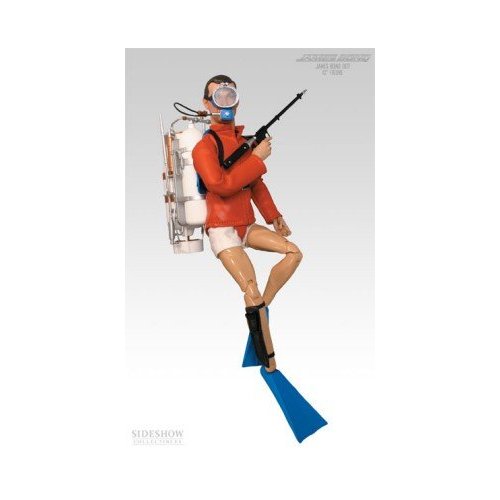
Bond’s Mission: James Bond is dead and burred at sea in a Navel ceremony. The camera follows 007’s tightly wrapped body to the ocean floor and then picks up two divers approaching. They retrieve the body, bring it aboard a nearby submarine, crack open the wrapping around the body and out pops Bond, wearing a scuba tank. Long Live Bond and hence the title of the film! (All I could think was ‘wow, he didn’t spend enough time underwater in the previous film?’) On board the sub are Miss. Monnypenny and M, who informs Bond of the disappearing spacecraft and England’s Japanese theory. Neither M nor Bond are convinced Japan has the technology to pull off such a stunt, but who could? Bond’s job is to find out and oh, by the by, you have 20 days or WW III will breakout. Very good old man, so it’s into the torpedo tube with you then. Relax as we shoot you out onto a Japanese beach from where you will walk to Tokyo and hookup with you’re contact, Mr. Henderson, who will direct you from there. Yes, James Bond was shot out of a submarine’s torpedo tube. By this point in the film I knew we were in trouble and wished I could abandon ship as well. After arriving in Tokyo, Bonds first trip to Japan, 007 is followed by women who talk into radios hidden in their purses. Jimmy B then goes to a sumo match where he meets a Japanese woman who will bring him to Mr. Henderson but first … oh forget it. Really, the plot unrolls so sloppily and half-assed it’s clear the filmmakers don’t care so neither should I. All you need concern yourself with is Bond has 20 days to find who has been launching the rocket that’s been stealing the other rockets. The question becomes how will 007 do this? Bond eventually meets up with Tiger (Tetsuro Tanba), the “M” of the Japanese secret service, who comes up with a three point plan. In order to carry out the mission Bond must 1) get married 2) become a ninja and 3) become Japanese. Again, I shit you not.

Villain’s Plot: Simply put; our baddies plan is to steal both the US and USSR’s spacecraft pitting the superpowers against each other until they start World War III. In 1967 the space race was on, and the U.S found themselves in second place. Three NASA astronauts had died in a launch pad fire earlier in the year and the US was fearful of falling to far behind their cold war adversary, lest the commies would control space and be able to launch weapons capable of taking over the world. Inserting Japan into the mix was another ripped from the headlines plot point. The Asian island nation was recovering quite nicely from WWII and was on the verge of become a major player in the international business world, stoking fears on Wall St. However, Japan was a long way off from a rocket launch, so what mad man could not only dream up such a plot but also have the finances to pull off such a diabolical scheme?

Villain’s Name: #1, or as he is named, and seen, for the first time, Ernst Stavro Blofeld. We don’t get conformation of #1’s involvement until about 2/3rd of the way through the film when a chair spins to reveal a white cat being stroked on a lap. This should have been a great moment but it feels like to little way to late, just like the big reveal when we finally see Blofelds face. After three films of hiding in the shadows, seeing the face of evil itself should have packed more of a punch. By now, Bond fans know what Blofeld and his SPECTRE origination are all about, but in case you forgot, as Blofeld tells his Japanese business partners “Extortion is my business.”

Villain Actor: Donald Pleasence, who was a last second replacement when the original actor cast as #1 was in director Lewis Gilbert’s words not scary enough and “too Santa Clause.” Pleasence began acting on the London stage in 1939 and was shot down in WWII when he was serving in the Royal Air Force. He became famous as the blind Lt. Colin Blythe or “The Forger” in the classic The Great Escape (1963). Pleasence was the only actor in that superstar ensemble cast to actually be held in a POW camp and served as an unofficial advisor to the director. However, for me and those of my generation, Pleasence is most likely remembered for his work in John Carpenter films, playing Michael Myers shrink Dr. Sam Loomis in Halloween (1978) and the president of the United States in Escape From New York (1981)

Villain’s Lair: As I was watching this film I didn’t recall much and felt at points that I somehow may have missed it growing up; that was until I saw the volcano hideout. I remember simply loving the hidden volcano base as a kid and at first glance, it’s truly impressive. It’s freaking huge. The creator lake moves away so rockets and helicopters can take off and land. Monorails zip to and fro transporting equipment and workers. These works have different jobs which are determined by the color of their uniforms. These red dudes, yellow dudes, and white dudes running all around brought up another childhood memory, Lego Spacemen.

#1’s minions, numbers 64 through 67

Blofeld was supposed to operate out of a castle on a cliff by the sea, as he does in the Fleming novel, but location scouts could find no such place in Japan. What they did find was a bunch of volcanoes so the idea was hatched for the secret mountain base. The $1 million set featured a movable helicopter platform, a working monorail, and a launch pad with a full size rocket that could be raised 50 ft into the air. To build one of the largest sets ever assembled for a film it took 700 tons of structural steel, 200 miles of tubular steel 200 tons of plaster 500,000 tubular couplings, over 250,000 square yards of canvas and a shitload of hubris. For this much time and money the thing should have been perfect, but set designers cheeped out on details that drag the whole affair down. The cars on the monorails are bouncy and look like chinchy cardboard cut outs. The control room is nothing special; just lots of switches and blinking lights. Even Blofeld’s office, which has some nice details, cheats on others. The main feature of his impressive room is a bridge over a Parana filled moat. After the sharks in Thunderball, which we actually see, bubbling green water that we are told is the home to Parana just doesn’t cut the mustard. Also, the office is never established or lived in. Blofild runs in, feeds the fish, and splits. It feels underused and rushed. On another note, the good guys get a cool lair in this film as well. Bond is chasing a girl through a hallway when the floor opens up and 007 sides down a chute, eventually landing in a chair. This is the office of Tiger Tanaka. As the head of Japanese Secret service he stays off the streets and gets around on his own private subway. Dude has a private train where he hangs out and drinks Saki! He also has an amazing house that comes complete with gardens, baths, and women to bathe you while in said baths. He also has a castle where he runs his own ninja training school, but we will get to that later…

Villain’s Coolest Accessory/ Trait: We already knew about Blofild’s cat and propensity to whack SPECTRE employees that fall into disfavor but we learn here he also has a nasty scar over his left eye.

Badassness of Villain: Look I love Donald Pleasence. I really do. I cried at the end of The Great Escape when he, a blind man, is one of the only POWs to make it out of Germany. Pleasence screaming “You are the Duke of New York, you’re A number one!” is one of my most quoted movie lines. So I hate to say it, but Donald Pleasence as #1 just isn’t that badass. This is a character who’s been built up for three films now. In this movie, #1 is ready to start freaking WWIII and blow up half the plant.  When his loyal #11 fails to kill Bond, she becomes lunch for the Parana. At the end of the film, Blofild gets away by blowing up his volcano, killing all those cute Lego dudes he had working for him. This is one cold blooded guy. He runs SPECTRE for crying out loud! But once we finally meet him, he just doesn’t seem that badass. In fact, he comes across as kind of old and feeble. I don’t blame Pleasence, I suspect it’s the fault of the film around him and the director for not getting a better performance.

Helga “#11” Brandt

Villain’s Asides/ Henchmen: Mr. Osato (Teru Shimada) is the owner of Osato Chemical and Engineering Company. SPECTRE loves using evil business men as fronts and I like the symbolism of dirty CEO’s in bed with global terrorist. Mr. Osato’s secretary is Helga Brandt (Karin Dor) or #11. She functions as kind of a poor mans Fiona Volpe, the Thunderball femme fatale who was a much better assassin and much smarter in her handling of Bond. Helga captures Bond, has him tied up, is about to slice his face, but ends up banging him instead. Post-coitus, the two take off in a small plane where 007 promises Helga he can get her to England and protect her. In response, she locks Jimmy B into his seat, and jumps out with the only parachute. Why didn’t she shoot Bond when she had him tied up? Why bother with the plane? Channeling my inner Ebert, the reason is so we, the paying audience, can get a sequence where we see a girl parachuting and Bond has a chance to escape a doomed aircraft seconds before it explodes. This is just one of several points in the film where the action sequences and special effects serve not the plot, but exist simply so things can go boom. Anyway, due to her failure to disposes of 007, we know what happens to poor #11. (Helga “#11” Brandt) There is also Hans, a personal bodyguard/ errand boy for Blofeld who is mostly useless and a shadow of From Russia With Love’s (1963) SPECTRE killer Grant. In fact, all of the characters in this film are second rate; they feel like flat versions of baddies that came before.

Bond Girl Actress: We are graced with two Bond girls in this film, Akiko Wakabayashi and Mie Hama. Both actresses were big names in Japanese film and both were extremely excited to be making their English speaking debut in such a high profile role. In a story that is 10 times more interesting that anything that happens on screen, both ladies were sent to England prior to filming so they could learn English. Wakabayashi picked up the language fairly quickly but Mie Hama struggled mightily. So much so that when she showed up on set and started reading lines Gilbert quickly concluded she would not work for the role. He contacted the casting agent who hired her and told him to take Hama out for a nice dinner and let her down gently. The casting director reported back to Gilbert the next day with news that he refused to fire the girl and Hama must stay in the picture. When asked why, the casting director said that Hama had informed him she could not return to Japan having been fired. The shame would simply be too great. She said that if she were fired, she would kill herself by jumping out of her hotel room window, which was several stories high. So, Hama stayed in the film, and the two leading lades switched roles giving Wakabayashi the more dialog heavy part. One last note, for what it’s worth, Mie Hama, in what had become a Bond girl tradition at this point, posed in Playboy, making her the first Asian woman to do so.

Bond Girl’s Name: Aki (Wakabayashi) and Kissy Suzuki (Hama). Aki, who meets Bond at a sumo match, is Tiger’s right hand woman and quite a competent spy in her own right. She successful lures Bond into Tigers trap hallway and saves his life twice; both times zipping in at the last second in her hot little white Japanese made Toyota 2000GT. (The breaks work and the gas doesn’t stick.) The second time Bond and Aki are trying to get away from a car full of four gun men, she radios Tiger who sends out a helicopter equipped with a magnet which picks up the gunmen’s car and drops it into the sea. Not bad. Then there is Kissy Suzuki; where to even begin? She too is an agent who works for Tiger, and she is the woman who Tiger sets Bond up to marry. As I mentioned, the first part of this plan is to make Bond Japanese. This is accomplished by surrounding Connery, I mean Bond, with five Asian women who shave his chest, dress him in a komono, and give him a wig that makes him look more like the fifth Beatle than anything remotely Asian. Then it’s simply a matter of the 6’2” Scotsman walking around hunched over and waalaa! There you go, he’s Japanese. The next step is to marry, Yes marry, a “pig faced” villager so Bond can “blend in” to a small fishing community and see if the locals know anything about rockets being launched nearby. Apparently, one of Tigers men couldn’t simply walk in and ask. Nor could Kissy, who after all has lived in the village all her life. So, Bond is to marry, yes marry! Kissy in a Japanese ceremony. They do (but not really, it was just for show) and later that night they learn the U.S. has moved up the launch date of their latest space mission and the SPECTRE launch sight must be found sooner rather than later. Now, if Aki gets points for saving Bond twice than Kissy should have a statue erected in Piccadilly Circus for her service to the crown. Bond and Kissy, clad in nothing but a white bikini, jump into a fishing boat and go explore a lava cave by the sea which, it turns out, is full of poison gas. To get away, the two jump into the water and swim a good 50 meters underwater. Bond concludes the cave starts all the way at the top of the volcano and asks Kissy “Do you think you can make it?” She answers “Of course, is business” and for the remainder of the film, Kissy is all business. The bikini sporting Kissy runs up the side of a HUGE volcano, all the way to the top of the creator. She and Bond then climb down the other side and discover it’s the SPECTRE hideout. “I’ll go check this out. You go get Tiger and tell him to bring every man he’s got.” Right O Bond San! Kissy then runs back up to the top of the creator, back down the other side, jumps into ocean, and while swimming the God knows how many miles to get to Tiger, she dodges machine gun fire from a helicopter that’s right on top of her.

Kissy makes Bond look like a...

She then gets Tiger and his army of ninja’s, runs back up the volcano, and back down into the creator where she avoids more machine gun fire. Then she repels into the creator, dangling like a sitting duck while every Logo guy in the joint is shooting at her. Somehow, she makes it to the bottom and joins the ninja’s in a huge battle with the Lego Spacemen. Please keep in mind, she is still wearing nothing more than a white bikini. She fights in this battle and then jumps in the water, and swims over a mile down the lava cave while the volcano explodes. She makes it out to the sea without a scratch, climbs aboard a raft with Bond and is ready to do the nasty…that is until they are interrupted by a submarine emerging under the raft. I mean, this chick is insane!

Bond Girl Sluttiness: That Kissy Suzuki is a hard nut to crack. Despite being “married” yes MARRIED! to Bond she insist on separate beds on their wedding night, forcing Bond to forego his oyster dinner. But then, during the first trip up the volcano mountain she gets randy and starts in on Bond, only to be interrupted by more damn helicopters. She also strikes out when the sub comes up under the raft at the end of the film, so the two, despite being married, THAT’S WHAT I SAID, MARRIED! never get to consummate their vows making Kissy the first Bond girl that Bond doesn’t sleep with.

Bond Girls Best Pick-up Line: Aki upon learning Bond will be working with her, “I think I will enjoy very much serving under you.” Ugh, eye rolling bad.

Bond’s Best Pick-up Line: Bond awakes to find himself tied to a chair, captured by Helga Brandt. Helga “I’ve got you now.” Bond “Well, enjoy yourself.” He gets a good slap for that one, but it was worth it.

Number of Woman 007 Beds: 2. He was to sleep with Ling in the open but then that whole murder thing happened before he could “finish his massage.” After getting washed by the bathing beauties at Tigers house he “finishes the massage” with Aki. For the record, the bath scene is outright uncomfortable. Bond walks into the bathroom with Tiger. While the women strip the men Tiger promises 007 his “first civilized bath.” Bond, while eyeing the women, replies that he “likes the plumbing.” Both men, now naked, sit next to each other as the women sponge them off. “In Japan men always come first, women come second.” Tiger informs Bond who quips “I may just retire to here.” The scene is cringe worthy and unintentionally hysterical all at once. Anyway, afterward Bond and Aki go at it just because. Really, there is zero reason at all for this to happen. He also sleeps with Helga “#11” Brandt in her cabin on the boat before she tries to kill him on the plane. Bond gets one more go with Aki, this time in his Chinaman disguise. And by the way, Dude, Chinaman is not the preferred nomenclature…

Miss. Moneypenny: Lois Maxwell is always a bright spot in the films, and this dreary affair needs all the help it can get. We find our favorite executive assistant not in her costmary London digs but on board a British sub and in uniform to boot. Bond walks in to her office after his funeral and, thankfully, finds the hat rack to toss his cover upon. As Bond is walking out, Monnypenny tosses a Japanese language book at 007 who responds that he studied Asian languages at Cambridge, giving audiences the best peek into Bonds past since Dr. No (1962).

M: Also on the sub, he must settle for dreary digs and not his grand office in London. M too is in his Navel uniform, wearing his dress whites. Bond, for the record is also in uniform, blue, the first time we have seen his so dressed. Anyway, M debriefs Bond and then shoots him out a torpedo tube.

Q: Poor Desmond Llewelyn. Connery made it clear he felt gadgets were taking on to big of a role in the Bond films and over-showing character. As a result, Q gets the short stick in You Only Live Twice. Keep in mind, this is a movie where Connery becomes a ninja, becomes Japanese, and gets shot out of a torpedo tube for Christ sakes and he’s upset about a few silly props? Regardless, Q is under written and I think he may have even been a last minute addition to film. The only gadget he provides was not in the original script and was a late add-on.

List of Gadgets: On the bonus DVD, the production designer admits “Little Nellie” was shoehorned into the plot after he heard an interview on BBC radio with Wing Commander Ken Wallis of the Royal Air Force. On that program, Commander Wallis described a one man portable auto-gyro; basically a mini single seat helicopter. The production designer tracked Wallis down and convinced him to bring the contraption to Japan and pilot it for the film. I’m sure this thing was a blast to fly around (or maybe not, a camera man lost a leg in a crashed while shooting one of the 85 flights required to get the scene) but as a Bond film gadget it’s severely lacking. It’s delivered by Q in four suitcases and assembled quickly. Q then dutifully lists the toys that come with the aircraft including machine guns, missiles, rear flame throwers, sky mines, and heat seeking missiles. No sooner does Q get done running down the items than Bond is off and being chased by four helicopters, robbing us of the fun game of guessing what gadget will be used and how. Quick, you get three guess as to how Bond will take care of each of the four helicopters. You’re first two guesses don’t count. This all just happens way too quickly and feels like it was throw in to have a chase scene featuring the new toy, which is exactly what happened. It is a self contained seven minutes in which Q comes, tells Bond about the four weapons, Bond takes off and uses the four weapons, land the aircraft in the airport he took of from, and then the film starts back up again where is left off prior to Q’s arrival. Remove it and the movie would play the same, all be it tighter by seven minutes. Again, action for actions sake. One last note, Bond, no matter what, should always look cool. While flying this lame looking bird, Connery is forced to wear the dumbest looking helmet I think I’ve ever seen in a movie outside of Mick Jagger’s lid in Freejack (1992).

Nice lid Mick

The helmet is equipped with a helmet cam, basically, a Nikon lenses sticking out the front. Terrible. OK, other gadget’s, none of which are supplied by Q. Bond is equipped with a safe cracker he uses to get Osato Chemical documents. Remember that ninja training school I keep threatening to explain? Not yet…but while there Bond gets “rocket bullets” which are exactly what they sound like and a pack of cigarettes that when smoked shoot out an explosive mini-dart. He also has big suction cups he can attach to his hands and knees so he can crawl on a wall like Spiderman and he blows a lock to a door that jails the captured astronauts… somehow.

Number of People 007 Kills: 19, none of them very memorable but some of them quite ridiculous. Take Mr. Henderson’s assassin for instance. Mr. Henderson, Bond’s English contract who has lived in Japan for over 20 years, is stabbed by an Asian assassin who is wearing a mask. This is covenant because after Jimmy B kills him, 007 can put the dead dudes mask on and jump into the back of his get away car. The driver then not only takes Bond to Osato’s office building, but he carries him up to the top floor! While escaping from this office building Bond shoots a kills a guy in the parking lot. At some point Bond and Aki end up at the docks so a battle can ensue where deck-hands of all stripes try to kill the superspy. Here, he shoots three dudes. Then, there is “Little Nellie.” While flying the mini-copter Bond takes out four helicopters, each being flown by a single pilot. That’s four dead dudes, one by missiles, one by flame thrower, one by sky mines, and the last by heat seeking sidewinders. If you think I’m lacking energy in the telling of this, you should see Connery as he’s actually doing it. He is so bored, wearing this dorky helmet while sitting in front of green screen, that he doesn’t even try to hide his contempt. He supposed to be narrowly avoiding machine gun fire and he looks like he’s about to fall asleep. While at the ninja school Bond kills a guy (Tiger “This man is a stranger to me.”) who attempts to stab him. Then there is the final ninja battle in the volcano hideout. This is terribly edited and looks like a bunch of guys run around in smoke, occasionally jumping on trampolines.

I’m running out of fish bait jokes

While watching this I thought back to the pride Young took choreographing the action sequences for From Russia With Love and got depressed. Anyway, in making his way through the chaos Bond kills an engineer with a cigarette death dart, shoots one guy, gets three more with a grenade (we know Bond killed them because they fly into the air, just like one would when jumping on a trampoline!), shoots another dude, and finally, kills a guy with a Chinese star, just like the ones you can buy at the local flee market from a guy who look like Matthew McConaughey in Dazed and Confused (1993). Bond then confronts Hans, who after a brief tussle with 007, ends up in the Parana tank, sleeping with the fishes.  That makes 18 dead at Bonds hand. One more to go…

Most Outrageous Death/s: Bond, in full on Japanese disguises, enters Aki’s room at night. “Tiger say, you must a do everything a Japanese style” Aki tells Bond before they do the nasty (Japanese style?) The two fall asleep and an assassin crawls into the room, hiding in the rafters above the sleeping couple. He unwinds a single piece of string until the end of it rests just above Bonds mouth. He then applies a few drops of a deadly poison to the string and it slowly works its way down, getting closer and closer to Bonds lips. At the last second, 007 rolls over in his sleep and Aki rolls into his place. Bond is awaked by her choking and shoots the assassin dead. Within seconds, he figures out what has happened, and Aki is dead. This sequence is actually a stand out moment in this otherwise humdrum movie. It’s inventive, creates tension, and is a classic “Bond” moment that could very easily fit into any of the previous far superior films, perhaps the only moment in You Only Live Twice that can be said about.

Gadgets/British Government Property Bond Destroys: Sadly none. Bond is kind of on his own in Japan, since he supposed to be dead and all, and outside of “Little Nellie” he uses only stuff given to him by Tiger.

Other Property Destroyed: Bond trashes Mr. Osato’s office while battling a sumo thug who 007 defeats by breaking a statue over his head. He blows up the four SPECTRE helicopters and crash lands #11’s plane. In addition he does some damage in the volcano base and ultimately pushes a self-destruct button, destroying SPECTRE’S spaceship swallowing spaceship. Although it’s not Bonds fault, it’s worth noting that in order to escape from the volcano base, Ernst Blofeld forces the volcano to erupt, not only killing all who are left in the base … well, not all. Tiger, Kissy, the ninjas, and Bond make the mile swim through the lava cave, a lava cave that is somehow not overflowing with lava during this particular eruption and is free of the poison gas that filled it earlier, to safety. Anyway, not only does the erupting volcano kill anyone who didn’t make the swim but also, we must assume, anyone in the quaint fishing village that sits at the volcano base. Again, not directly Bond’s fault, but a good bit of Japan is destroyed, a small house cleaning matter the film has no time to concern itself with.

Felix Leiter: No Felix. Truth be told, as much as I took the piss out of the CIA man in the last film, we could have used him here. I’m a proud resident of New York and therefore considered American in most circles. As I’ve said a few times, I love how Felix is used as a stand in for American buffoonery. The character is a way for England, in the form of James Bond, to look superior. It’s a funny and appropriate running joke. However, in this film, the Americans are outright non-thinking jack-asses. They refuse to even consider England’s suggestion that Japan or more accurately, a third party operating undetected in Japan, might be responsible for the space kidnappings. Even after a Soviet spacecraft is abducted, the U.S. still refuses to believe anyone but Russia is involved. They even move up the launch date of a second mission, knowing full well the most likely outcome of this launch is going to be WWIII. If Felix, who has extensive experience with SPECTRE, were involved, I suspect even he would be sharp enough to connect the dots and convince the Dr. Strangelove generals that #1 was behind all the nastiness. But no, Felix was nowhere to be found. We get in his place Tiger Tanaka, the head of Japanese secret service who unlike M is quite hands on. He is, in fact, the most interesting character in the film. Now, the third part of his plan for Bond. On top of become Japanese and marrying a Japanese woman, Bond must train to become a ninja. Tiger has a ninja training school and that I can swallow. He is, after all, the head of Japanese intelligence. I do take issue with the idea that Bond trains, for three days and then, presto, he becomes a ninja. Three freaking days! Anyone who has seen a marshal arts movie worth its salt knows a bit more is involved in becoming a ninja.

Best One Liners/Quips: Honestly, this was incredibly difficult since Connery delivers most of Bond’s lines like he’s a hostage reading a written statement denouncing his country. One of the only lines given the old Connery roughish charm is when 007 wakes up, tied to a chair in Helga’s room, and he asks “What’s a nice girl like you doing in a place like this?”

Bond Cars: Since he travels via one man copter and torpedo tube, MI6 fails to supply a car for Bond in this film. He gets driven around by Aki in a hot little white Toyota 2000GT convertible. Besides being quite sporty and sleek looking, this car has one of the most astounding features I’ve even seen on an automobile. As I described earlier, Aki gets rid of a car full of machine gun shooting baddies by calling in a helicopter with a big magnet to pick up the car, fly it to the sea, and release the car into the water. Good enough, but what’s so crazy is Bond and Aki are able to watch the entire flight and car dump on a monitor in the dashboard in the Toyota. This in itself is fine but how are they getting the picture? The angels in which they view the flight can’t possibility be shot by cameras on the helicopter. So what amazing device is recording these images and relaying them back to the car in real time?

Bond Timepiece: None noted. One more detail the film simply has no time for.

Other Notable Bond Accessories: It was interesting to see Bond in his military dress blues. I also like that he is smoking again. Other than that and the Beatle wig Bond operates fairly bare-boned in this movie.

Number of Drinks 007 Consumes: 4, in the only category where this movie hits on all cylinders. When Bond first arrives in Japan he visits Mr. Henderson who has done his homework. He offers Bond a martini, shaken. Bond takes one sip and is pleasantly surprised noting Mr. Henderson used real Russian vodka. It turns out Mr. Henderson is friendly with one of the doorman at the Soviet embassy who supplies the Brit with booze from the mother land in exchange for other favors. Details like this bring Bond’s world, that of spying and international connections, to life. Sadly, these touches are in short supply in this film. Bond has a different reaction to his vodka drink in Mr. Osato’s office. After knocking out the sumo dude, Bond raids Osato’s liquor cabinet to finds a bottle. He takes a pull and then winces saying to himself “Siamese vodka.” I Googled Siamese vodka and as I suspected, it doesn’t exist. On board the private subway, Tiger offers Bond some Saki, unless he would like a martini. In a perfect “when in Rome” moment, Bond turns down his favorite drink, showing his host the proper respect. 007 goes a step further impressing Tiger when he points out the Saki is served at 98.4F as it should be. Then next morning Bond finds himself once again in Mr. Osato’s office, this time posing as an international business man. It’s only 11:30 AM but Mr. Osato offers some Champaign, a drink Bond turns down due to the early hour, until he learns it’s a Dom ’59. I love the smell of Don ’59 in the morning.

Bond’s Gambling Winnings: Heartbreaking but true, no gambling here.

I can see Russia from my house!

List of Locations: The film spends a small amount of time in space and in the Alaskan tundra where the UN meeting takes place. Why Alaska? Maybe so everyone can keep an eye on those shifty Soviets. The third opening location, Taiwan, is a non-location since all we see is the inside of a hotel room, which could be in Poughkeepsie for all we know. This film doesn’t make it to London, making this the first Bond film where 007 doesn’t set foot in the UK. 98% of You Only Live Twice happens in Japan. Bond starts in Tokyo. The coolest place he visits is an arena in the round for a Sumo Wrestling bout. The shipyard scenes were shot at the Kobie Docks which sadly no longer exist. On January 17, 1995 the port was destroyed by largest earthquake to his Japan since 1923. Akime Village, pop. 180, was used for the idyllic seaside fishing community. Finally, the volcano was Mt. Kirishima, located on a southern island in a national park. Despite the fact that Japan is woven into the plot, the country and culture somehow manage to be little more than a backdrop. It feels like Bond is detached from the locations in someway, where as in past films, Bond became part of them. Like most of this film, I’m sure many things are to blame, from Connery’s less than committed performance to the lackluster direction to the silly screenplay. If I could pick a single shot to sum up the entire film, it would be the one look we get at the U.S.S.R. It’s a wide shot of a Soviet rocket launch. In the foreground, several palm trees can be seen.

Bonds Special Abilities Displayed: When Bond points out to Tiger that his Saki is served at the proper temperature, 98.4F Tiger responds “For a European, you are exceptional cultivated.” Indeed, we learn that Bond San studied Oriental languages at Cambridge, however we never hear him udder a word in Japanese. Bond also works double duty as a pilot, not only dog fighting in “Little Nellie” but also crash landing a small prop plane. Then there is the small task of become a ninja in three days. I can’t think of any reason to include this nonsense other than the fact that in 1967, Kung Fu films were breaking through and become hot in the west. It’s kind of sad to see Bond flowing and not leading but, there you go. In another of the countless logic defying moments in this film, during the SPECTRE rocket launch, Bond dresses up like an astronaut and attempts to sneak onto the spacecraft. Blofeld becomes suspicious when Bond tries to carry his air conditioning unit into the capsule and #1 calls Bond out. What the hell was Bond’s plan? Suppose Blofeld missed this small mistake and Bond gets into the cockpit? What then? How in the name of Jesus H Christ is he going to fly a God Damn spaceship? I’m not sure if you’ve picked this up yet, but this film kind of sucks.
Thoughts on Film: “Welcome to Japan, Mr. Bond,” you should have stayed home. Since everyone involved knew this was Connery’s last film, there was a feeling that all the stops needed to be pulled out. Subsequently, Broccoli and Saltzman gave more energy to marketing than the movie; the trailer came first, the film came second. The script was changed and changed again with the goal of loading as much “stuff” as possible into Connery last go in Bond’s shoes. As a result, the final product is not a movie but a Frankenstein’s monster of action sequences sewn together with the hope of creating life. They failed and the movie is D.O.A. The poster, on the other hand, lived, screaming out loudly; Bond Dies! (but no, not really) Bond Marries! (ahh yah, but no, not really) Bond becomes Japanese! (not even Fing close) Bond finally meets SPECTRE’S #1! (OK they deliver on this last one) Connery’s Last Bond Is The Biggest EVER! (Arguable, but it’s certainly not the best.) Some of the blame for the films failure must be hung around Connery’s neck. Getting shot out of a torpedo tube, crawling on the ceiling like Spiderman, making Bond a Japanese ninja, it’s all bullshit and Connery knew it. He simply couldn’t bring himself to care and it shows. If Connery was indifferent about the movie, the producers and director were outright hostile. The cheesy special effects, the retrofit action sequences, the terrible screenplay all pile on to make this movie a labor to simply sit through.

A classic tale of a farm boy and his robot

For the record, I have a suspension of disbelief that stretches a mile wide. I will buy pretty much anything a movie is selling. If I sit down in a theater and you tell me there’s a guy with breathing problems who flies around the galaxy in a huge circular weapon that can destroy planets and he’s defeated by a farmer with magic powers and his trash can robot sidekick, I can get behind that 100%! All a movie has to do is tell me things in a logical way, don’t break its own rules, and treat me like an intelligent person. I think most movie goes will agree, we want fantasy, but don’t lie to us or worse yet, don’t treat us like fools. We will be fine with an alien who wears tights and flies (Superman I and II) but we balk at the idea he can throw every nuclear weapon on earth into the sun (Superman IV.)  You Only Live Twice not only disrespects its audience, it dares Bond fans to care and shows them no respect. It simply assumes if Bond is on the screen with some chicks and explosions, all is right with the world. Thankful, the audience struck back, hurting the films bottom line. (Ed Note: For this project, I want to focus on the films and avoid the Fleming novels as much as possible. That said, I highly recommend you read this fantastic post which details Bond creator/author Ian Fleming so-called “Blofeld Trilogy” and how that storyline was destroyed when shooting schedules demanded that YOLT be made before OHMSS. The post goes a long way to explaining why YOLT is such a mess.) To be fair, the film has it’s moments; the Aki assassination is top notch. There is a breathtaking shot of Japanese fishing boats on the water a dawn, but for every bright spot we get ten bummers. The plot is a mess, the laughs aren’t funny, the dialog is lazy, the characters are forgettable and the film is ultimately a sad swan song for Connery. Perhaps I’m being overly harsh, but I was shock at how far off the beam You Only Live Twice had fallen. Coming after three incredibly strong films I found this movie to be trying and an embarrassment to the Bond name.

Martini ratings:
Thunderball

Title: Thunderball

Year: 1965. Both the U.S. and British premieres were held in December within a week of each other. For what it’s worth, Thunderball is the first Bond film that wasn’t originally a novel …kind of. It was also intended to be the first Bond film …kind of. In 1959, Ian Fleming had the idea of bringing his super spy to the big screen. He teamed up with Kevin McClory and Jack Whittingham to write James Bond, Secret Agent but Fleming reportedly got fed up with both the screenwriting process and working with others. Feeling Bond was his, he took the screenplay, changed it a bit, and wrote the 1961 novel, “Thunderball.” McClory took legal action, claiming the story was his, and United Artist refused to touch the script or the book while legal proceedings were underway. Ipso facto, Dr. No (1962) became the first James Bond film. Thunderball was shelved until an out of court deal was struck in 1964. As a result of the deal, UA could go ahead with Fleming’s novel and McClory held onto the screenplay rights and later released a film based on what he called the “original concept,” the “unofficial” Bond movie Never Say Never Again (1983). Everybody got that?

Film Length: 2 hours 10 minutes

Sir Paul and Sir Sean; Rock Stars

Bond Actor: Sean Connery. In August of 1965 the Beatles were the biggest band on the planet. To promote/ introduced their new single, they played the BBC program “Blackpool Night Out.” After performing a few hits, Ringo and John left the stage as George stepped to the microphone and introduced the brand spanking new never before heard song “Yesterday” by announcing “Paul McCartney of Liverpool, opportunity knocks.” The inside joke being, yes, the Beatles were the biggest thing in the world, but this was Paul, standing alone on stage playing a song that he alone wrote, and the other three Beatles knew they were, thanks to the ballad, about to become even bigger. After the smashing success of Goldfinger (1964), Sean Connery was a rock star in his own right, and it wasn’t a question of the new Bond being big, the question was how big. Many people created the international monster that was James Bond, but Connery knew all eyes were on him. He felt responsible for Bond, and he took his role as the face of the franchise seriously becoming physically invested. I’m a card carrying “out of the closet” heterosexual (You might not have asked, but I’m going to tell anyway) and as such I must say, Connery looks simply dreamy. When sporting a perfectly fitting tight shirt or no shirt at all, our hero could pass as an Olympic athlete. His charm is dialed up to 11 and he is as good as ever with the one liners. While Connery was giving it his all on screen, he was taking a stepping back off camera. He didn’t go to any of the many Thunderball premieres and granted just one interview, a long in depth profile for Playboy. In the profile, Connery comes across as down to earth and thankful for the success of Bond, but he also admits he doesn’t like the publicity side of things. “I find that fame tends to turn one from an actor and a human being into a piece of merchandise, a public institution. Well, I don’t intend to undergo that metamorphosis.” He also lets it be know that he has two more Bond films on his contract (at that point they were to be On Her Majesty’s Secret Service and “probably” You Only Live Twice) and that after that, he would be happy to walk away. “Bond’s been good to me, so I shouldn’t knock him,” but he also admitted that he’s “fed up to here with the whole Bond bit.”

Director: Terence Young, returning to direct his third and final Bond film. Goldfinger director Guy Hamilton was asked to helm the fourth film but he felt “drained of ideas.” He had giving everything in his arsenal to Goldfinger and said he “had nothing to contribute till he recharged batteries.” Indeed, EON were popping these films out at an incredibly fast clip, one a year for four years straight with each one being a bigger production with bigger expectations. Thanks to challenges inherent in the plot, Thunderball promised to be the biggest yet.

Reported Budget: $9,000,000 estimated. After Bonds 1,2, and 3 cost one $1 million, $2 million and $3 million respectively, Bond 4 jumped to $9 mil. (Ed. Note $5.6 million is listed as the budget on the Special Addition DVD, but I’m using Box-Office Mojo for all my budget and box office figures since studios are notoriously inaccurate when it comes to these numbers.) I’m sure Connery’s salary climbed some but much of the money was up on the screen. About 20% of Thunderball takes place underwater, and in the days before digital effects, that meant 20% of the movie had to be made underwater. It got me to thinking, what if Thunderball was the first film made like originally planed, and they only had the $1 million. Needless to say, it would not have been nearly as good. None the less, after four years, Bond was now officially a big time Hollywood production with the money to match. Additionally, product tie-ins were everywhere, with Bond vodka, Bond clothes, and oodles and oodles of Bond toys coming out to coincide with the films December release and the holiday shopping season. At the end of 1965, Bond was everywhere. “Sean Connery of Edinburgh, opportunity knocks.”

Reported Box-office: $63,600,000 (USA) $141,200,000 (Worldwide). Thunderball was released in the final weeks of 1965, so its box-office run lived mostly in 1966, and it was that year’s #1 film, with a bullet. Making $10 million more than Goldfinger in the states alone, it was clear to all the other studios that they needed a Bond themselves, but as the lady would sing in a later 007 film, nobody does it better than Bond. Mark Harris details some of the copy-cat films in his best seller “Pictures at a Revolution.” According to Harris, Warner Brothers answer for Bond mania was the now forgotten Kaleidoscope (1966) staring Warren Beatty. 20th Century Fox employed James Coburn in Our Man Flint (1965) and In Like Flint (1967). United Artist even got into the Bond rip-off business. Eager to own Pepsi and Coke, the Bond studio cast a young Brit named Michael Caine as a kind of nerdy “anti-Bond” in The Ipcress Files (1965). The most aggressive attempt to dip into Bond mania was made by Columbia who between 1966 and 1969 made four films in their Matt Helm series. However, I doubt Connery lost any sleep worrying about his American counterpart Helm who was played by the immortal and terribly miscast Dean Martin.

As is often the case in Hollywood, when studios scramble to rip-off what’s working now, they are blind to what’s coming next. The #2 film in 1966 was Who’s Afraid of Virginia Woolf? (1966) staring Elizabeth Taylor and Richard Burton.

Studios should be afraid of Virginia Woolf

Earlier Bond films pushed the standards of the Production Code, but the Mike Nichols helmed Virginia Woolf literally distorted the standards that had been in place since the 1930’s. Bond films had a sex and violence, but it was presented as a “comic strip for adults.” Who’s Afraid of Virginia Woolf? was a brutal black and white kitchen sink drama that focused on an alcoholic abusive couple where they lived. This was the “new Hollywood,” and though studios didn’t realize, it was already here.

Theme Song: “Thunderball” performed by the one and only Tom Jones. The theme song for this film was to be “Mr. Kiss Kiss Bang Bang” performed by Dionne Warwick but producers freaked-out at the last second, panicking that the theme’s title wasn’t the not-so-easy-to-write-into-lyrics title of the film. Enter Tom Jones to save the day. The words, it must be said, leave something to be desired. “Any woman he wants, he’ll get / He will break any heart without regret / His days of asking are all gone / His fight goes on and on and on.” It’s nowhere near as good as the “Goldfinger” theme, but it has it moments. And for the record, the whole women throwing underwear on stage TJ shtick isn’t nearly as creepy when the singer is a 20 something year old man as it is in his later “Vegas” years.

Opening Action Sequence: For the first time, audiences saw Connery at the top of the film in the gun barrel sequences and not stuntman Bob Simmons who turns and shoots at the camera in the first three films. Sticking with the tradition started in From Russia With Love (1963), the opening minutes of the film are a mini adventure that takes place at a breakneck pace using humor and action to throw audiences into Bonds world. James is attending Colonel Jacques Bouvar’s funeral when he observes the widow Bouvar open her own car door. This leads Bond to conclude the good Colonel, also known as SPECTRE #6, has faked his death and is now posing as Madame Bouvar. Bond confronts he/she in a palatal red room and a brutal fight ensues in which no piece of expensive future is spared while Bond beats on a man in a dress and heels. Bond finally gets the better of the Colonel and pays his respects by tossing lilies on the dead body as he exits. Outside, 007 straps on a jetpack and flies away from the pursuing security detail. The shot of Bond flying over the Chateau d’Anet is worth the price of admission. Bond then jumps into …hey! That’s the Aston Martin DB-5 from the previous film, the one Bond destroyed! Humm, I guess Q has been busy. Anyway, Bond raises the bulletproof shield and douses his pursuers with water, which washes into the underwater credit sequence. Fast, exciting and funny (punching a widow in the face is ALWAYS funny) this is the best open yet.

Opening Titles: Maurice Binder, who set the opening title standard with Dr. No returned after a two film absents. (He would go one to do every opening title up until and including License to Kill (1989)) Going with the water theme of the film, the credits feature nude women swimming this way and that while explosions of color paint the screen. It’s cool, but not show stopping.

Villain’s Plot: SPECTRE is back baby! Taking a page out of Auric Goldfinger’s book, SPECTRE has decided when it comes to taking over the world; nukes are the way to go. However, being the Special Executive for Counter Intelligence, Terrorism, Revenge, Extortion they do everything bigger and badder. If a little suitcase nuke almost worked, imagine what two full-on war heads could do? #1, who abandon his boat and is now operating out of a Paris bank (insert you’re timely Wall St/ Bernie Madoff/ Goldman Sachs joke here) pulled out all the stops for this caper. It involves paying one Angelo Palazzi to undergo plastic surgery so he will look just like Major Francois Derval, a NATO big wig. The real Derval is then killed and Palazzi takes his place aboard a flight that is carrying two nuclear bombs. After gassing the entire crew, Palazzi pulls of a water landing that would make Captain Sully stand and applaud. As the plane descends to the bottom of the ocean, SPECTRE divers swim to the aircraft with a custom sub perfectly designed to carry two nuclear bombs. They grab the bombs and escort them to the Disco Volante, a yacht equipped with an underwater diving hatch. While this is a genius plan, the film stumbles in its execution. The pacing is off and so many characters are introduced in a glossed over fashion it’s nearly impossible to keep up. I suspect this was to rush to the underwater stuff, which his indeed super cool.

Bond’s Mission: After securing the bombs, SPECTRE sends a taped ransom note demanding 280 million dollars (100 million pounds) or they will blow up an unnamed city. Every Double O is summoned to London where they meet in a super posh giant room populated by a bunch of stuck up snooty white guys in suits. (Her Majesty’s Secrete Service could use some diversity, just saying.) Each Double O receives assignments and Bond is off to Station “C” Canada. However, he petitions M to switch his port of call to Nassau, and no, it has nothing to do with the photo of the bird in case file. Bond recognizes her brother, Major Derval. (For a split second, I wished M was The Dude so when Bond says it’s the guy, not the girl he’s after, M could respond “Vagina? I mean…you know the guy?”) Why Yes! Bond does know the guy; he bumped into the Major at the Shrubland Health Club at the same time that the Major was supposed to be piloting the plane. The American military man in the room doubts this very much and in a moment that made me want to stand up and cheer, M sticks up for his agent and chops the American off at the knees. So, it’s off to Bermuda for Bond to make contact with the girl, figure out who is behind the bomb plot, and shut it down before the deadline and mass destruction. The game is afoot!

Villain’s Name: Emilio Largo or #2. As #2 he is SPECTRE’S most trusted operator and is given the task of overseeing the plastic surgery, installing underwater landing lights, covering the submerged plane with a camouflage net and getting the bombs aboard his boat. This would be enough to stress out most, especially considering SPECTRE’S history when it comes to dealing with failure, but our eye patched clove smoking villain handles his assignment with ease. He even finds time to relax, play cards, and do some skeet shooting while hanging around the Bahamas.

Villain Actor: Adolfo Celi. Born in Tuscany, Italy, the working actor was very popular in Europe and appeared in over 100 films. According to his IMDB Bio, Celi was fluent in English, Spanish, French, Portugues, and German in addition to his native Italian. Despite this we yet again have a main character being voiced by another actor, in this case Robert Rietty. EON must enjoy writing checks to SAG and getting one actor for the price of two. Celi strikes a perfect balance in the role, playing it cool until he needs to act, and then like a coiled cobra, he attacks with out warning.

Number 1, jettison the cocoon!

Villain’s Lair: Coolest yet. Largo operates out of an ocean side villa in the Bahamas that comes equipped with two swimming pools; one for the ladies, and the other for the sharks. With a convent push of a button, a tunnel between the two can be opened and the occupants of both pools can mingle. Although the house, know as Palmyra, is protected by the ocean and high walls, the place is crawling with armed guards who are dressed like assistants in a Vidal Sassoon salon. Docked off shore is the even more impressive Disco Volante. Hailing from Panama, this impressive yacht is capable of hitting nearly 20 knots and features a dive room, good for feeding out divers and gobbling up nuclear bombs out of the sight of prying eyes. But the absolute coolest feature is its ability to “jettison the cocoon.” Basically, if you need to get away in a big hurry because, say a Navy destroyer is after you, you can shoot the front half of the boat out on hydrofoils and leave the back half behind with any unfortunate crew members. It instantly reminded me of the USS Enterprise engaging in a saucer separation.

Villain’s Coolest Accessory/ Trait: I was going to go with the shark tank, but I can’t get the image of the SPECTRE boardroom meeting out of my head. #1 is sitting at a desk, in a separate box like room. On his lap is the cat, and in front of is face is, what exactly? A screen of sorts… Why is he hiding his face in this manner? Anyway, assembled at a table are his loyal “number” underlings who report on earnings from various blackmail, assassination and train robbery schemes. Ahh, but #9 and #11 are not hitting their projected profits with an American narcotics ring. After deciding #11 is embezzling from SPECTRE, #1 hits a button and #11’s chair descends into a furnace, only to reappear smoking and empty. Austin Powers be damned, this scene is ridiculous all on its own and it doesn’t need his help. It’s also, I must admit, quite enjoyable. This cold blooded failure = death policy keeps the “Execution Branch” of SPECTRE employed, but it also has it drawbacks. At one point, an assassin fails to off Bond in his Nassau hotel. Obviously, this failure must be dealt with. Fare enough, but is blowing up the assassin’s car while he has Bond in the cross-hairs the best use of resources? For a crime syndicate that can flawlessly orchestrate the hijacking of two nuclear bombs, this just seems counterproductive, inefficient and down right dumb.

Badassness of Villain: Largo is a pretty cool costumer, focused on the mission at hand. But if he feels you’re crossed him, look out. He has no trouble feeding underlings to the sharks and even enjoys torturing his mistress. Holding a lit cigarette and a bowl of ice, he informs her “This for heat, these for cold, applied scientifically and slowly.” This scene actually kind of got to me for a second as Largo coldly leans in and we hear screaming from behind a closed door. It’s shortly after that Largo leave half his crew to be attacked by the Navy while he makes his getaway in the faster section of the boat. Oh, yah, and he was willing to nuke Miami if SPECTRE didn’t get their money. So yah, pretty badass. I would also say he’s the “scariest” of the villains so far if for no other reason than he seems to enjoy his job a little too much.

Villain’s Asides/ Henchmen: Largo has a few #2’s of his own, mostly cold blooded assassins. There is Vargas. “Vargas does not drink… does not smoke… does not make love. What do you do, Vargas?” and then there is the sexy Fiona Volpe (Luciana Paluzzi). Volpe does it all, she sleeps with guys just to wack em, she skillful rides a motorcycle at 110 MPH while shooting off rockets, and she keeps the other SPECTRE operatives in line. When she shows up in the room next to Bond’s (lounging in a bathtub), she seduces “Mr Bond James Bond” (no hard job that) and manages to resist his sexual turning power. When done with the hanky panky, she pulls a gun on Bond and mocks his prowess forcing 007 to resort to an I-know-you-are-but-what-am-I playground response. “Don’t think it gave ME any pleasure. I did what I did for king and country.”

Bond Girl Actress: Claudine Auger. The former Miss France (1958) and dramatically trained actress is the first woman who, for me at least, lived up to the ideal of what it means to be a “Bond Girl.” She is that smart, international, amazingly hot woman who is also down to earth, fun and has an easy laugh. In other words, a woman that doesn’t really exist.

Bond Girl’s Name: Domino Derval who is by far the most sophisticated and sexiest Bond girl yet. As tribute, a little song in her honor. Take it way, Van the man.

Domino is the Major’s sister from the photo and also happens to be Largo’s niece by which he means mistress. Bond first encounters Domino while she’s free diving for shells in a bathing suit that must leave some odd tan lines. She immediately proves to be Bonds equal in the witty flirting department and seems like she’s up for anything at any moment. She can play classy just as easy, as Bond learns when he finds her with Largo at the baccarat table, where Jimmy B deftly talks her off Larog’s arm onto his own. “Any woman he wants, he’ll get / He will break any heart without regret.”

Bond Girl Sluttiness: As a kept woman who was using Largo as much as he was using her, she knows how to get what she wants using sex. At first, she playfully brushes aside Bonds advances, but once she give in, she up for some kink, like when she and Bond engage in an underwater SCUBA tango, easily taking the 1st place prize for craziest make-out location in a Bond film yet. “Lord have mercy, I said Ohhhh woooo Domino!” Still, Domino is low on the slut scale. She’s an import cog in the plot, and one of the few Bond girls who’s function in the film is more than just sex.

Number of Woman 007 Beds: 3; a blond, a red head and burnet. We already covered Domino’s underwater antics and Bonds inability to turn the badass SPECTRE assassin Fiona Volpe. That leaves the bizarre seduction, some would say forceful blackmailing, of the fetching masseuse Patricia Fearing (Molly Peter). Patricia works at the spa where Bond is recovering from his fight with Major Bouvar. Totally unimpressed with Bond and his witty banter, Patricia orders him to lie on a device meant to stretch out the body called “the rack.” It’s a table that one gets strapped onto while it gyrates back and forth. The film shows us this action using a 70’s porn zoom in and out while a shirtless sweaty Bond bops back and forth on the table. A SPECTRE agent sneaks into the room and puts the thing on high speed, nearly ripping Bond into two, literally. 007 actually passes out with pain and is saved at the last second by Patricia who is guilt ridden thinking she pushed the wrong button and almost killed her client. Now again, Bond was just out cold. After he recovers he stands up from the rack, and doesn’t correct Patricia, letting her think she is responsible. He then goes a step further and implies he will rat her out to her boss unless … I’m not sure why Bond had to resort to this sleazy tactic, I’m mean, according to Tom Jones “Any woman he wants, he gets.” Is this how? Anyway, 30 seconds removed from certain death, Bond has Patricia’s shirt off in the steam room where things proceed to get hot. (Sorry, it was teed up, I had to take the shot.)

Bond Girls Best Pick-up Line: While lying in bed, Fiona comments on the iron frame that acts as the headboard. “This bed feels like a cage, all these bars. Do you think I will be safe?” Killer.

Bond’s Best Pick-up Line: I cracked up when at one point Bond hits the fire alarm in the spa and a robbed woman runs into the hall “What’s going on?” she asks James who answers like he talking to a four year old “Well, I don’t know. Could it be the front door bell?”

Number of People 007 Kills: A whooping 25 plus one shark. 25 people, holy Jesus, 007 must be making up for the lack of carnage in the last film and he earns his time and a half over-time pay here. In the open he kills the Colonel “#6” Bouvar before the credits even role. But at least he respectful enough to leave some flowers. In a nasty bit of payback for the rack business, Bond boils his attacker in a personal sauna unit during the 10 minutes of the film I like to call “death by spa treatments.” He takes out two of Largo’s Vidal Sassoon goons during a nighttime raid on his compound. Then there is one of my favorite; in a tension filled sequence, Bond is dancing with the assassin Fiona at Nassau’s “Kiss Kiss” club as a band rocks out on the congas. One of Fiona’s goons is hidden behind the band and points a gun at Bond on the dance floor. The fast and furious cross-cut editing gives us quick shots of the drums, the gun and Bond, and it looks for sure our hero, who is already wounded, is done for. At the last second, he spots the gun, spins Fiona into the on coming bullets, and leaved her slumped at a table. (“Can my friend rest a moment? She’s simply dead.”) The other SPECTRE badass assassin, Vargas, gets a nasty spear gun shot into his gut (“I think he got the point.”) Now, we know the 00 protects Bond from legal issues when it comes to killing men and woman, but I wonder if Greenpeace recognizes this bit of international law skirting. Felix and Bond find the submerged plane, but to get to it they must swim though shark infested waters. Bond orders Felix to take out one of the man eaters so the other will be drawn to the blood and not Bond. Good plan and it works. That leaves us many, many divers. As I mentioned earlier, much of the film happens underwater, and Bond takes out a diver under the Disco Volante and similarly slices the air hose of a second dude he comes across in the vault where the bombs are hidden. The climatic battle takes place under the sea where the good guys (in red wetsuits) and bad (in black) face off like underwater civil war soldiers; that is, they line up, charge each other, and when the front row is done in by spear guns, the second row happily marches/swims forward, until they are squirming and battling in what looks like a cross between hand to hand combat and “O,” the underwater Cirque Du Soleil.  Dudes gets stabbed, air hose get sliced, face masks get ripped off, and spears get shot through arms and legs as the sharks circle. I saw a comment on IMDB where the poster felt this underwater battle went on to long. That person is wrong. This is a fantastic fight that must have been a nightmare to choreograph and it’s truly the highlight of this fantastic film. Anyway, Bond jumps into the fray while the battle is in full force, entering at great speed thanks to his underwater jet pack (why not?) 007 waists no time killing 14 men. (Deep breath) Bond cuts at least two dudes air hoses, drops a heavy door on three more, throws a grenade into a vault with three baddies in it, beats one, cuts a third guys hose, rips off two masks and stab yet another before he spear guns Largo’s right hand man. Bond’s people recover one of the bombs following the battle but Largo makes it to the Disco Volante with the second. Superman, I mean Bond, grabs onto the boats anchor and climbs aboard for more fast paced fist fighting on the bridge of the boat which is going 110 MPH and narrowly missing all kinds of rocks. This last 15 minutes is non-stop action and edge of your seat exciting (and looked fantastic on my big flat screen.) It’s worth noting that Bond doesn’t kill Largo, that’s left to Domino who shoots him in revenge for her brother. Largo then falls on the dashboard of the boat but not before he “jams the controls.” Let me take a moment here and conduct a poll, has anyone ever been on any kind of vehicle where one can “jam the controls?” Why would anyone ever want to do this? How is it done? By pushing a button? By shoving a screwdriver into a circuit board? Anyway, “He’s Jammed the Controls!” Bond announces forcing he and Domino to bail out of the stern moments before the Disco smashes into a rocks and makes a great big satisfying boom.

You do not talk to a man like Moe Greene like that!

Most Outrageous/Fantastic Death/s: All thought Bond isn’t responsible for it, the coolest death happens in the underwater battle when one of the divers gets his goggles “Moe Greened” by a spear. The greatest killing involving Jimmy B happens in the shark pool at Largo’s compound. One of Largo’s men and Bond fall into the pool which Largo quickly covers with a plastic that keeps the two underwater. “Release the sharks!” While one of the big fish chomps on the baddie, Bond deftly swims in and out of the other man eaters and makes his way to the second pool and safety.

Miss. Moneypenny:  It appears she’s been doing some rearranging of the furniture in her office, and I do not approve. When Bond pops his head into her doorway, he finds the hat rack has been moved. More disturbing, when 007 goes to leave, his hat has disappeared all together. “I think I had a hat when I came in.” You did! Where did it go? Why, oh why are you screwing with Bond Monnypenny? He’s got enough on his mind with the whole tracking down two nukes business to have to worry about his hat.

M: Ahh, now that’s more like it! After giving Bond nothing but grief for the first three films, M finally pulled the stick out of his ass and defends his #1 agent in front of both the American’s and his boss, the Home Secretary. Good show M. Good show indeed.

Q: In by far the funniest Q appearance yet, the gadget guru pops out of a wall like a jack-in-a-box sporting a less-then-dignified hat and a pineapple Hawaii print shirt. Upon spotting him enter Bond roles his eye “Oh no.” Q is none to happy about having to meet Bond “in the field” and he proceeds to alternate between giving Bond his gadgets and slapping his hand for playing with them.

List of Gadgets: Bond gets some really good toys in this film, and none of them are to far outside of reality. There was the jet pack, or Bell Textron’s rocket belt, from the open which, by the by, is real. At the time only two men in the world could pilot the thing and one of them was brought in to fly over the Chateau d’Anet in France. No wires or CGI here. Bond also has a hollowed out book that conceals a tape recorder he leaves going when he vacates his room so he can come back and listen to hear if anyone has broken in. Spoiler alert, someone has. After emerging from the wall in Bermuda, Q supplies Bond with a watch that houses a Geiger counter, an underwater camera that can take infrared photos and also has a Geiger counter, a mini flare that can be hidden almost anywhere and a 4 minute underwater breather, convenient pocket size. That is, as Bond points out, “If you have a convenient pocket.” Then there is a radioactive but harmless pill that when swallowed acts like a homing device. Last but centrally not least is the rescue raft that is dropped to Bond and Domino after they jump out of the exploding Disco Volante. It inflates on its own, impresses enough, but it also comes with a sky hook. That is, a red blimp shaped balloon that flies into the sky. It’s tethered to Bond who simply sits in his raft, holds onto Domino tightly, and waits for the plane with a V shaped noise to hook the rope. Bond takes off like Christian Bale in The Dark Knight (2008), literally flying off into the sunset. I was watching this thinking it might just be the coolest thing I’d ever seen till it occurred to me, how in Gods name do you land? I mean, you’re hanging on a rope attached to a speedy plane. How does one get down from/ wheeled in/ off the damn thing? One more note about this rescue, a third guy, a Largo lackey who finds religion and helps Domino escape at the last second, also jumps off the boat with Bond and his lady. He can’t swim, so he gets a flotation device, but what happened to him? While 007 and Domino are flying off into the wide blue yonder he’s left behind in shark infested waters only a few hundred yards from a nuclear blast sight. This guy may still be out there for all we know, some kind of nuclear zombie fighting with sharks for fish food. Just saying…

Gadgets/British Government Property Bond Destroys: The pill gets swallowed and the flair gets shoot off, but they were one and done deals to begin with. Bond actually treats everything OK, and even manages to return the Aston Martin with out a scratch. Oh wait, there the God Damn nuke on the Disco Volante! How much trouble do you get in for allowing a NATO owned nuclear bomb to detonate in the middle of paradise? Strangely, the film doesn’t deal with the “fallout” of the explosion.

Other Property Destroyed: Bond trashes a bunch of future at breaks a window at the Chateau d’Anet. He also escapes from Fiona by pouring rum on the backseat or her car and setting the auto aflame. And then the Disco gets blown up but Bond wasn’t directly responsible for that. However, SCUBA tank sales in Bermuda must have skyrocketed after Bond  cut countless breathing hoses.

Felix Leiter: After following Bond around the pool and lobby of the hotel, Felix knocks on Bond’s hotel room door and gets a punch to the stomach. If Bond didn’t recognize his old friend you can’t blame him, as Felix is played by yet another actor, this time one Rik Van Nutter. Van Nutter not only has the coolest handle ever, at times he looks like a poor mans Clint Eastwood. Rik Van Nutter (really, that could be a Bond character name) has one of the more interesting IMDB pages I’ve ever encountered. His first credit in 1959 and his last is ‘79 and in the twenty years he had only 13 credits, and then he just stops. Theater perhaps? Now, I consider myself a Felix fan but I must say, I wanted to bunch him in the face by the end of Thunderball. We first encounter the American flowing Bond around Nassau. If anyone was playing “can you spot the CIA agent” Felix, the only guy sporting a full on three-piece suit (blue) on the beach, would be picked 11 times out of ten. When Bond answers his door, the American loudly blurts out “Well double O..” before getting the shot to the gut. Felix, super-spy that it is, nearly blew Bond’s cover. Then there is the inexcusable mistake he makes while hunting for the lost NATO plane. Bond and Felix know the aircraft has been hidden underwater near Bermuda, but where? While the clocks ticks, the two agents search the miles of ocean surrounding the island in a helicopter until Felix finally say “Well, we searched everywhere. Everywhere that is except the Golden Grotto.” (By the by, the Golden Grotto sounds like the wing of the Playboy mansion James Caan got his mail delivered to circa 1973.) “But we won’t find it there?” Well why the F not douche bag? And since it’s the only place you haven’t looked, wouldn’t you conclude that is exactly where the damn plane is? Bond immediately instructs Felix to bring the helicopter down in the Grotto where, HOLYSHIT! It’s the plane. Idiot. At least he learned his lesson from Goldfinger when it comes to homing devices. When Bond swallows the pill, Felix has enough brain power to know it’s a call for help.

Best One Liners/Quips: Any Bond film worth its salt has the fantastic scene where the villain hosts Bond and Thunderball is no exception. When Bond shows up at Largo’s compound he finds the eye patched baddy carrying a shot-gun. Bond “That gun, it looks more fitting for a woman.” “You know much about guns, Mr. Bond?” “No, but I know a little about women.” Awesome. In the next scene, Largo shows Bond how to shoot skeet, taking out the first bird with ease. Before Bond takes his shot he says “It looks very difficult.” He then rips off a shot, from the hip no less, and cracks the clay pigeon into a million pieces. “Why no, it isn’t, is it?”

Bond Cars: The Aston Martin DB-5 makes a return despite it being smashed into a wall in the previous film. Other than that Bond grabs a ride from Fiona in her blue Mustang. Bond also drives what I think is a Bentley at one point but I’m not 100%. If anyone can clarify for me, please feel free to comment.

Bond Timepiece: Breitling Geneve, Top Time. These puppies go for around $1200 today; this is a no joke watch. Also, I’m not one to point out editing errors and the like because (A) I never catch them (B) it’s sniveling and nitpicking, like a way to say you’re smarter than the film makers which unless the film makers name is Michael Bay, no, you’re not and (C) I don’t care. That said, at one point Bond checks his watch and it’s a Rolex Submariner. Just saying, for the integrity of this blog and all.

Other Notable Bond Accessories: He lost his hat, which simply breaks my heart. I hope we see it return in the next film. Bond’s attire is much more casual in this film, mostly because he’s in Nassau and unlike that twit Felix, Bond knows that when acting as spy, it’s good to blend in. Another thing I noticed is Bond doesn’t smoke at all in this film, a first. But again, this might have more to do with location than anything else. After all, not even Q can come up with a cigarette that stays lit underwater.

Number of Drinks 007 Consumes: 2, for a depressing drop off in this department. I simply love when Bond drinks, gambles, or partakes in anything that could be considered a vice. It’s just awesome to know the coolest guy in the room enjoys these naughty habits. Regardless, he mixes himself some kind of vodka drink in his hotel room and much to my amusement; he doesn’t offer a drink to Felix who is standing right there. He also has a Rum Collins with Largo on his pool deck.

Bond’s Gambling Winnings: Bond starts off with 500 pounds worth of those cool “plates” they use instead of chips at all the really high-end places. He sits down at Largo’s table and wins the first hand prompting Largo to fall into the classic gambling trap; when down, go deeper! “Shall we raise the limit, say 500 pounds a hand?” Everyone declines at these stakes, everyone that is except Jimmy B who not only wins this hand, but leaves the table with Largo’s girl errr, I mean niece. The game, James’ favorite, baccarat. In the interest of this blog project as well as my own curiosity I took to the web to learn exactly how baccarat is played. (Ed. Note; I’m a poker guy.) According to Wikipedia it looks incredibly straight forward. “Baccarat is a simple game with only three possible results—’Player’, ‘Banker’, and ‘Tie’. The term ‘Player’ does not refer to the customer, and the term ‘Banker’ does not refer to the house. They are just options on which the customer can bet. In Baccarat, cards 2–9 are worth face value, 10s and face cards (J, Q, K) are worth zero, and Aces are worth 1 point. Players calculate their score by taking the sum of all cards modulo 10  , meaning that after adding the value of the cards the tens digit is ignored. For example, a hand consisting of 2 and 3 is worth 5 (2+3=5). A hand consisting of 6 and 7 is worth 3 (6+7=13 or 3) the first digit is dropped because the total is higher than 9. A hand consisting of 4 and 6 is worth zero, or Baccarat (4+6 = 10 or 0). The name “Baccarat” is unusual in that the game is named after the worst hand, worth 0. The highest score that can be achieved is 9 (from a 4 and 5, 10 and 9, or A and 8, etc).” That be that, then it’s just a matter of straight forward odds. Could be fun; I’ll suggest we play a few hands next Tuesday at the hold em game.

List of Locations: After falling into the background in the last film, elegant locations are back in the limelight, I suspect this is thanks to Young returning to the helm. He milks these exotic beautiful places for all their worth and at moments, like during the nighttime parade in Nassau, the locations come alive and simply sing. The opening sequence takes place at the Chateau d’Anet in Anet France which features an impossibly beautiful room that gets trashed when Bond and #6 grapple mono a mono. SPECTRE operates out of Paris and MI6 is of course in London. (what does this say about Anglo/ French relations?) After getting wacked with a poker, Bond recovers at the Shrubland Health Club in St. Peters England. For some reason, the hallways in this location struck me, they just looked so 1965. Most of the action happens in the capital city of Nassau and other locations on and around the Bahamas. The underwater stuff is stunning and little details like the Kiss Kiss Club, waterfront hotels and Largo’s amazing compound contribute to the overall feel of the film in classic Bond fashion. No offence to our northern neighbors, but thank God 007 didn’t end up at Station “C” Canada.

Bonds Special Abilities Displayed: Right off the bat Bond pilots a jetpack. If I ever even got one on my back, I assume I’d burn my legs off before I left the ground. Bond clearly got certified in SCUBA for this adventure and that included the lesson in underwater screwing. Bond also proved himself to be expert marksmen who can heal wounds in a bar sink. The guy is a machine.

Slim Pickens rides into the sunset

Thoughts on Film: For the second flick in a row, nuclear bombs are the thing which is incredibly 1965.  In fact, the entire film just feels very 1960’s, which is the golden time for Bond, at least, this version of Bond. At a time when grade school students were forced to hide under their desks during air raid drills, nukes were at the front of everyone’s mind. But unlike Goldfinger, this time the two warheads are treated with the seriousness and gravity they deserve. Not to say there isn’t humor (in fact, there are many funny moments) but the silliness is gone. For as straight forward as the plot is, the first act is a bit muddied and uneven but once the film settles down in Nassau Thunderball plays as classic 1960’s Bond. It’s got the locations, the girls, some gambling, some gadgets, a great villain and the super cool 007 at the center of it all. I love when Bond is vulnerable and not bullet proof and he actually gets shot and needs to limp his way through a massive street parade in a scene that ups the stakes and really gets the ball rolling. The action builds from this point bringing the audience on a climb up similar to what Young did in his previous Bond film, From Russia With Love. Young also once again uses little moments and details to add to the over all emotion. There is genuine tension when Largo captures Domino, there is beauty and foreboding in the shot of a dozen parachutes descending on the clear Caribbean water, and the underwater battle is simply breathtaking to watch. The film just keeps unspooling faster and faster until the final battle takes place on Largo’s boat as it skims across the ocean. The crazy hand to hand combat is shot and edited in a “jerky cam/ jump cut” style that would become a staple 30 years later. Here it’s fresh and exciting, allowing the audience to feel the force with which everyone is getting tossed around the bridge while the boat careens out of control on the open water. By the time Bond is pulled into the air, a truly rock star exit, I was literally on the edge of my couch. Thunderball doesn’t have as many memorable “Bond” moments as Goldfinger, and it stumbles out of the gate, but out of the four flicks so far, I think it maybe, along with From Russia With Love, my favorite Bond film yet.

Martini ratings:


Goldfinger

Title: Goldfinger

Year: 1964 (September in the U.K., December in the States)

Film Length: 1 Hour 50 Minutes

Bond Actor: Sean Connery, in his third go-round as 007. In the previous entry, I wrote “In With Love, Connery truly defines Bond, making him a three dimensional character we care about, not a cartoon action hero.” Here, Connery carries that weight effortlessly tap dancing through the film as if he were Fred Astaire. Bond brushes aside threats with a flourish and shameless chases skirts when he should be chasing bad guys. This is the film where Bond becomes the man woman want and men want to be. Connery himself is having so much fun in the film that he gets swept up by his alter-ego. When asked by a female interviewer about the physical demands of the role, Connery responds in Bond like fashion that he doesn’t advise playing 007 on a hangover. This tweaking of the Bond character and shift in tone could have pushed the series into parody, however, here it works, thanks to Connery and the new face behind the camera.

Director: Guy Hamilton. The Paris native made his name directing the second unit for such classics as The Third Man (1949) and The African Queen (1951) and had a prior friendship with Connery. Goldfinger was a one off for the director as Young would return for the following Bond film Thunderball (1965). (Hamilton would himself return to helm three other Bond films in the early 70’s.) The story of why Young didn’t return for this picture is kind of murky. I’ve seen that he was simply unavailable (he is credited with directing two films following With Love.) I also read that he felt the character of 007 was slipping into superhero territory, a statement that holds water since Goldfinger is much more of an “action picture” than Young’s two Bond films. However, there is a whiff of studio PR speak to all of this and although I can’t confirm it, I suspect the driving force behind Hamilton’s hiring was the all might dollar. Hamilton had a reputation for coming in on time and on budget. After all the set back on From Russia With Love, it’s not too much of a stretch to picture EON wanting someone who worked quick and cheep. (Ed. Note, EON is the company founded by producers Albert R. Broccoli and Harry Saltzman, the two men who launched the Bond franchise.) EON is also known for exhibiting a vice like control on the character of Bond. Another undocumented theory behind the replacement of Young; I suspect EON likes to hirer directors that are good, but don’t have a long track record of hits, and are therefore easier to control. Perhaps Broccoli and Saltzman were fearful Young would take over Bond. In any case, the tone of the first two films convey that Young was a much more “serious man” than Hamilton who deliberately pushes Bond in a lighter direction. Hamilton himself was concerned that Bond was becoming a superhero, but instead of pulling back to a more realistic approach, he used humor as well as winks and nods to the audience to acknowledge the outrageousness of the proceedings.

Reported Budget: $3,000,000 estimated. Dr. No was a $1 million, With Love was $2 million and now Bond 3 is…. see a pattern? That said, I’ll bet you dollars to doughnuts The Spy Who Loved Me (James Bond 10) didn’t have a $10 million price tag. For the record, I’m not cheating. I’m taking the films as they come, in order, and I have not looked ahead. That said, after three movies in a row going up by a million a pop, I wonder when the trend breaks?

Reported Box-office: $51,081,062 (USA) $124,900,000 (Worldwide). This, needless to say, is huge business and Goldfinger saw Bond mania go worldwide. The film was #3 at the box-office for 1964, coming in behind the massive “road show” musicals Mary Poppins and My Fair Lady. The box-office was no doubt helped by a massive publicity campaign, the likes of which are standard for Bond films to this day. The global rollout included premieres in multiple big cities, a world tour for the cast and even advertising cross-over’s.

Theme Song: “GOOOOOOLLLLLD FINGER!!!” Written by John Barry and performed by Shirley Bassey, the “Goldfinger Theme” is one of the best and most memorable Bond tunes. It’s not only the first Bond Theme to feature lyrics (which are freaking killer,) it was also the first Bond Theme to have massive US chart success hitting #8 in the states and #20 in the U.K.(the sound track album hit #1 in the US.) The original Barry score is incorporated into the song as Bassey belts out lines like “Beware his heart of gold – This heart is COLD!” over ear ringing horn blasts. “Goldfinger”   truly belongs on the list of top Bond themes having a classic and instantly recognizable “Bond” feel, not unlike another ditty from 1964. Copping a guitar line from the original Bond theme, Johnny Rivers had a huge hit (#3 in the states) with “Secret Agent Man.” Even thought the song was the theme to “Secret Agent,” a TV show which was itself trying to cash in on Bond fever, lines like “They’ve given you a number and taken away your name” leave little doubt 007 is the secret agent of the title. 

Opening Titles: Taking the title projection technique used in From Russia With Love to the next level, Goldfinger features film clips projected onto Margaret Nolan’s gold painted body. (Nolan can be seen in the film as Bond’s pool side masseuse Dink.) Shots from this and the previous two films are used, the most effective being the rotating licenses plates seen on Nolan’s lips and a fiery explosion covering her entire body.

Opening Action Sequence: While With Love introduced the “Opening Action Sequence,” Hamilton and screenwriters took the idea a step further in Goldfinger, making the opening a stand alone featurette having zero to do with the bigger plot of the film. This mini-adventure is a small work of genius, encapsulating the “new” direction Bond will be taking and establishing the cheeky tone with the opening shot. Night. The camera pans a warehouse complex and comes to rest on a single seagull swimming in the darkened water. The bird then pops up and we see it resting on Bonds head. The seagull is in fact a breathing apparatus which Bond tosses aside without a though. Bond proceeds to infiltrate the complex and rig a secrete room with plastic explosives. After checking his watch, Bond sheds the wetsuit to revile a perfectly dry white tux. Then with a little flare, he pins on a red rose before joining a party in full swing. Before Bond can even light his cigarette the explosion sends revelers in every which direction as Bond settles in at the bar to meet his contact, the only other person in the room not in a full on panic. After some vague talk about how Mr. Ramirez will no longer be able to use “heroin flavored bananas to finance revolutions” (What??) Bond is off to the dancing Bonita’s (Nadja Regin) room. Bonita, fresh out of the tub, complains about Bond’s sidearm when they embrace. Ever the gentleman, Bonds puts his gun down, a decision that he will regret only moments later. In one of the many signature shots of the film, Bond catches a glimpse of his would be assassin approaching from behind in the reflection of Bonita’s eye. Bond throws Bonita to the floor and after some serious hand to hand, he dispatches of his attacker by throwing an electric heater into the bathtub, foreshadowing a future death by electrocution. This is also not the last time a woman Bond encounters will initially appear to be on one side and then flips to the other. Most importantly, this opening adventure sets the tone for the film. From the breakneck pacing to the tongue in cheek humor, the sequence broadcasts in no uncertain terms exactly what the audience is in for. Hamilton is throwing down the gauntlet right out of the gate; saying in effect “If you don’t find this funny and fun then walk out of the theater now because this film is not for you.”

Bond’s Mission: Felix gets the ball rolling right off the bat interrupting Bond’s vacation in Miami Beach. It turns out that M put Bond up at The Fontainebleau because international gold smuggler Auric Goldfinger has temporally set up shop at the hotel where he is fleecing an unsuspecting mark by cheating a Gin. Jimmy B (given the lighter tone of this film, yes, Jimmy B is appropriate) breaks into Goldfinger’s room to find the bikini sporting Tilly Masterson (Tania Mallet) perched on the balcony feeding Goldfinger his opponent’s hands via a radio. Bond introduces himself to Goldfinger by talking into his ear piece, convincing the cheater to loose the money back to his mark, with interest. This pisses Goldfinger off something fierce, and he exacts his payback in a most alarming fashion. Meanwhile, back in London, Bond learns that the Bank of England suspects Goldfinger is up to more than cheating at cards. The British suspect he’s involved in smuggling gold out of England and selling it in Asia, they just haven’t caught him red handed. In what could be viewed as entrapment, Bond is given one bar of Nazi gold, worth 5 thousand pounds, to use as bait to enter Goldfinger’s web.

Villain’s Name: Auric Goldfinger “He’s the man, with the Midas touch” as Bassey sings. Bond finally meets Goldfinger face to face on the links; a meeting Goldfinger deduces is not a coincidence. “What’s your game Mr. Bond?” Goldfinger asks while setting up for a putt, “you didn’t come here to play golf.” Bond drops the gold bar next to Goldfingers ball (a Slazenger 1) causing the villain to miss his shot. Goldfinger establishes himself as relaxed, confident and in control. Not unlike Bond he has expensive tastes and is accustom to being one step ahead of everyone else. He also once again demonstrates he’s not above cheating to win a wager, switching balls after he looses his in the rough.

Villain Actor: Gert Fröbe. Gert strikes an imposing figure. The tall, heavy German was in over 100 films, most of them in his native tongue. In fact, his German accent was too thick to be understood, so English actor Michael Collins dubbed his lines, a practice that the post house at Pinewood Studios must have perfected by this time. According to the indispensable IMDB.com Gert “received much criticism throughout his postwar career for having been a member of the Nazi party in Germany during World War II, although it was later revealed that he was using his membership as a cover to hide Jews from the Gestapo in order to smuggle them out of Germany.” Now there is a film I would love to see. Gert, a classily trained violinist and by all accounts a gentle giant told and interviewer he never got past the role of Goldfinger, as most people he meet expected him to be an evil calculating international felon.

Villain’s Plot: Smuggling, it turns out, along with rigging golf and card games, are mere drops in the bucket when it comes to Goldfinger’s criminal enterprises. Using a nifty tracking device, Bond follows Goldfinger to Geneva and ultimately to his warehouse compound in the Swiss Alps. Under the cover of night, Bond makes his way into eavesdropping distance to overhear some reference to “Operation Grand Slam.” Hummmm? Later on, while Bond is relaxing on the patio of Goldfinger’s Kentucky horse ranch, the jet setting criminal lets it be known he plans to knock over Ft. Knox. It’s just a matter of employing six planes to drop nerve gas on the 21 thousand troops stationed at the fort and from there it’s simply a smash and grab heist. One of the great things about re-watching the Bond films is the rediscovery; there are parts I’ve 100% forgotten. I remember images and sequences but in some ways it’s like I’m seeing the film for the first time. In the case of Goldfinger, I don’t think I’ve seen it since I was a kid. So, when Goldfinger tells Bond his plan over mint juleps, I found myself thinking, “Jesus, is Goldfinger simply bank robber with an inflated scene of ego and a irrational need to acquire what Hearst of  ‘Deadwood’ fame loving refers to as ‘The Color?’” (Ed. Note: I think about “Deadwood” a lot.) Any who, Bond, it turns out, was thinking the same thing and points out to his gracious jailer/host that he will never be able to move all the gold without a ton of men, trucks and time. “But who said anything about moving it Mr. Bond.” Eureka! Turns out, Goldfinger is in bed with The Peoples Republic of China who supplied him with a nuke he plans to detonate in the vault, making the gold supply for the United States radio active for 60 plus years. “I apologize Goldfinger, it’s an inspired deal. They get what they want, economic chaos in the west and the value of your gold elevates many times.” It’s worth noting that while Goldfinger is clearly the main bad guy, this is the first time the Bond franchise dips its toe into Cold War politics. 1964 saw Red China joining the arms race when they successfully tested an atomic bomb. The idea of China engaging in nuclear proliferation with a man who just went from bank robber to global terrorist was as timely then as it is today. That said, the Chininess connection is simply an aside as far as the plot goes; the film is really about the race to stop Goldfinger from setting of his nuclear bomb.

Villain’s Lair: Goldfinger is a rich man, and as a result, he owns some real estate. In the Alps, he has an extensive compound guarded by countless Asians in blue smocks and one machine gun totting grandma. (He’s also got a cool room there which we will get into below.) But his more impressive base of operation is his Kentucky horse ranch, and more specifically, his rec room which features gadgetry to rival Q’s best stuff. Rendering PowerPoint obsolete 25 years before it’s even invented; Goldfinger lays out his plan to “rob” Ft. Knox to members of the mafia using projections, sound effects and a scale model of the fort which emerges from the floor to take up the entirety of the room. The mobsters, who come not from Chicago, LA and New York as alleged in the film, but from central casting, watch the elaborate presentation and actually speak lines like “What’s with that trick pool table,” “Whats that map doing there,” and “What are you trying to pull Goldfinger?” before they are gassed to death. As Roger Ebert pointed out in his write up of the film, why go through all the trouble of telling the mobsters what your going to do if you’re just going to kill them 30 seconds later? So Bond can listen while hidden under the model, that’s why. (Bond’s eyes looking out from the gold building in the model of Ft. Knox is a great touch, and when he gets his legs yanked out from under him it provides one of the bigger laughs in the film.) Anyway, the room is super impressive and worth every penny Goldfinger must have spent on it.

Villain’s Coolest Accessory/ Trait: Time to acknowledge the most memorable scene in the film. Goldfinger’s coolest toy is by far is his “laser.” The first functional “laser” or Light Amplification by Stimulated Emission of Radiation was invented in 1960 by Theodore Maiman. The concept of coherent light, that is, light that doesn’t spread as it travels, has something to do with phasing and the electromagnetic spectrum and some other stuff that was even more mysterious and confusing to audiences in 1964. In fact, in a world before Star Wars (1977) or even “Star Trek” (1967) the “laser” was a brand spanking new real life “death ray” and as far as I can tell, Goldfinger was the first film to feature such a device. So, when Bond awakes to find his manhood threatened by the gold cutting beam of light, it gets his attention. Since the beam is moving toward him in a deliberate manner, Jimmy B assumes Goldfinger is after information, otherwise the light would be shot between his eyes. “Do you expect me to talk?” “No Mr. Bond. I expect you to die” maybe the most quoted and famous exchange from any Bond film, and not without reason. The scene is both funny and frightening at the same time and executed brilliantly, right down to the close-up of Bond where we actually see him sweat. What is not often remembered is that the laser is not just a torture device; it also plays a critical part in the Ft. Knox break in.

Badassness of Villain: Let there be no doubt, while the film is the “lightest” of the three so far, Goldfinger is nothing short of a freaking terrorist. One part Bin Laden and one part Goldman Sacks vice-president, he’s hell bent on not only bankrupting the US to make himself a gijillionaire, but he is willing to team up with the Commies to do it. Capitalism be dammed, he simply wants all the gold to himself, and if he needs to rig the game, so be it. As if this wasn’t enough, the dudes plan to get to the gold involves gassing an entire division of the US Army to death. Haaaaa, but it’s also the little touches that make Goldfinger one twisted puppy. Take the case of Mr. Soto. The mobster, thinking Goldfinger nuts, bails on the map room meeting prior to the gassing. Here is where Goldfinger’s playful, some would say sadistic, need to toy with his victims and out and out cheat, rears its ugly head. Goldfinger makes a huge show out of paying Mr. Soto his promised $1 million (in gold of course) and even sends him along to the airport. While his cohorts get gassed ( “I don’t like this .. hey what’s going on here..”) and killed, Soto looks to be the smart one, but he’s only half smart. Goldfingers driver shoots Mr. Soto on the way to the airport. Not content to just dump the body, Goldfinger has his driver bring the car to a junkyard, where it’s crushed into a cube the size of a large bail of hay, put into the back of a pick-up, and driven back to the ranch so Goldfinger can extract his $1 million in gold. Dirty pool old man. On a personal note, the car crushing brought back a crazy detailed memory from a childhood viewing of this movie. Earlier in the film, Bond is shot with a tranquilizer dart from a gun. When shot, the gun made a “vump” sound as opposed to the loud bang heard when a bullet is shot. When Mr. Soto is shot, he is done so by a gun with a silencer which makes a similar “not bang, vump” sound when shot. As a kid, I didn’t know about silencers, and since the two guns sounded the same, I thought that Soto was, like Bond, shot with a tranquilizer and was therefore asleep, not dead. You can imagine the horror my 8 year-old self felt in the next scene when (the in my mind still alive) Mr. Soto was crushed to death in the car. So powerful was the image that it wasn’t until this viewing, however many years later, that I realized Mr. Soto had expired prior to the crushing. Anyway, cool, calculating, double-crossing and willing to throw the world in chaos just to go from super crazy rich to Bill Gates rich, Goldfinger is one bad mother father.

Villain’s Asides/ Henchmen: Speaking of Goldfingers driver, The Korean manservant Oddjob is one of the most memorable and beloved characters from any of the Bond films. Oddjob was played by Harold Sakata, a professional wrestler of Japanese decent born in Holualoa, Hawaii. Sakata, who had no acting experience prior to Goldfinger, won a silver medal in light-heavyweight weight-lifting at the 1948 Olympics. A strong silent type, Oddjob performs his duties as driver, errand boy, assassin, and caddy without speaking but simply pointing and shouting “Ahh-Ahh” like a seagull. He is strong (he crushes Bond’s golf ball with his bare hands) and skilled with a bowler. His deadly hat which he tosses like a Frisbee is capable of chopping a head off a marble statue. However, when he attempts the same trick on a woman, one Tilly Masterson (Tania Mallet), she is simply knocked over, her head remaining attached without even a scratch. But when Bond checks her pulse moments later, she is in fact dead. Odd. Other Goldfinger associates include the humorous but pointless machine gun totting grandma. Then there are the countless Asian guys in blue who form this point forward will be called “The Gang that Couldn’t Shoot Straight” (these cats have worse aim than a battalion Stormtroopers going after Ewoks.) And last but not least, there is a lady. Isn’t there always?

Bond Girl Actress: Goldfinger’s personal pilot/ arm candy is played by Honor Blackman. At 38 she was not only the oldest Bond girl to date but also the most experienced actor. The London native was already known to British audiences for her role as the leather-clad Mrs. Cathy Gale in the English hit TV show “The Avengers.” Check out this clip where Blackman can also be heard singing. Director Guy Hamilton would later complain “One of the rules with the Bond pictures is that you’re not allowed to have a leading lady who can act – because we can’t afford them….If ever we were to have a real leading lady, the next time around we’d have to find another one. And in no time at all we’d have to have, oh, Jane Fonda for $2 million and up.” While this maybe true of the Bond films he’s helms in the future (we shall see when we get to them) he surly must have forgotten about Blackman who was not only strikingly beautiful and could deliver a line, but thanks to her work on “The Avengers,” was also proficient at judo.

Bond Girl’s Name: Pussy Galore. “I must be dreaming” offers Bond upon hearing her name but no, there she is. The name is clearly meant as a joke. However, all promotional items for the film referred to the character as Miss. Galore as to not offend the more sensitive types. Needless to say, Pussy Galore is one of greatest character names ever. The handle is so good the Bond franchise couldn’t let it go (Octopussy 1983) and it even inspired the title of this summers children’s film, Cats & Dogs: The Revenge of Kitty Galore (2010).

Bond Girls Best Pick-up Line: Better, a “shoot down line.” After his typical approach fails to win over the lady known as Pussy, Bond goes the more direct root asking Miss Galore “What would it take for you to see things my way?” She counters “A lot more than you’ve got.” “How do you know?” asks Bond. “I don’t want to know.” Meee-WO!

Bond’s Best Pick-up Line: “You’re a woman of many parts, Pussy.”

Bond Girl Sluttiness: Curious one .. In the last film, a meeting between Bond Girl Tatiana and Colonial Rosa Klebb carried lesbian undertones. Here, there are strong indications that Pussy might not be so into men. As the head of the “Pussy Galore Flying Circus” she clearly prefers the company of woman, she is more than a little disgusted by Goldfinger’s advances, and she even seems impervious to Bonds charms … that is until the two engage in some kung fu fighting which quickly becomes a roll in the hay. And once Pussy breaks down, she breaks down all the way. Not only does she turn on Goldfinger, but she works with the British and United States governments to set up the most ridiculous sting job in movie history short of …The Sting II (1983). On the day of the Ft. Knox robbery, Pussy’s Flying Circus dump the gas on the army as planed. In an over long sequence, scores on top of scores of soldiers drop dead, as does Felix and countless other folks. (In a shot that could have been lifted from the original Invasion of the Body Snatchers (1956), we see three cars on “Main St. USA” sitting idle with dead citizens at the wheel.) Needless to say, this is something of a heavy moment, I mean; 60 thousand people (by James count) have just been killed! Oh but hahahaha, jokes on us and Goldfinger. Thanks to Jimmy B’s libido, Pussy switched teams in more ways then one, falling for Bond and filling the canisters in the planes with harmless smoke. James Bond, saving the world; one converted lesbian at a time.

Number of Woman 007 Beds: 2 confirmed, the most modest count up to this point. In addition to Pussy Galore, (once in the barn and once under a parachute as the credits role) Jill Masterson (Shirley Eaton) is Bonds only other conquest. We will get to Jill in a moment but I first want to touch on some thoughts when it comes to Jimmy B and the ladies. All of the sex in these films is suggested. Yes, sometimes it’s implied more strongly than at other times but none-the-less, sex in the Bond universe is all a double entendre here, a passionate kiss there and then it’s off to the next bit of business. So, can we assume that Bond and Bonita, the woman from the opening, have a history? Likewise, can we safely infer Bond slept with Dink, his poolside masseuse that he cavalierly slaps on the ass? Hard to say. Speaking of ass slapping, three films in, I’ve noticed Bond has no trouble at all smacking woman around. Sometimes it’s playful (Dink), sometimes it rougher like when he pushes Sylvia (From Russia With Love) away while he’s on the phone with M, and sometimes it’s out and out brutal like his pummeling of Tatiana (Also From Russia With Love) when he suspects she betrayed him. One last note on the women in Goldfinger, as I touched on before, all four ladies Bond spends any kind of time with are not what they first appear to be. Take Tilly Masterson. Bond encounters her while driving in the Alps, and ignores her until she starts shooting at him. I guess that’s what happens when you find a stranger in the Alps. Like Bonita, who first appears to be OK but was in fact setting Bond up, and like Miss. Galore who first kidnaps Bond but ends up working with him, Tilly is also not what she first appears. Turns out she was not gunning for Bond at all, but for Goldfinger. “You’re a lousy shot” Bond informs her before she and Bond lead Goldfinger’s men on a midnight car chase though the woods that ultimately leads to Tilly’s death courtesy of Oddjob’s bowler. Her demise, regrettably, comes before Bond has a chance to work his magic. Regardless, she was after Goldfinger to exact revenge for the death of her sister, Jill, the woman who was helping Goldfinger cheat at cards. After a brief introduction on the balcony at the Fontainebleau, Bond has Goldfingers lady back in his room and in his bed. When 007 goes to the fridge for some more Dom, he is knocked out cold by Oddjob. He awakes to find Jill in his bed, dead, and covered in gold paint. So iconic is the image that like the horses head from the Godfather (1972), another grisly between the sheets discovery, the golden naked body draped over the bed is known by people who have never even seen Goldfinger. One last note, Bond’s horn dog actions lead directly not only to Jill’s death, but Goldfingers escape from The States. A rare slip-up by 007, and M lets him know it.

M: After calling Felix to clean up the golden corps at the hotel, Bond finds himself back in London getting dressed down by his boss. Not only is M upset with Bond for letting Goldfinger slip away, but he suspects that Bond maybe taking his besting by the smuggler personally. After all, it could have been Bond covered in gold. M threatens to replace Bond with 008 if he can’t get his head screwed on straight. For a slight moment, it looks as if Bond might just fly off the handle and go rouge. Other than the sweat on his brow in the laser sequence, this is the closest Bond comes to being human in the film.

Miss. Moneypenny: Charming as always. So great is Lois Maxwell as M’s security that I was surprised to learn she was initially reluctant to take role. Maxwell went as far as telling Dr. No director Terrence Young she had no interest in playing a woman with her hair in a bun who answers the phone. When Young responded “good girl,” Maxwell saw Young also wanted Moneypenny to be more than a secretary. Before shooting even started on the first film, Maxwell got together with Connery and the two agreed upon a back story where the characters of Moneypenny and Bond did in fact become intimate on a holiday the two took some time back, but that’s where the relationship stopped. Moneypenny feared she would fall in love and knew the ever prowling James would break her heart. For his part, Bond felt that if M knew about the two of them, he wouldn’t get his 00. I like this background and I wish it was included in the films in some way.

Bond and Q?

Q: We get our first look into Q’s workshop where he is testing gas emitting parking meters and bullet proof vets. In addition, the Q character evolves greatly from the last film and fleshes out into the Q we love. (The “me” part of “we” at least.) In an interview included on the special edition DVD of Goldfinger, Desmond Llewelyn explains Hamilton directed that Q is not to like Bond. Hamilton explained that 007 doesn’t give a damn about Q’s gadgets and treats them with great disrespect. This establishes what Llewelyn calls the “odd couple like relationship” between Q (Felix) and Bond (Oscar).

Number of Gadgets/List of Gadgets: 4. In addition to the seagull SCUBA hat there are the two homing devices, a larger magnetic one that fits on a car and a smaller one to fit in the sole of Bonds shoe. Then there is the car.

Bond Car/s: The Goldfinger Aston Martin DB-5 has been called the “world’s most famous car” and it may even be in the running for the world most famous ride period, right up there with the Starship U.S.S. Enterprise and Santa’s sleigh. But unlike both of those fictional flying transports, the Goldfinger Aston Martin is very real and can be yours for a cool $5 Million. The car, as big a star in the film as anyone, was sent around the world as part of the publicity push for the film and was even seen by the Queen herself. Interesting then that the “world’s most famous car” was almost a Bentley, one of the many jokes built into the screenplay. When Q walks Bond to the Aston Martin, 007 immediately protests, “Where’s my Bentley? It’s never let me down.” As dryly as only an English man can, Q dismisses the hand made classic by responding “It’s had it day I’m afraid …” He then introduces the silver Aston Martin “Now pay attention please …” and it’s off to races. First up, “Rotating plates, naturally, good in all countries.” The rotating license plate, like much of the gadgetry on the hand built Aston Martin, really worked. Director Guy Hamilton dreamt up the simple device after he got several parking tickets while on location. Behind a sliding panel in the interior is a radar screen, good for following the fore mentioned tracking devices up to 150 miles. Hidden in the arm rest center counsel are controls the release smoke and oil slicks out of the rear of the car. Both of these buttons also worked for real as did the third which deployed two machine guns out of the front grill (the guns themselves were fake.) Still another button would make a bullet proof metal shield pop out of the trunk; the shield also worked in real life but was not, alas, bullet proof. Also real where the spinning blades that came out of the hubcaps and could shred the tires of any car driving along side. Anyone from my generation who played Spy Hunter knows how handy all this stuff can be. “This one I’m particular keen of” Q says as he flips the top of the stick shift to reveal a red button. “Whatever you do don’t touch it.” Because if you do, Bond old boy, you will launch the ejector seat, sending your passenger through a break away panel in the roof and off to never-never land. Even Bond can’t believe this one “Ejector seat? Your joking.” “I never joke about my work double O 7” And yes, the ejector seat, taken from a fighter plane and installed into the Aston Martin, does work. However, it’s an air pressure system because the explosives used in a jet ejector system would have burned the hell out of the driver. In watching all this business I couldn’t help but note that gadgets of a pre-digital world were just plan cooler. Yes, iPhones are slick and streamline, but there is something so awesome about the analog buttons. I think it’s the clunk, snap and actual mechanic behind the throwing of a physical switch. Along those lines, cars in general were just cooler in 1964. Even the “everyday” cars seen while Felix is tooling around, following the beep beep beep of the homing device, are great to look at. How the cars of yesteryear guzzled gas is another manner, but yes, cool looking. One last car note, Bond is driven from the airport to Goldfinger’s horse ranch in a red station wagon, which has got to be the biggest piece of shit Bond has ever sat in and I’m sure offended his sensibility even more than being captured and locked up in the first place.

Number of People 007 Kills: 7, a low body count indeed. I wonder if this reduced number, along with only two lades bedded, was a deliberate choices meant to “lighten” the tone of the film? Anyway, deaths. There is the guy in bathtub (death by electric heater) from the opening. Then there is a mid film chase in a night covered forest featuring the Aston Martin and the “Gang that Couldn’t Shoot Straight.” With Tilly Masterson riding shotgun, Bond uses the smoke screen to get rid of one car that harmless goes of the road into the trees. The oil slick on the other hand sends a car full of four hurdling of a cliff. The car explodes in a rather dubious fashion; it starts to go over the ridge and suddenly “KA-Boom” for no discernable reason other than the special effects guy pushed the button too soon. Then, there is the undoing of Oddjob which puts a “!” on Goldfingers badassness. After the plan to nuke the gold goes sideways, Goldfinger ends up locking his loyal #2 into the Ft. Knox gold vault along with Bond and the nuke.   Oddjob who is…well quite and odd job, doesn’t seem to mind at all. He just goes about his business, fighting with Bond. The room itself is quite impressive. The US government turned down filmmakers requests to see even one photo of the inside of Ft. Knox, so set designers were forced to make up what they thought the gold depository would look like. They came up with an airplane hanger size vault filled from floor to ceiling with stacks on top of stacks of gold or a “cathedral of gold” as a Goldfinger’s producer described it. Anyway, Oddjob goes about throwing his bowler and laughing off all of Bonds assaults, including gold bars heaved at his chest. In fact, the only time he panics is when Bond picks up the bowler and throws it; only to miss Oddjob and loge the hat into a set of bars. Oddjob goes to recover his beloved weapon and he is shocked when he gets the surprise of his life. Or is it he gets the surprise of his life when he’s shocked? Anyway, Bond kills him by electrocution and then must deal with what Ebert’s Little Movie Glossary calls an unnecessary countdown device; IE the clock that displays exactly how long our hero has to disarm a bomb (Why would the manufacture bother to included such a device on a bomb Ebert asks?)  Bond was originally meant to stop the clock with 3 seconds to spare but in a last second re-write he stops the nuke 7 seconds short of detonation so the readout displays “007.”

Most Outrageous Death/s: OK, so let me get this straight. Bond gets Pussy Galore to set up an elaborate hoax with the US government a mere 12 hours after she sleeps with him. This hoax involves an entire base worth of soldiers pretending they are dead so a known terrorist can drive a nuclear weapon into the middle of said base. Then, they allow said terrorist to get into the gold depository…at Ft. Knox… and get his nuke inside as well. Surprise, surprise, this all gets mucked up so badly that the terrorist actually gets to within seven second of blowing the place to hell. Then what? Well, after defusing the bomb, they put the terrorist off in some corner so he can knock out two pilots. Not just any two pilots but the very two pilots who are scheduled to fly Bond to … where else? The freaking White House! Goldfinger has better security clearance than Felix. So, yah, Bond is on a DC bound plane, going to Washington so the president can personally thank him for saving the country, when Jimmy B is confronted by Goldfinger who along with Pussy has hijacked the plane. Yielding a golden gun, Goldfinger confronts Bond, and then a bullet (golden?) gets shot into the plane’s fuselage, ripping a hole that depressurizes the cabin and sucks Goldfinger out into the wide blue yonder. “Where’s Goldfinger?” Pussy asks. “Playing his golden harp.”

Gadgets/British Government Property Bond Destroys: When Q presents Bond with the Aston Martin, the gadget guru off handedly mentions “we very much would appreciate its return, along with all your other equipment, intact for once when you return from the field.” Bond smiles “Oh you’d be surprised at all the wear and tear that goes on out there in the field” further establishing James as thorn in MI6’s side. Anyway, Bond smashes the car into a wall, destroying both the wall and car. He also tosses aside his seagull breathing apparatus, which I assume sank.

Other Property Destroyed: Bond blows up the heroin flavored banana factory in Havana. There are the numerous Gang Who Can’t Shoot Straight cars he forces into crashes, including the spontaneously combusting cliff jumper. He trashes Tilly’s car with his rotating tire knives. And he puts Goldfingers plane into the ocean, after he and Pussy jump to safety, natch.

Felix Leiter: Cec Linder becomes the 2nd Felix and like Jack Lord before him, he only plays the CIA agent once. Felix is more involved here than in Dr. No since most of the action takes place in The States but he’s still kind of useless. At one point, Bond, being held prisoner at Goldfinger’s ranch, trips his homing device. Felix gets the signal but fails to realize it’s a call for help. Also, Linder is an old frail man who would keel over if he had to perform 1/10th of the physical feats Bond is required to pull off.

Best One Liners/Quips: The most famous of course is “No Mr. Bond, I expect you to die.” However, it was another line that struck me during my viewing of the film. Before the gold paint/dead girl incident, Bond has just finished getting down with Jill when he reached for an open bottle of champagne. It’s no good, too warm, and Bond hops out of bed to hit the fridge. Jill protests, asking him to stay. “My dear girl, there are just some things that aren’t done, such as drinking Don Perignon ‘53 above 38 degrees Fahrenheit. That’s as bad as listing to the Beatles without earmuffs.” I found this hysterical and right in line with who I think Bond is. Keith Phipps of the AV Club, a writer I truly enjoy  found the line  to be “cringe worthy” and Ebert, who I simply adore, saw it as a misstep as well. Full disclosure, I’m a Beatles fanatic. That said, I 100% see why Bond isn’t. What would he have to do with thousand of screaming teenaged girls? It’s beneath him. We are talking 1964, where the Fab Four we a force of nature no doubt, but they were also only three albums in to there career having yet to rival Jesus when it came to the number of Twitter followers. The scene also made me crack up since when Oddjob whacks Bond on the head, 007 falls to the ground while the fridge still open, all but guaranteeing the 10 or so bottles of Dom inside will rise well above 38 degrees Fahrenheit. That’s worse than listening to Radiohead … ever.

Bond Timepiece: A Rolex Submariner with a black face. My wife, something of a watch expert, was mildly impressed, but felt Bond could and should do better. Either way, it looked hot with the white tux.

Other Notable Bond Accessories: Most have already been mentioned, but he has an impressive set of clubs and he is still rocking to cool hats.

Number of Drinks 007 Consumes: 5 perhaps 6. First, the warming Don Perignon ’53. Next, while M and Colonel Smithers download Bond on Goldfingers smuggling operation over a fancy dinner, the Colonel apologizes for the sub-par cognac. M doesn’t see what wrong with it but Bond takes one sniff and notes its been blended, publicly insulting M. “Colonel Smithers is giving the lecture double o seven” This is another nice little moment between M and Bond, funny and light, and Connery pulls it off. After waking up to find himself on Goldfingers plane, Bond gives us his first ordering of a martini in his costmary fashion. True, he drank two in Dr. No, but they came shaken not stirred, he never actually ordered them as such. So, he got his martini but in the very next scene we see Bond sitting on the plane with a glass of cognac, and there is an empty red wine glass on the table. Hell of tear to go on when you’re about to meet up with the head baddie. Then, once on the ranch, Bond enjoys a Kentucky favorite, a mint julep. After all, it would be rude not to.

A tremendous slouch

Bond’s Gambling Winnings: Gambling maybe illegal at Bushwood sir, but at Goldfingers country club it’s encouraged. Bond and Goldfinger start out playing for a shilling a hole but after the Nazi gold bar is introduced the villain says 8 of my favorite words to hear in a Bond film “Do you mind raising the stakes a bit?” by which he means a bunch; 5 thousand pounds to be exact, the value of the gold bar. Bond aggresses as Goldfinger insists they play “strict rules of golf;” by which he means “I’m going to cheat.” Bond and his caddy Hawker pull a fast one of their own, and it all comes down to the climatic 18th hole putt. James misses his gimmie shot, on purpose I suspect, but wins the match and the 5 thousand pounds. Goldfinger reacts like he’s Phil Hellmuth getting sucked out on the river, throwing down his club and instructing Oddjob to decapitate a statue and crush a golf ball with his hand.

List of Locations: The film opens in Cuba, but none of the beautiful island nation is seen. The action quickly moves to Miami Beach for Jimmy B’s first trip to the U.S. The Fontainebleau hotel, where most of the action takes place, is sight to behold and the beautiful establishing shots of the pool reminded me of the famous tracking shot from I Am Cuba (1964), a documentary that came out the same year.  The hotel also features an ice skating rink overlooking an underwater window so you can watch people swim while perfecting you’re triple sow cow. London of course is experienced mostly from M’s office. Then it’s off to the twisting mountain roads of the Swiss Alps, which are shot to milk all their majestic beauty while Kentucky, the sight of Goldfinger’s horse ranch as well as the Fort Knox climax, looks suspiciously like Miami Beach at times. Outside of the hotel Fontainebleau pool, most of the location just kind of come and go leaving little impact. It’s the interior sets (The map room, the cathedral of gold depository room, the laser room) that leave the deepest impression.

Bonds Special Abilities Displayed: 007’s areas of expertise grows to incorporate an extensive knowledge of cognacs, cars (complementing Goldfinger on his Phantom 3-37,) chemistry, and new math, as he mentally calculates the exact weight of all the gold in Ft. Knox. He gets to work on his judo chops with Miss. Galore and demonstrates how to break out of a guarded cell. But most impressive was his golf game. While playing a guy who owns a country club, Bond holds his own, keeping even till the final putt.

Thoughts on Film: Ian Flemming, who died a month prior to the third Bond films September 1964 releases, once summed up his creation saying Bond “may go wildly beyond the probable, but not beyond the possible.” Goldfinger walks that thin line and though on occasions crosses it, the film manages to not trip over it. Yes, crushing a golf ball with a single bare hand, as Oddjob happily does, maybe pushing the truth envelope a little too far into FOX News’s version of “true,” but I digress. (Going forward, this post will remain fare and balanced.) When Goldfinger does fall off the truth wagon, it does so for a laugh, and acknowledges the fib with a wink and a nod to the audience. When Bond takes off his wetsuit to revile a perfectly pressed tux it could have been an eye rolling moment. However, when he puts the flower in his lapel, even the most cynical must giggle. It’s those touches where the film makers seem to be saying “Yes we know, but please, come along for the ride, it will be so much more fun if you don’t resist.” And indeed, resistance is futile. Goldfinger is the lightest and most fun Bond film of the three made to this point. It’s also the biggest and sexiest, and if one word had to be picked to describe this film, it would be sexy. The ladies, the locations, that car, and the object of desire itself, gold, are all incredibly enticing. The gold motif is carried throughout the film, from Goldfingers many golden assessors, to the incredible towers of gold in Ft. Knox’s and most famously, the unforgettable image of a dead naked woman covered from head to toe in gold paint. In fact, this film contains several of the most iconic Bond images of all time, in addition to Jill’s death by gold paint we have Oddjob and his deadly bowler, the crotch threatening laser coupled with “No Mr. Bond, I expect you to die,” the car being crushes into a cube, and Bond’s pimped out Aston Martin. Additionally, Q is full formed, Bond officially becomes the smart ass pain in the neck and the name Pussy Galore is worth its weight in gold. But….but, silliness makes its way into the Bond world here. Yes, the first two had jokes, but the material was handled with an overall tone of seriousness. Here, moments that should be stressful and tense come across light as a feather. Worse, the third act is not well thought out. For example, an entire brigaded of the U.S. Army, guarding one of our most important assets and treasures are gassed, we think at the time, to death. Soldier after soldier drop like a cartoon character that just drank from a bottle labeled “Poison.” And they are gas by “Pussy Pilots?” (OK, Pussy Galore’s Flying Circus, but still!) Hamilton handles this whole thing poorly. The director himself admitted he rounded up a bunch of extras to play the soldiers last second and paid them $10 a beer for their time. It shows. It looks as if he was hung up on shooting the planes and the dying army was an after thought. Even then, the planes are kind of lame; the helicopter in the previous film was 100 times more menacing. Goldfinger has so many classic moments, but they don’t come together nearly as cleanly as the great moments in From Russia With Love. While I praised With Love for taking the time to give Bond a heart, the more wiz bang Goldfinger just wants to move you from one set piece to the next. Watching the two films back to back, Goldfinger almost plays like a fun house mirror version of Young’s film in pacing and tone. With Love is a better film, but it could be said that Hamilton’s Goldfinger maybe a better “Bond Film.” What is undisputable is for two films that were released only one year apart, they are very, very different. From Russia With Love cares about who Bond is and how he goes about his business while Goldfinger is unapologetically all spectacle. That approach could have sent the film off the rails, but despite its issues, Goldfinger manages to stay on track for an incredibly fun rollercoaster ride. Much of that is thanks to Connery, who handles the pitfalls of the script deftly and somehow manages to keep the material both light and grounded, an incredibly difficult task. Goldfinger is the first 007 movie to feel like a blockbuster and it was in fact just that; a huge “Hollywood” action film that sets the bar high for every Bond film that follows.

Martini ratings:


From Russia With Love

Title: From Russia With Love

Year: 1963 UK (Spring 1964 US)

Film Length: 1 Hour 51 Minutes

Bond Actor: Sean Connery, who is nothing short of brilliant in his second go around in 007’s shoes. In Dr. No, he was figuring it out, here he is Bond. Cocky, cheeky, sexy, witty, worldly while at moments, soft and flawed, and I mean that in the best possible way. Connery simply gets it here; the one-liners are delivered naturally where as in the first film they were silly, hooky rim shots. In With Love, Connery truly defines Bond, making him a three dimensional character we care about, not a cartoon action hero.

Director: Terence Young. After the success of Dr. No (1962), a sequel was a no brainer. In fact, United Artist and EON announced they would churn out a Fleming Bond novel a year and Connery singed a multi-picture deal. From Russia With Love was picked to be the next film made after the novel showed up on Life Magazine’s list of President John Kennedy’s ten favorite books. With Connery, Young and most of the other first films talent returning, With Love was seen by producers as a slam dunk. Then production began. Deadly illness, terrible weather, last minute location changes, special effects misfires and a car wreck all served to push the film over schedule and over budget. The largest catastrophe, however, didn’t delay the film at all. One morning Terence Young boarded a helicopter to scout locations for a climatic boat chase. As the chopper took off over the Scottish sea it ascended 50 feet into the air, stopped momentarily, and then began to plunge toward the water. When the aircraft hit, it sank like a rock. Several members of the production crew jumped into the cold sea, swam for the spot where the aircraft went down, and dove 40 to 50 feet underwater to find Young and two other men trapped in the rapidly flooding canopy. The door was prided opened and Young and the others swam to the surface. Once back on shore, Young had his arm put in a sling and 35 minutes later he was behind a camera setting up the next shoot. The entire day went by with no one mentioning the incident. Like we said in the Dr. No entry, Young was James Bond. Despite this and all the other mishaps, set backs and out and out disasters (to be chronicled below) Young and Connery both agree that of the Bond films they worked on, From Russia With Love is their favorite.

Reported Budget: $2,000,000, (estimated) double the budget of the first film, and it is, as they say, all on the screen.

Reported Box-office: $24,796,765 (USA) $78,900,000 (Worldwide)

Theme Song: “From Russia With Love” performed by Matt Monro hit #20 on the UK charts. The tune fits right in thematically with the film and John Barry’s theme music. An instrumental version of the song is played over the opening titles, while the vocal version is held for the closing credits. “From Russia With Love” is fine, but not memorable as a part of the film or among other superior Bond songs.

Opening Titles: Classic. As the theme music plays the titles are projected onto belly dancing women, telegraphing the gypsy element that will be an integral part of the film. The titles move like waves of water dancing on super tight shoots of thighs, forearms, bellies and butts. The lighting and extremely fetishized close-ups of writhing bodies create what to 1963 audiences must have been the most seductive credit role in memory. By the time the classic horn blasts of Barry’s 007 theme kicks in we have bought the ticket…and we are ready to take the ride.

Opening Action Sequence: Thanks to a happy accident (hat tip, Bob Ross) With Love kicks off the Bond staple of staging an action sequence prior to the opening titles. Around the same time as the helicopter crash, production was delayed when leading lady Daniela Bianchi badly bruised her face in a car wreck. With Bianchi sidelined for weeks, Young was forced to rearrange and cancel shoot days, loosing some key scenes. Among the casualties were scenes that would set up the already shot SPECTRE Island training sequence. Consequently, the set piece no longer had a place in the film. Loath to cut the scene, Young and his editor Peter Hunt decided to make it a stand alone piece, separated from the film by the credits. It worked incredibly well and gave audiences a jolt in the opening moments of the movie. Its night in a well manicured garden and Bond is being pursued by a blond haired thug (Grant). The scene is a study in editing as we become lost in the topiary along with Bond, unable to know exactly where the baddie may be. The thug finally makes his way behind 007, pulls a fishing wire from his watch and chokes Bond. After a few second it becomes clear Bond isn’t going to escape, he stops breathing, and starts to drop down out of frame. Right at the moment where we are thinking, “Holy shit, is Bond dead?” a flood of lights hit the camera head on, revealing a mansion and twenty or so men watching the chase. The man who is obviously in charge (Morzeny) steps forward, “Exactly one minute, fifty-two seconds. That’s excellent.” To further demonstrate it was simply a training exercise the “Mission Impossible” like latex mask (three years before that show hits the air) is pulled off the dead body, reviling the corpse to be someone other Bond. The scene not only drops us into the middle of a chase, but it introduces the main heavy Grant as a force to be reckoned with and sets up SPECTRE’S obsession with killing Bond, all before the film “starts.”

Villain’s Name: Ernst Stavro Blofeld, the head of SPECTRE; or, as he is referred to in this film, Number 1. Not only do we not learn #1’s name, we only see his hands, sporting a huge black ring and constantly stroking a white cat that rest in his lap. He never leaves his desk because he doesn’t need to; everyone comes to him. (Plus his beloved fighting fish are within arms reach.) He issues orders by simply pushing one of five white buttons.

Villain Actor: The cat stroking hands belong to Anthony Dawson, better known as Prof. Dent, a Bond victim in the previous film. Dawson and Young were great friends and both wanted Dawson to be involved in the second installment, but as Dawson explains on the Dr. No DVD commentary, once you’re dead in Bond, you don’t come back. But, since Dawson is never seen in the movie the friends were able to work together again. The voice for #1 was supplied by Viennese actor Eric Pohlmann. Since #1 is all hands and voice, that voice better be menacing, and Pohlmann is indeed chilling as the leader of a global organization hell bent on world domination … not to mention the death of one James Bond.

Villain’s Asides/ Henchmen: #1 has a loyal and lethal #3, ex- Russian Colonel Rosa Klebb. Clearly the inspiration for Frau Farbissina in the Austin Powers films, Klebb is actually a very interesting character; a female villain who is not a femme fatale but an ugly woman with a brilliant mind. The infinitely more attractive Lotte Lenya was cast against type as the Russian Colonel. Lenya, an internationally renowned singer and widow of composer Kurt Weill, was known mostly for her work on the stage. She not only plays Klebb as an ambitiously successful military woman, but she also proves to be Bonds equal at both undercover ops and physical combat, nearly getting the better of our hero in the films climax. Walter Gotell breaks the no one returns in Bond films rule, playing Morzeny from the opening training sequence. Most Bond fans know him better as General Gogol from The Spy Who Loved Me (1977) through The Living Daylights (1987). He’s not on screen much but he ends up leaving quite an impression (See Bad Assness of Villain) That leaves Donald ‘Red’ Grant, played by the late, great Robert Shaw. Allow me a minute to digress. If you have not seen the original Taking of Pelham One Two Three (1974) staring Shaw and Walter Matthau get thee to thy Netflix queue pronto and #1 slot that baby. (And may every copy of the 2009 remake be destroyed, never to poison a viewer’s eye again. The movie makes an argument for censorship.) And for the record, Jaws (1975) is one of my top 5 movies of all time with Shaw’s Quint one of the most memorable characters of modern film. Now, back to our regularly scheduled program. Grant is introduced literally killing Bond, or, a man we think is Bond. We see him next shirtless on SPECTRE island. Not impressed by his six pack, Klebb gives him a punch in gut with brass knuckles. He doesn’t flinch and Klebb is sold.

Villain’s Plot: Unlike my complaint with Dr. No, SPECTRE’s plan in this film is straight forward, even though it’s a plot device intended as a work around. Thanks to the book, writers had a plot involving NATO’s desire to capture a Russian decoder known as a Lektor. Despite the cold war being hotter than ever, the producers were leery of tackling the days biggest political issue head on. So once again, SPECTRE was used as a stand in for all things evil. This third party, like MI6, wants to get their hands on the Soviet Lektor and they figure the best man for the job is James Bond. The problem being he works for the British. Kronsteen (AKA #5), the brilliant chess strategist, devises a plan that will employ both the Russians and Her Majesty’s Secret Service, but “Naturally, neither the Russians nor the British will be aware that they are now working for us.” Coronal Klebb (AKA # 3) has found the perfect pawn to bait Bond, a female Russian decoder who works with the Lektor at the Istanbul consult. #5 assures #1 “I have anticipated every move” including the fact that the British will know it’s a trap. “It is what will entice them; they will see it as a challenge.” What makes this plot even juicier is #1’s personal grudge against Bond, he wants revenge for the murder of SPECTRE baddie Dr. No (#2 perhaps?)  “Let his death be a particularly unpleasant and humiliating one” #1 growls, taking a dead fighting fish from the tank and hand feeding it to his lap cat. This isn’t just business, it’s personal.

Villain’s Lair: All of the above business takes place on a large boat. Since #1 is a man without a country, this is a logical base of operations. In addition, SPECTRE controls an island where the fore mentioned training exercise takes place. While the boat is not spectacular in and of itself, #1’s desk and office are very impressive, and unlike some other villain hide outs, a large Navy like vessel is a realistic and practical home for an international outlaw.

Villain’s Coolest Accessory/ Trait: His cat, and row of five buttons.

Badassness of Villain: #1 is not only mysterious, he is super badass. We never see him, but we see how #3 and #5 fear him, and with reason. After the plot to kill Bond falls apart (What? You didn’t know he made it?) #5 is dealt with in the push of button. Responding to said button, Morzeny enters the room, a knife pops out of his boot, and he plants it into #5’s leg. As the man drops to the ground #1 bemoans “12 seconds. One day we must invent a faster working venom.” He delivers the line with the same blasé detachment in which Darth Vader accepts Captain Needa’s apology. Now that’s how you motivate the troops! Badass? This dude could eat Dr. No for breakfast and ask for seconds.

Bond’s Mission: M has received word from Station T (the British base of operations in Turkey) that a woman who works in the Turkish Russian consulate wants to defect. She will turn over the Lektor to boot, as long as Bond himself comes to collect her and the device. 007 simply needs to go to Istanbul, meet the woman and escort her and the Lektor to London. Simple…too simple. M and Bond know it’s a trap, but assume the Russians are setting them up, not SPECTRE. They decided it’s worth the risk, MI6 has been trying to get the Lektor for years. Still, Bond asks of his contact, “Suppose when she meets me in the flesh I don’t live up to expectations?” M answers “Just see that you do.” So Bonds mission is a bootie call. Brilliant!

Bond Girl Actress: Daniela Bianchi, a former Miss Rome and runner up for Miss World 1960. Bianchi spoke almost no English and delivered her lines phonetically. For the second film in a row, the international beauty playing the Bond girl had to have her lines dubbed by and English-speaking actress.

Bond Girl’s Name: Tatiana Romanova; “My friends call me Tanya.” OK, not the best Bond girl name, but Tatiana is 100 times cooler than Honey Rider. Unaware that Colonel Klebb has flipped and joined SPECTRE, Tatiana is tricked into thinking she is trapping Bond for mother Russia. But a funny thing happened along the way to Tatiana who shows up naked in Bond’s bed for their first meeting. (There is a brief shot of Tatiana from behind were we see nudity, extremely rare in Bond films.) Wearing nothing but a towel, Bond first pulls a gun on the intruder before some small talk about the Lektor. By morning Tatiana falls in love with the suave spy and all bets are off; Mother Russia is dropped for big daddy Brittan after one night in the sack. But this Bond girl is no pushover. Unlike Honey Rider from Dr. No, she’s a true protagonist with a story arc. She’s intelligent, working as a cipher clerk for the Russian, and she kicks ass. At the end of the movie, she literally saves Bonds life …. twice, and prevents the Lektor from falling into SPECTRE’S hands. Plus, she is not afraid to use her sexuality to get what she wants. Tatiana is a giant leap forward when it comes to woman’s lib in the James Bond universe.

Bond Girl Sluttiness: The above not withstanding, Tatiana is a 12 on a 10 scale when it comes to jumping between the sheets. Time and time again she simply wants bed Bond, the Lektor be damned. One of the funniest sequences in the film involves M, Miss. Monnypenny and several British officials listing to a taped conversion between Bond and Tatiana. As Bond pumps his Russian contact for info on the decoder, she repeatedly try’s to seduce him. “Will you make love to me in Britain James?” “Day and night, now the Lektor…” When she asks Bond about past conquests, he responds “once when I was with M in Tokyo we had an interesting experience….” At that point M stops the tape “Thank you that will be all Mrs. Monneypenny.” M, who I just assumed has sat in his office since the dawn of time, has a colorful past after all.

Bond Girls Best Pick-up Line/Bond’s Best Pick-up Line: Bond “You’re one of the most beautiful girls I’ve ever seen.” Tatiana “Thank you, but I think my mouth is too big.” Bond “No, it’s the right size… for me, that is.” Haaaayyyy-O!

Number of Woman 007 Beds: Four. We first encounter Bond relaxing with Silvia “reviewing an old case.” Bond gets a call on his car phone (literally, a rotary dial phone in the car) but before he heads off to London, it’s off to the back seat. Later, we have a Bond first, a ménage à trios! Bond’s contact in Turkey, Kerim Bey (Pedro Armendariz) takes him to hideout in a gypsy camp. On the night they arrive, two women are scheduled to fight each other for a man. After an incredible turn of events, Bond brokers a piece between the two and ends up in a tent with both Zora and Vida. He emerges in the morning, both beauties draped at his feet. Last but certainly not least we have Tatiana. Trains, boats, and bedrooms, nowhere is out of bound for these two.

Number of People 007 Kills: 26 ½ by my count, give or take. There is a fantastic shoot out at the gypsy camp that has literally dozens on each side trying to kill each other but its shot and edited in such a way that we never feel overwhelmed. Bond, a striking figure in his suit among the natives, stabs a dude, runs over three with a flaming wagon, and shoots at least 9, including one baddie who was about to take out the gypsy leader. (Bond’s reward for saving the gypsy elders life is the cat fighting Zora and Vida.) Bond and his dapper attire strike another great juxtaposition when he finds himself running on green rolling hills. Young references/rips off North by Northwest (1959),  replacing the plane with a helicopter in the most exciting action sequence of the film. Bond dives, weaves, and rolls away from the swooping helicopter until he finally gets a shot at one of the two men in the aircraft, both of whom meet their demise when a grenade meant for 007 blows the chopper to bits. Bond also tosses a stooge of the side of boat, after asking if he can swim (as it turns out, no. He can not.) Bond goes on to eliminates a dozen or so men in a climatic boat chase where 007 (sporting a naval cap so cool Connery should be require to wear it at all times) shoots a flare gun into floating barrels of fuel setting the sea and his pursuers aflame. The set up and execution of this extremely tricky scene proved to be another hurdle in making With Love. Although the action in the story takes place in the Gulf of Venice, foul weather forced the crew to shoot the water scenes in Scotland. Once there, the pyrotechnics, which took days to set up, were mistakenly set off during a rehearsal while the camera sat idle. No one was hurt but the production was set back and big bucks were wasted. Costly mistakes like this are a primary reason many of today’s film makers add digital fire and other effects in post. Studios save money and time but other important elements are lost. The boat and helicopter chases are two magnificently choreographed sequences in which the viewer is aware they are watching real boats, on real water that is really on fire. You know that is Sean Connery running away from a real helicopter. It made me feel the moment in way I suspect I would not have if these sequences were done digitally. Sure, with digital effects the explosions would have been bigger while the camera would be swooping and zooming every which way, but it would have failed to hit on the emotional, gut level this climax did. As for the ½ a man, Bond acts a tripod for Kerim, who injured his arm and couldn’t steady the rife to take out a Russian strong-armed enforcer who “kills for pleasure.” Bond and Kerim catch up with the Russian at a safe house; a building that has a six story ad painted on the side, featuring a smiling woman with bright white teeth and huge red lips. As the Russian climbs out of a hatch hidden in the woman’s teeth Kerim scores a perfect shoot dropping the man to the ground. “She should have kept her mouth shut.” This is another sequence that is simply and beautifully shot. And that leaves us with just one more 007 kill, that of Grant.

Most Outrageous Death/s: After following him every step of the way, Grant finally makes his move to relive Bond of the Lektor on the Orient Express. Posing as a fellow British spy, Grant slips a mickey into Tatiana’s drink and gets Bond held at gunpoint in his sleeping cabin. “My orders are to kill you and deliver the Lektor. How I do it is my business. I’ll make it slow and painful.” Grant is tricked into opening Bond’s briefcase which is booby trapped with teargas and a brutal fist fight ensures in a room no bigger than a closet. The fight, which some who worked on the film felt was too violent, is another example of how important the action sequences were to Young. The actors did there own stunts so audiences could see it was these two men fighting. It was shot with three different cameras and it took three weeks to film. It’s worth it, we feel the punches land, it’s shocking to watch, and unlike the Bond of later years, he gets hurt. Today, this sequence would be cut to pieces in MTV edits and thrown together in post with loud music. Here, it’s two guys literally beating the shit out of each other. It’s another stand out example that proves the film makers were truly masters of their craft. Action pieces can be art, as this, along with the helicopter and boat scenes demonstrate. In the end, our hero once again reached for the tricked up suitcase, pulling out a knife to turn the tables on Grant, who is choked with the same device he used to kill faux Bond in the open.

Q: Speaking of that tricked out suit case, With Love gives us our first gadgets and along with that, Q! Peter Button, who played Major Bloothroyd in the first film, didn’t come back for the sequel and Desmond Llewelyn was cast in the part. However, when M calls the Major into his office, he referees to him as “Q” for Quartermaster. Llewelyn would reprise the role of Q in nearly every Bond film up until his death in 1999, appearing in more Bond films than anyone else (17.) Fans fell so deeply in love with the Bond gadget master that producers were force to bring him back after he failed to appear in Roger Moore’s first Bond turn, Live and Let Die (1973). The Welsh actor was mystified by Q’s popularity telling one interviewer he had no idea why a character with a total screen time of less than 20 minutes in all his appearances combine struck such a cord. (Ed. Note. I think Llewelyn was being conservative in his estimate of screen time, but the point is taken.)

List of Gadgets: Other than a camera that doubles as a tape recorder, Bond has only one real gadget, a briefcase. But this puppy has more surprises than a Swiss army knife. Q describes the standard double O issue as “an ordinary briefcase” before going on to show Bond the 40 rounds of ammo hidden in spring loaded compartments, a flat throwing knife that pops out with the push of a button, and fifty gold sovereigns hidden in lining. Inside is an AR7 snipers folding rifle, .25 caliber with an infrared telescopic sight. (Super cool technology in 1964.) Nothing makes me happier than to hear Q say something like “Now watch very carefully..”, whatever’s coming next is the good stuff. In this case (pun intended) “an ordinary can of talcum powder” containing a tear gas cartridge. When attached to an inner wall of the case, the gas is set to be triggered by flipping the catches that open the case, giving the unsuspecting victim a “nasty little Christmas present.” That is, unless the catches are turned to the side; then the case can be opened safely. One of the more fun Bond games is looking at the gadgets he receives at the beginning of the film and then figuring out how he will use them …because you know they will be employed in one manner or another.

Gadgets/British Government Property Bond Destroys: Bond does indeed use everything in the case and I can’t say for certain if a tear gas canister deploying in a leather briefcase destroys it but I assume it would. So, one briefcase; small potatoes in the Bond universe.

Other Property Destroyed: Ahem…. a lot. There is the gypsy camp that gets shot up and burned thanks to Bond’s presences (yet he gets the two women as a reward.) There is the sleeping cabin on the Orient Express. Then there’s the helicopter (exploded), the several SPECTER speed boats (wall of fire) and a flower truck gets bang up (grenades from the helicopter.) I’m sure this all cost a few pounds but the bill for the above pales in comparison to the international incident Bond nearly sparks in Istanbul. In order to seize the Lektor, Bond simply walks into the Russian consulate under the guise of acquiring a visa while Kerim plants a bomb in the catacombs directly under the building. Bond looks at his watch and then asks if the time on the wall clock is correct. “Russian clocks are always correct!” an indigent desk clerk snaps, and then BOOM. Let’s forget about the damage to this beautiful ancient building, Bond’s lucky he didn’t start World War III. Anyway, while the entire joint goes into a panic, James waltzes into the decoder room, grabs the Lektor and Tatiana, and escapes in the catacombs where Kerim leads them on their escape. This seems like a good time to bring up the second Spielberg film of the entry, Indiana Jones and the Last Crusade (1989). While running through the underground tunnels, our party comes across avalanche of rats before they emerge, via a hatch, onto a street crowded with pedestrians. With Love also features a camera panning a map to show the path of the Orient Express a la the Indy films. And the climatic boat chase shares elements with the Last Crusade’s Venice boat chase. Finally, this film ends up in …Venice. Oh, and who plays the elder Jones in that film? Keith Richards famously said he nicked every riff he’s ever played and Spielberg is clearly a geniuses, so I say this not as a slam to Spielberg, but more as a nod to Young for creating something so classic that it inspires the best in the biz. One of the biggest joys for me as a fan is seeing how film makers (and musicians) are inspired by past works and make it their own. Listening to the Stones should make one want to learn about the blues that inspired them, likewise I can’t help but frequently think of the how the Bond films created the blue print for modern action/adventure pictures.

Miss. Moneypenny: Bond once again enters Miss. Moneypenny’s office by ring tossing his hat upon the rack, but his line “For my next miracle …” is cut short when he sees M in the room, once again playing the killjoy. However, when Bond leaves after his briefing he has one of the most loving and engaging Bond moments I can think of. After some classic back and forth with the ever suffering Monnypenny, Bond tells her “I’ve never looked at another woman” and goes to whisper something in her ear before M’s voice interrupts via the intercom. Bond and Monnypenny look up smiling, cheek to cheek, both giggling to themselves at the never ending string of missed opportunities without actually laughing. The shot is classic and incredibly endearing. In this one moment Connery and Maxwell give these characters an intimacy beyond sex and demonstrate how Bond is closer to Monnypenny than any of the women he beds. It’s these small moments in addition to the incredible action that make From Russia With Love something more that a “Bond film.”

M: Other than the fascinating tease that suggests Bond and M experienced some kind of racy time in Tokyo, M is once again simply the guy with the pole up his ass who sends Bond out to do all the work.

Felix Leiter: No Felix in this picture. Bonds contact is instead an Arab working at the British consulate in Istanbul, Kerim Bey. Kerim is played by the veteran Mexican actor Pedro Armendariz who was recommended for the part by none other John Ford. Kerim as played by Armendariz was something like Sallah in the first Indy film (not the cartoon he became in the third); a humors native fixer who is smart enough to know all the angles and cunning enough to keep our hero one step ahead of the local pitfalls. Kerim was such a cool and interesting character you could see him become a part of the James Bond universe. Sadly, With Love would be Armendariz’s last film. The actor knew he had cancer but as shooting began the actor’s condition worsened exponentially and he became extremely ill. There was a palpable feeling among cast and crew that the end was near. Armendariz however felt obligated to finish the film and Young rearranged his schedule to shoot all the Kerim scenes as quickly as possible. Despite being in great pain, Armendariz delivers a deep three dimensional performance, displaying incredible timing and humor. As he sits on the train with a gagged prisoner, Kerim lights a cigar saying “I’ve had a particularly fascinating life. Would you like to hear about it?” As the man nods a violent no, Kerim sits back smiling “You would?” Sadly, Armendariz would never see the finished film.

Best One Liners/Quips: While Kerim and Bond are tying up the above mentioned prisoner, Bond takes a look at the guy and off handedly quips “I’m not mad about his tailor, are you?”

Bond Cars: I don’t think he ever drives in the film. He is driven from the airport, and he hijacks the flower truck, but he makes the driver man the wheel. He does drive a boat but no car.

Bond Timepiece: Bond looks at this watch in the Russian consulate but we don’t see it.

Other Notable Bond Accessories: Other than the briefcase Bond gets to sport some fantastic hats in this film.

Number of Drinks 007 Consumes: 4 drinks, all wine. Bond and Silvia share a bottle. 007 has a glass before the gypsy battle and pulls of a bottle following. His fourth glass is shared with Grant on the dinning car of the Orient Express in what turns out to be a very un-Bond like moment. Bond orders the fish and glass of white while Grant, posing as a fellow British spy, orders a glass of red with his fish. Bond later admits he should have caught the glaring faux pas but by then it’s too late; Grant has a gun at his head. “You may know your wine, but you’re the one on your knees, old man.”

Bond’s Gambling Winnings: Sadly, Bond does not get an opportunity to gamble in the film.

List of Locations: Ironically, Russia is not a location in From Russia With Love. (Nor is the U.S.S.R., but that’s a history lesson for another time.) London is of course featured, but the majority of the action happens in the beautiful exotic city of Istanbul. As soon as Bond lands at the airport the city is full of intrigue. By the by, 007 must get M to do something about the leaks at MI6 because like the Kingston airport in the previous film, this hub is full of people who are awaiting Bond’s arrival. Istanbul is set up as a city where the cold war is something of a game. While leaving the airport, Bond mentions to his driver that they are being followed. The driver informs him it’s the Russians “They follow us, we follow them, it’s an understanding.” There is something very English and sporting about the set up, but it also immediately raises the stakes for Bond, whose mission after all is steal an import piece of military equipment. Young uses the city for all its worth and the locations are striking and awe inspiring. When it comes time for Bond and Kerim to look in on the Russians, the two descend into an underground labyrinth of columns built by the Emperor of Constantine. The duo navigate the water filled catacombs in a boat till they arrive at Kerim’s perch directly under the Russian consulate. Though not as fantastic as the swears in The Third Man (1949), the vast underground tunnels rival the Mines of Moria from the Lord of the Rings films. Likewise, a mosque where Bond is to secretly meet Tatiana could be out of fantasy. But there it is, in marble and stone. Young once again demonstrates how to use a location as part of the story, and not simply window dressing. While hiding in the shadows of the impossibly lager room, Bond is tracking Tatiana. So is a Russian. And Grant is watching Bond. All of this business is handled while a tour of mosque is being conducted; the voice of the tour guide echoing among columns and chandeliers while our spies play their deadly game. With each shot Young builds tension with a slow burn. Unlike the shoot out at the gypsy camp which was clearly filmed on a sound stage (as my wife pointed out, people in head scarves carrying bails of hay does not a gypsy camp make) the location of the mosque is used to heighten all the action and Young crafts one the best sequences in the film. I have a lot of rules, and one big one for me is any film featuring a train is going to be good. While there are exceptions, With Love is not one of them. The famed Orient Express, founded in the 1880’s to transport the wealthy from Turkey through Romania all the way to Paris is more than a location, it’s a character in the film. All the scenes aboard the train and at the stations between provided a noir, classic spy feel rendering the outdated cold war theme secondary. (In fact, the Lektor itself is a MacGuffin.) Young uses the train, moving fast as the action picks up, to make this a story about who has the upper hand, and once Grant makes his presence known, it’s not Bond. The chess metaphor introduced at the top of the film is carried out and the stakes are pushed to the limit. The film ends up in Venice but it could have ended in Slough. I suspect this was a budget thing and most of the shoots in Italy needed to be scraped because for such a beautiful city, Venice gets no love. The best shoots of Venice are simply B-roll under the closing credits. In fact, the final scene with Bond and Tatiana in a gondola is so clearly faked I wonder why filmmakers even bothered.

Bonds Special Abilities Displayed: Nothing here that seems all that out of character for Bond. Again, his mission was to get a woman to fall in love with him, no stretch. He also uses his libido to broker a peace between two women who earlier in the evening were ready to rip each others eyes out. He’s a hell of a shot and skilled at hand to hand combat but he was a little slow to figure out SPECTRE was pulling the strings all along. Additionally, if it weren’t for Tatiana saving his skin, Bond would have been toast.

Thoughts on Film: Big. That’s the best way to describe a Bond film. Big sets, big set pieces, big laughs, big wardrobes, big music, big villains… sometimes this works, sometimes it doesn’t. Here it works beautifully. Part of the films success is the story itself; a true Cold War spy thriller complete with espionage, coded messages, double agents, exotic locations and a train. But most Bond films have all that, what Young and Connery do with From Russia With Love is make it all mean something by making the small moments count. Small moments don’t come to mind when discussing Bond films, but here they are not simply filler between the “kiss kiss, bang bang.” They create a context for the action so both the action and the intimate moments serve the story as part of the plot; not simply as devices to push the plot forward. However, to be fair, I wonder if in someway it would be impossible to make From Russia With Love as say Bond Part 12 or Bond Part 23. An example; at one point Bond and Kerim have a discussion about how to best use Tatiana to get the Lektor. Bond feels after winning her affections, Tatiana will do anything he wants. Kerim is not so sure and suspects Bond himself may be comprised. Has Bond fell for Tatiana and therefore is 007 in the task at hand? Where do Bond’s loyalties lie, with getting the device or the girl? Of equal importance, who’s playing who? For Kerim, it all stinks; he points to his noise “This is an old friend of mine and it tells me something smells.” Further, he thinks Bond, in his arrogance and flip attitude maybe missing some of the angles. This could never happen in a later Bond film because we have too much of a history with the character, Bond would never be outplayed by a girl or anyone else for that matter. We as an audience would never buy it. But here, in only the second film, Connery is able to play 007 in a way where we think his over confidence may get the better of him. While everyone is telling him to watch out, it’s a trap, he laughs them off. Its possible Bond will get his comeuppance. This adds greatly to the tension and story telling of the film. We don’t know who’s the cat and who’s the mouse…who’s playing who? To add further tension, neither party knows that it’s been SPECTRE pulling the strings all along. This is fantastic story telling and Young handles it masterfully. That said, by the time we have 8, 10, or 18 Bond films, is it impossible to get true tension from this kind of smaller moment? After a while Bond becomes bulletproof, there is never a doubt he will make it, it becomes a question of how. This is perhaps why later Bond films became so big and bloated; we need something so over the top to feel the protagonist may actually be in danger. What makes this film stand out is these smaller moments serve to give resonance, meaning and context to the action sequences. In turn, the action sequences work better because something is at stake and they are presented as part of the story, not the story itself. Another element this film has going for it which is lost in future offerings is the Bond character himself. In 1963, James Bond embodies the very definition of hip. I’m currently reading Mark Harris “Pictures at the Revolution,” a must read for any fan of the great auteur movement of the late 60’s and 70’s. Harris’s premise is that 1967 was a watershed year for Hollywood and American film, a time where the young brash kids (New Hollywood) who were inspired by French New Wave set out to make a new kind of film outside the old studio system. In the very first chapter, Harris writes about how Bonnie & Clyde (1967) was conceived by two guys at Esquire Magazine, which in the early 60’s was reinventing reporting (New Journalism.) In 1963, the year of With Love’s release, Esquire printed an article defining what it meant to be “today’s man.” He was “urban, sophisticated, unshy about sexual appetite and a love of the good life, but also cynical, suspicious of cant, and contemptuous of mediocrity, conformity, and 1950’s-style groupthink.” Sound like anyone we know? That said, lets face it, Bond has more often been behind the times rather than ahead of them, a concept that Mike Myers milked for laughs in all three Austin Powers films. (Ed. Note, only the first one is worth a damn, and it’s incredible well done. After that…ugh. Goldmember (2002) is not only an assault on taste, but film itself.) Today, it’s truly amazing to think of Bond as representing a modern “today’s man” as dreamt up by the hippest writers and pop cultural thinkers of the day. But in 1963, there he was, ahead of Hollywood and the Production Code. Bond was the very embodiment of “new cool.” In a crazy irony, Bonnie & Clyde, only four years down the road, would launch a new film hero in Warren Beatty’s Clyde Barrow, who would quickly turn Bond into a dinosaur. Obviously, Bond has had to reinvent himself several times to span 6 decades, and the late 60’s anti-hero ascetic would force the first of those reinventions upon the creative forces behind the Bond films. Regardless, in From Russia With Love, Bond was the new hero, replacing the old World War II “man on a mission.” Bond is a cynic, a guy who literally mixes business with pleasure, and isn’t afraid to be bad (kiss kiss, bang bang) to be good. The one other element which I think contributes in making With Love one of the best films in the Bond canon is the pacing, and that obviously all goes back to Terence Young. The action is back loaded and once we get on the train, itself moving quickly, the action picks up. After the incredible build, the climatic chase sequences truly feel like a release. All of the above adds up to make not just a great Bond movie, but a great movie, period. From Russia With Love manages to treads the needle; it’s both a film of it’s time and timeless. The second Bond film is widely considered one of the best, if not the best film in the series and it manages to surpass even those incredibly high expectations.

Martini ratings:

Dr. No

Title: Dr. No

Year: 1962, (October) in the UK. However, the film was not released in the U.S. until April 1963.

Film Length: 1 Hour 50 Minutes

Bond Actor: Sean Connery. Prior to playing Bond, the Scotsman was known mostly for his work on British television. Bond was his first lead role in a film and by most accounts he was nervous but excited when he landed the part. While many who worked on the film described him as quite green, all agree that he was a hard working professional who was a delight on set. Director Terence Young once said Connery was the only man he ever worked with who had no ego. Connery, of course, would go on to define James Bond and is widely considered the best of the six actors to fill 007’s shoes.

Director: Terence Young. For some reason, when it comes to the Bond films, the director is an after thought in most people’s minds. (Quick, who directed Casino Royal (2006), the film widely credited with rejuvenating the Bond franchise?) Young, at the helm for Dr. No and two other early Bond films, is considered to be the visionary behind the film incarnation of 007. No small accomplishment considering James Bond is one of the strongest brand names in movie history. In life, Young was James Bond. The Cambridge educated WWII vet was said to be a lady killer, sharp dresser, knowledgeable about wine and was well traveled, visiting many of the exotic locations that would be featured in the Bond franchise. While preparing to make the film, Young took Connery out to several dinners with the purpose of showing his leading man how to dress, order, drink, and command a room as Bond. With Dr. No, all the “rules” that go along with Bond were not yet in place, however, Young’s use of humor, pacing, music, brilliant sets and intricate set pieces would define the Bond franchise going forward. From everything I’ve seen, and this is no slight to Ian Fleming, the film character of James Bond is the creation of two people, Sean Connery and Terence Young. If you want the whole back story on what exactly Young brought to Dr. No as well as the story of Connery being cast as Bond, please read this excellent post.

Reported Budget: $1,100,000

Reported Box-office: Just over $16,000,000 in the US and $59,600,000 worldwide. Nobody involved with the production or at the studio really knew how this film would fare at the box office, but expectations were not high. In fact, the script was considered flat and prior to Young coming on board, nobody thought of Bond as more than an international cop. Additionally, the books were a hit in the UK, but were virtually unknown in the states. While not pocket change, a one million dollar budget was tight for a film with exotic locations and special effect heavy action sequences, even for ‘62 (Laurence of Arabia, also 1962, had a reported budget of $15 million.) One producer said on the DVD commentary that they knew they had a great score, a woman in a bikini, guns, and a tarantula. The rest? Needless to say, all involved must have been over the moon with the films return. So much so that I think they made a few sequels.

Theme Song: The James Bond Theme – Composed by Marty Norman and preformed by John Barry & Orchestra. It’s been said that without the music, Bond is just another action film. While this is an exaggeration, it’s true the Bond films would not be what they are without the hypnotic score. With all due respect to John Williams and Danny Elfman this theme has to be one of the most famous and recognizable ever composed for a film. When the Bond music kick in, it’s the sonic equivalent to Clark Kent taking off his glasses; the audience knows Superman (or Bond) is coming, he’s about to kick ass and he’s going to save the day. Just hearing the theme invokes feelings and images from the Bond films. In later Bond movies, a theme song written specifically for that film will become something of a marketing point, like the casting of the Bond Girl. But Dr. No. simply has the Bond Theme; the music went on to be used in every Bond movie since, and it’s as fresh today as it was in 1962.

Opening Titles: This film is different from Bond films to follow in that there is no action sequence prior to the opening credits. For the opening of the movie, the MGM lion comes up, roars, and the famous white dots move along the middle of the black screen. Then, the single dot or gun barrel moves with a fedora sporting Bond as he walks to the middle of the screen, turns and shoots at the camera, a la The Great Train Robbery (1903). THEN the score kicks in. Next, the dot wiggles to the bottom of the screen the open credits role. The titles feature an awesome colored dot graphic that screams early sixties. The music, though now iconic, must have felt modern and prepared audiences for something new. Then, as quickly as the theme started, it’s stopped, for some drums and dancing women in silhouette, drawing the blueprint for every opening title sequence going forward in the Bond series. Finally, the music switches one last time and we see three old men with canes walking across the screen as an island voice sings “Three Blind Mice.” As the credits end, the three blind men walk out of the credits and into the opening scene in the film itself. Before we even know what’s happening, we are thrown head first into the story. Fantastic opening.

Opening Action Sequence: Dr. No doesn’t have the pre-credit action sequence that would become a Bond convention. So, I will use this space to cover the scene that introduces our hero. After some opening business in which MI6 suddenly looses touch with their contact in Kingston Jamaica, we follow a man into the Le Cercle, an exclusive club in London. The camera snakes onto the casino floor of the club much like the camera entering Rick’s in Casablanca (1942) and comes to rest on a group playing baccarat, the dealers back is to the camera. The dealer is playing heads up against a woman who is loosing and goes to buy more chips. We then hear the dealers voice “I admire your courage Miss….” “French, Silvia French. And I admire your luck Mr…” Cut to the dealers face for the first time, an unlit cigarette dangling from his lips. “Bond…(the music kicks in, he lights his Zippo) James Bond.” Silvia French, as cool as Bond, responds “Mr. Bond, I suppose you wouldn’t care to raise the limit.” “I have no objections.” The two engage in witty banter and flirting until business calls James away from the table. Miss. French gets up with him and walks him to the cashier’s window, where Bond collects his winnings and asks Miss. French to dinner. Then, he’s gone. It’s remarkable how much we learn about this character that will be with us through 2010 and beyond in one scene. He’s able to command a table in an exclusive club with easy and charm, while taking everyone’s money. He is wearing an impossibly perfect suit and flirting with a woman no one else would dare even approach. He is smart, sarcastic, witty, blasé, and looks as if he could give a damn about anything happening around him, yet he takes it all in. Finally, he leaves with a stack of money and the best looking lady in the room, off to perform some kind of business. What? We don’t yet know. How mysterious. In short, Bond is in complete control and by far the coolest mother fer in the room. He knows everything, while we know nothing. The ground work for everything that Bond is comes together in these few minutes of screen time. Knowing all that will follow, the scene is perhaps more powerful today that is was 48 years ago.

Bond’s Mission: The film opens with the murder of a man and his sectary. The killing of the female sectary is rather violent and shocking, especially coming so early in the film. She is on a radio when a window is smashed by the three blind mice (not so blind it turns out) who shoot her at close range. They steal two files marked “Crab Key Island” and “Doctor No.” Back in London, MI6 becomes concerned that the radio transmission was suddenly cut off and the game is afoot. The pacing here is economical but not rushed and it immediately pulls us into the story. Who was killed? Why? Bond is contacted at the Le Cercle and comes to learn from M that John Strangways, an agent in Jamaica, was the man who was murdered. Strangways was following up on intel that suggested some kind of radio wave being transmitted from the island was affecting the gyroscope navigation systems in U.S. “rockets.” Bond must leave for Jamaica at once but when he gets home to pack he encounters Miss. French practicing her short game in his bedroom, putting clad in one of Bond shirts … and nothing more. Despite having to leave “immediately” Bond sleeps with his first girl in what maybe his flat. Do we ever see Bond’s place of residence again in any future film? When Bond lands at the Kingston airport it seems half the island is waiting for him, including a U.S. agent, a mysterious woman who tries to take his photo, and a driver who is to take Bond to the Government House. The driver, of course, tries to kill Bond, fails, and Bond knows he can trust no one. After searching Strangways’ office 007 finds a receipt from a geologist and a photo of Strangways with a local fisherman. Bond tracks down the fisherman, who turns out to be the CIA and MI6’s local fixer. Quarrel is the man’s name and he, along with CIA agent Felix, fills Bond in on the details. Strangways suspected Crab Key, an island protected by a dragon and owned by a mysterious Chinese man, maybe the source of the radio waves interfering with the “moon rockets.” “What else do we know about this Chinese gentleman?” Bond asks Felix “Nothing much. But his name, Doctor No.”

Villain’s Name: Dr. Julius No

Villain Actor: Joseph Wiseman, a veteran of the Broadway stage, was not the first or third choice to play Dr. No, but most of the better known actors offered the part turned it down. The film was seen as a career killer thanks to it’s less than stealer script and the fact the leading man was a little known TV actor.

Villain’s Plot: Here sadly, is where Dr. No falls apart. It’s fitting that the first movie would hit a speed bump in this department as it seems like a lot of Bond films have trouble nailing the villains plot in a concise and logical manner. I have no idea why this is since Bond movies are known for featuring so many fantastic and memorial bad guys. None the less, as explained to Bond by Dr. No over dinner, the brilliant Chinese/ German doctor is pissed off at the world because both the East and the West (read capitalist and communists) failed to see his geniuses. So, he now lives on Crab Key with the immediate goal of disrupting a US moon launch, step one in his plot to take over the world. How messing up a moon mission gets him on the road to world domination is anyone guess. He also lets Bond know he is a member of SPECTRE, “Special Executive for Counter Intelligence, Terrorism, Revenge, Extortion. The four great cornerstones of power.” Noble pursuits all. SPECTRE, Dr. No explains, is made up of the greatest minds in the world and transcends petty East vs. West politics. “They are just points on a compass.” Long time Bond fans will also note this is not the last time 007 will come in contact with one of this origination super villains.

Villain’s Lair: Dr. No’s Crab Key hideout fits right in with the proud tradition of Bond villain’s owning grand bases of operation. (Ed. Note, my favorite Bond Villain lair ever was featured in Pixar’s The Incredibles (2004)). Accessible only by boat, the natives are fearful of Crab Key because it’s guarded by a dragon, IE a fire breathing tank. From the outside, the place looks like a heavily guarded industrial complex. Inside, it’s very high tech and modern. The first time we go to the island is with the shady Prof. Dent, the geologist who Bond tracked down after finding a receipt in Strangways’ office. After Bond asks the professor too many questions about Crab Key, Dent is on the next boat to warn Dr. No that Bond is on to them. When the professor arrives at the hideout he is escorted by guards into a large room with no windows; save the huge circular skylight in the ceiling. A disembodied voice, that of Dr. No, makes clear to the professor he is less than happy with him for failing to eliminate Bond. The professor leaves with a caged tarantula and these simple orders, “Tonight.” The room is awesome and the unseen Dr. No is truly scary and evil. It’s sadly the last time in the film he will seem so. The rest of his lair is equally fantastic. The room Dr. No hosts Bond in is underwater and features paintings, trees, statues, and a huge window with gigantic fish swimming on the other side. “One million dollars Mr. Bond.” says Dr. No the first time we see him, 1 hour and 27 minutes into the film. He is telling Bond how much the undersea room costs, though Bond did not ask. Thanks to Austin Powers, there is no way to take this line seriously. Mike Myers also makes the climax of this film, which happens in another amazing room, difficult to watch without giggling. Dr. Evil, obviously, is Dr. No right down to the clear doom hazmat suit helmet. In fact, the climax of Austin Powers: International Man of Mystery (1997) is a spot on spoof of Dr. No, complete with an over the top count down to launch, walls of blinking lights that serve no discernable purpose, and even a gigantic globe in the center of the room. There is also a nuclear element to Dr. No’s lair which plays a critical role in the plot, but is never properly explained. It appears that a reactor is necessary to power everything on the island, but why the reactor needs to be shut down to operate the radio beam is never addressed. Further, why is the reactor, implied to be very dangerous, located in the middle of the control room where dozens of men are working to stop the NASA launch? Surly there is a more suitable out of the way location somewhere on the gigantic island. The nuclear element is clearly meant to play off 1960’s fear of radiation and all the havoc that goes along with a meltdown, but it feels shoehorned into the plot. Why couldn’t Dr. No simply drop a nuke on Cape Canaveral?

Villain’s Coolest Accessory/ Trait: Dr. No wears rubber gloves and refuses to shake hands, having lost his ten digits in some kind of nuclear mishap. He now has robot hands capable of crushing a bronze Buddha statue. Dr. No is the first in a long line of Bond villains with physical abnormalities, from bleeding tear ducts (Le Chiffre in Casino Royal (2006)) to steel teeth (Jaws, several films) to terrible blond dye jobs (Max Zorin in A View to a Kill (1985).) The hands themselves are cool, but after the statue trick, he never uses them again, including when he and Bond are grappling hand to hand. A basic rule of drama; don’t introduce a gun in first act if you don’t intend to shoot it in the third.

Bad Assness of Villain: Dr. No is much more evil in concept than in reality. Yes, killing secret agents and attempting to take down a NASA rocket are not nice things to do. However, once we meet him, Dr. No is not all that badass. Not only does he not show up till very late in the film but beyond talking a lot, he really doesn’t do much.

Villain’s Asides/ Henchmen: Dr. No employs hundreds on his island. Outside, there are armed guards while inside the lair, there are men are in pink, green and white hazmat suits. There are also Asian woman who tend to prisoners, like Bond, as if there were in a five star hotel. Beyond Professor Dent, who seems more like a partner out of convince than a sidekick, Dr. No seems to have just faceless minions surrounding him.

Bond Girl Actress: Ursula Andress. Andress was not interested in acting prior to this film but she hung around with Brando and Kurt Douglas who encouraged her to take the part when she was asked. On the commentary she talks about how every time she had to say a line she would get so nervous she almost couldn’t speak. A leading lady unable to deliver lines might be seen as a detriment to a production; however it presented no problems as far producers were concerned. The German-Swiss Andress spoke so little English and had such a thick accent that her lines were re-voiced in post by another actress. No matter, she doesn’t show up to the third act anyway, has very few lines, and even less to do. She is in the movie for one purpose and one purpose only, to look good. And boy dose she ever.

Bond Girl’s Name: Honeychile Ryder – Just a fantastic name that sets the tone for all the Bond girls to follow. We don’t meet Honey till we are almost two thirds of the way through the film, but when she does come on screen, it’s one of the most iconic entrances in film history. Bond and his guide/ sidekick Quarrel sneak onto the mysterious and heavily guarded Crab Key Island under the cover of darkness. Bond suggests they sleep for they will need their strength in the morning. Quarrel pulls off a bottle of rum and passes out. The next morning, Bond is awoken by the sound of a woman singing. He looks toward the voice and sees Honey emerging from the sea, wearing a white bikini and a knife on her hip, carrying shells and singing “Under the Mango Tree.” Bond joins her in singing, startling the woman as he asks “What’s you name? “Rider, Honey Rider.” Honey’s first moments on screen are amazing and ooze of sex, but she quickly becomes nothing more than scenery and is pretty useless when it comes to mission at hand. Sure, she knows how to get deep into the islands interior, but I’m confident Bond could have figured this out himself. Honey gets few lines but when she and James have a quite moment where she tells her story, it’s by far the strangest moment in the film. We are just minutes past an incident where Bond cracks a guard’s neck, killing him, and Honey reacts with such horror that Bond tells her “I had to do it.” While drying off in the jungle, Honey explains how her father, a marine biologist, disappeared off the coast of Crab Key when she was just a girl. (Despite this and the fire breathing dragon she’s encountered she still comes to the island to collect shells?) She goes on to explain that with both her parents gone a friend of the family looked after her till one night he came into her room and tried to rape her. As revenge, she killed him with a black widow spider. “It took him a whole week to die. Did I do wrong?” Bond “Well, I wouldn’t make a habit of it.” She delivers this bit of business with the feeling and conviction one would use when ordering and omelet with side of bacon, despite the fact that moments earlier she was unable to deal with Bond taking down a guard. She spends the rest of the film both looking amazing and getting in the way until the final scene when Bond finally beds her, as he must.

Bond Girl Sluttiness: She hangs all over Bond in moments of danger but never throws herself at him. She is incredibly sexy but has no heat or sexuality after climbing out of the ocean. Beyond the bizarre rape story, I have no idea if sex ever crosses this woman mind. She acts more like a little girl than a woman.

Bond Girls Best Pick-up Line: Sometimes actions speak louder than words. Zina Marshall’s Miss. Taro has invited Bond to her home on the other side of the island. While in root, James avoids getting run off the road by would be assassins. When he knocks on her door, the fresh out the shower Miss. Taro answers wearing a towel around her head, another around her torso, and high heels. Adding to the comedy of the moment is her surprise at Bonds arrival, since he was meant to be killed on the way to her house. So…. she was just hanging out, drying off, in her stilettos.

Bond’s Best Pick-up Line: My favorite line from Bond to a woman is a blow off and not a pick up line. After a woman in a dance club tries to take Bond’s photo he demands to know who she is working for. She claims to freelance for the local paper which Bond quickly exposes as a lie. He then dismisses her saying “Now run along freelance.” Cold, funny, perfect.

Number of Woman 007 Beds: 3 ladies, 2 of them twice. The fore mentioned Silvia French is bedded less than 17 minutes into the film; after Bond wins her money and says all of six sentences to her. He doesn’t even have to bring her home, she shows up at his place unannounced. Fantastic for the first Bond conquest. Next is Miss. Taro who Bond first solicits while she is on her knees ease dropping on him at a door. Despite the nastiness on the way to her abode, the two do it twice (does she keep the heels on?) and then Bond sends her off with British agents, never to been seen again. But not before she spits in his face. Surprisingly, Honey and Bond don’t get down to business till the last scene in the film. While escaping Crab Key Island, their small two seat boat runs out of fuel (Petrol if you’re British.) The two pass the time getting to know each other until Felix shows up with the British Navy to rescue them. They don’t get on the Navy boat, electing to stay in their small craft as it dragged like a digging. They just can’t keep there hands off each other and while going for round two, Bond unties the line so they are once again alone…and adrift. Cheeky. This is the start of a running joke in the Bond films where Bond is either interrupted or saved by the British government while performing with a lady. It must also be noted here that in 1962 this was racy stuff. Particularly the scenes with Zena Marshall where she and Connery were actually in bed together, something that was all but verboten at the time. Young decided to lighten the sexually and chill the censors out by adding elements of humor. Hence the piffy one liners and the high heels in the shower. 007’s caviler and almost sarcastic attitude toward bedding women would come to define the James Bond character.

Number of People 007 Kills: At lest seven men and one tarantula; slammed repeatedly with his shoe. The most shocking is the murder of Professor Dent. After several failed attempts to dispose of Bond (including the fore mentioned tarantula being unloaded in Bonds bed) Dr. No’s lackey Prof. Dent enters a room where Bond is sleeping and empties several bullets into him, or more accurately, into blankets rolled up under the sheets. Bond gets the drop on the professor, holding him at gun point while casually smoking. After some banter Bond seemingly convinces the professor to spill the plot (“You might as well know since you won’t live to tell.”) Just before he gives everything away, the professor makes a quick move, recovers his gun, and fires at Bond only to hear an unsatisfying click. Years before Dirty Harry lost count of how many bullets were fired and asked a punk if he’s feeling lucky, Bond tells the professor “It’s a Smith & Wesson, and you’ve already had you’re six.” Without batting an eye, Bond then pumps him twice. Awesome. Much like the sex in the film, the censors were less than pleased with the hero killing a man in cold blood telling Young it was “not very sporting.” Young argued that this was guy who tried to kill Bond twice in the past thirty seconds, not to mention several other times in the film, and that 007 had every right to give him what he had coming. As for the other killings, Young once again tried to down play the violence with humor. Bond’s first victim is upright in the back seat of a convertible when 007 pulls up to the Government House “Sergeant, make sure he doesn’t get away.” When he runs a black car off the road, Bond quips “I think they were on their way to a funeral.” Again, much like Bond’s double entendres when it comes to sex, his humor in the face of killing was originally meant to soften up censors but would go on to become a trademark of the film series. In actions films of the ’80, these smart assed one liners would become a cliché that was flogged to death by Bruce “Yippy Kai-yea M.Fer!” Willis, Arnold “I’ll be Back” Schwarzenegger, and many others. One last note, at the end of the film, Bond blows up Dr. No’s lair and half of Crab Key Island. Before the explosion there are dozens of Dr. No’s employees running around. We see many of them escape and none die on camera, but one can assume some poor souls didn’t make it. Hence my count of “at lest seven men.”

Most Outrageous Death/s: The shooting of Prof. Dent is shocking but not outrageous. I was thinking of this category being about people who were shredded by yo-yo saw blades or decapitate by deadly bowlers. While not outrageous, Dr. No’s death is the silliest. After he and Bond grapple on a slowly descending platform, Bond gets the upper hand as Dr. No (wearing his Dr. Evil hazmat suit) is dipped into …what exactly? As far as I can tell, its really hot water. But it’s implied to have some kind of radioactive properties that don’t melt the Doctor, but simply pull him under.

Miss. Moneypenny: Lois Maxwell! She played the role in 14 films opposite 3 different Bonds. (She also was Miss. Moneypenny in a 1975 movie called Bons baisers de Hong Kong or From Hong Kong With Love.) I will get into Maxwell in a future post, as well as the character of Mr. Moneypenny. (This puppy is way long as it is, but it’s the first movie, a lot to cover.) I will say her introduction is fantastic. Bond opens the door to her small office located off M’s, tossing his hat onto the rack. After some light back and forth Mr. Moneypenny notes 007’s attire. “You never take me to dinner looking like this James; you never take me to dinner.” “I would, but M would have me court marshaled for illegal use of government property” “Flattery will get you nowhere – but don’t stop trying.”

M: Bernard Lee, who was M for eleven films (and Bons baisers de Hong Kong) played the part in every Bond movie up till his death in 1981. Like Miss. Moneypenny, I will tackle Lee and M in a future post. That said, the character is firmly established from the get go. M’s office is as it always will be, a room that impressed me ever since I was kid. It also stuck me on this viewing how M’s purpose, at least in this early film, is to dispense with the plot in an economical manner. Just one more thing Mike Myers hit on the head, naming his M character Basil Exposition. M’s only other role in Dr. No is that of a curmudgeon trying to cramp Bond’s playboy style.

Q: No Q here fans, move along. And since we have no Q, we have no ….

Number of Gadgets: NA

List of Gadgets: NA

Gadgets/British Government Property Bond Destroys: Sadly nothing. Sure, he soils a suit and gets his nice blue golf shirt all messed up on Crab Key, but that’s about it.

Other Property Destroyed: Bond blows up Dr. No’s lab, runs an enemy’s car off the road and inadvertently gets Honey’s boat shot full of holes, but that’s about it.

Felix Leiter: Jack Lord, in the only film which he will play Felix, 007’s faithful CIA counterpart. I must admit, I forgot Lord was Felix in this film and my first thought when I saw him at the airport was “Hey, it’s Det. Steve McGarrett!” (My grandmother was a HUGE “Hawaii Five-O” fan.) The Felix character always cracked me up and I’m always happy to see him in Bond films. He is supposed to be the American secret agent man, but next to “Bond the Superhero” he’s a mall parking lot attendant. I will do some research into this but I have a strong feeling Felix is a way for the British to take the piss out of the U.S., and good on em. It’s a great joke; their man is all powerful and saves the day every time while the American simply looks on and plays a gofer.

Best One Liners/Quips: Covered a bunch already and more to come, but the following exchange it quite enjoyable. While at dinner with Dr. No, Bond grabs a bottle and goes to strike a guard with it. Dr. No. “That’s a Dom Perignon ’55, it would be a pity to break it.” Bond “I prefer the ’53 myself.”

Bond Cars: Sunbeam Alpine Series 1, which appears in the parking lot after Bond “orders” it. It’s a small blue convertible that handles the sandy mountain roads of Jamaica like a champ. That said, no toys. We need Q.

Bond Time Piece: He may have had one, but to be honest, I didn’t notice.

Other Notable Bond Accessories: Other than the hat, which I love, the one item of note is Bond’s sidearm. During the mission briefing, M orders Bond to hand over his Berretta while Major Bloothroyd, a third party in the room for the briefing, makes a quip about it being a ladies gun. Bond defends the weapon saying he’s never missed with it, but M counters that it jammed on his last mission resulting in a six month hospital stay for Bond. M then threatens to revoke Bond’s double O status (I.E., his license to kill) and return him to “standard intelligence duties” unless he takes the 7.65 mm Walther PPK. Bond naturally takes the Walther but tries to sneak out with the Barrette as well. M catches him and orders Bond to leave the Berretta behind. This is just throw away stuff in any other movie but it fascinating business in the world of Bond. Why is James attached to the Berretta if it belongs in “a ladies hand bag” and has failed him in the recent past? Bond was so badly hurt he spent six months in hospital; does he ever enter a hospital for care again in the series? What happened? What were his injuries? What was Bond doing when he was simply “standard intelligence?” This is the only hint we get to Bond’s background in the first film to feature the character.

Number of Drinks 007 Consumes: 5 or 6. He has some Dom, a beer and of course, martinis. His first drink is delivered to him when he checks into his room in Jamaica. Though we never see him make the order, the drink comes mixed, like he asked, not stirred. In his first meeting with Dr, No, the villain offers him “A medium dry martini, lemon peel, shaken, not stirred.” “Vodka?” Bond asks. “Of course” Dr. No responds, indicating he’s done his homework on our old boy. It’s worth noting, Bond is never seen asking for his martinis blended in his preferred fashion, but he gets them that way none the less. I was also stuck by the fact that everyone is drinking and smoking (including Bond) through the film. The sex and killing was a major hang up that pushed the envelope of the Production Code, but smoking and drinking happen freely with Quarrel even playing drunkenness for laughs in the classic drinking (in this case rum from a growler) to fortify courage gag. In a day and age where there is a push to give any film that features a character smoking an “R” rating (meaning, no one under 17 years of age can view the film in a theater without being accompanied by an adult guardian) yet sex and violence are more prevalent and explicit than ever, Dr. No plays like a fun house mirror of the moral concerns in 2010.

Bond’s Gambling Winnings: It’s a personal rule of mine that any movie Bond gambles in is a good one. However, I didn’t remember that the very first scene he’s in he’s playing baccarat, and taking a woman’s money to boot! This made me very happy indeed.  I don’t know how much he takes off her but he cashes in a pile of plates for a stack of bills which he then freely hands out as tips to half the floor. Love this guy. He also plays solitaire while waiting for Prof. Dent to show up and shoot him.

List of Locations: Unlike other Bond films there is one location outside of London, Jamaica. I’m assuming this was a budget thing but they use the island to its fullest and it is as exotic as a local as any. In 1962 Jamaica was newly independent from England and tourism was in its infancy so the island consisted of fishing villages, slums and villas for the super rich. No high-rise hotels or beach front resorts. Young uses the island to maximum effect from the mountain roads to dark lagoons to stately plantation homes and even a shanty beach side bar. Unlike other Bond films where he bouncing from one city to the next, we get to live in Jamaica for a while, and the film benefits. The island is beautifully shot. My favorite looking sequence features Bond, Honey and Quarrel traveling up a river on Crab Key and devising an ingenious way to hide from several guards with dogs. The light is perfect and the sequence creates a true sense of exploration and adventure. It’s also worth noting that a few years after this film, Jamaican music exploded in popularity in the UK and Bob Marley became an international superstar. Some critics have pointed out the popularity of Dr. No may have contributed to Jamaica become more visible on the world stage.

Bonds Special Abilities Displayed: I’m not 100% what this category is yet. One of the many things that I always loved about Bond is he knows how to do anything that’s called for at any given moment. Need to ski, he’s an expert at downhill. Need to drive a submarine, he can do that backwards. Defuse a bomb, hotwire a tank, escape from a windowless room, unhook a bra with no hands, yep yep yep and hell yes. Anyway, in Dr. No he drives a boat (no biggie,) is super proficient at hand to hand combat, and is generally shrewd, more so than I recall him being in future films. He puts baby powder on a brief case and a single hair across a door in his room so when he returns he can see someone has been there. The one other thing I took note of is how Bond escapes from a cell in Dr. No’s lair. He smashes a grate and crawls out of the room via a large pipe that periodically has hot water pumped through it. While crawling through the pipe Bond is wearing a white undershirt which is ripped and bloodied. He also rips up part of his shirt to cover his hands so they won’t get burned. Besides being a very smart and practical way to deal with the scalding pipes, the image immediately reminded me of Bruce Willis in the first Die Hard (1988). I couldn’t help but see John McClane’s bloodied white shirt as he is crawling through air ducts, his bare feet wrapped in his ripped shirt. It was also really cool to see Bond bloody and beat up in ripped clothes. I feel like there are Bond films where he’s always in a tux and never gets a scratch.

Thoughts on Film: Dr. No, the first of 22 Bond films and counting, was famously describe on an Italian promotional poster as “Kiss Kiss Bang Bang.” It’s 100% that, and quite a bit more. Its 48 years old, has been referenced and out and out ripped off countless times, and still resonates. Which got me to thinking, just what the hell else was going on in 1962? A huge point, rock and roll was thought to be dead. Buddy Holly was gone, Elvis left to serve in the Army and the Beatles…not yet. Brian Epstein singed on as their manager in January of ’62, they wouldn’t hit in the UK till ’63, the US in ’64. As much as it’s now fashionable to think of the 60’s as groovy hippies and the rise of counterculture, that didn’t really happen in the mainstream till ‘67. This is why my beloved Mets, founded in 1962, are forever saddled with this little diddy. Rebellion and edgy fare was also not popular in Hollywood. The best picture nominations were Lawrence of Arabia, The Music Man, Mutiny on the Bounty, and To Kill a Mocking Bird, old studio system type films. Dr. No seems quite “Rock and Roll” and cutting edge next to these more “traditional” films. Bond, the hero, is not a single minded “man on a mission” but morally ambiguous. He takes in drink, travels in fancy cars and stays in top notch accommodations. He doesn’t sideline the task at hand for these pleasures, but makes them one in the same. It’s impossible to picture Bond eating a stale sandwich while sitting in a car for days at time waiting for his mark to show up. Bond also has no trouble jumping into bed with woman and leaving just as quickly. He even kills, with no remorse, in order to achieve his goals. He is a man slightly ahead of his time and in direct violation of the Production Codes of the day. It’s also worth noting that in 1962, the red scare was in full effect. In February, captured American spy pilot Francis Gary Powers was exchanged for Soviet spy Rudolf Abel. October saw the Cuban Missile Crisis. Despite this being the height of the Cold War, Dr. No doesn’t deal with the worldwide tensions in any direct way. However, the ideas of international spying, double agents, and the ever present danger of worldwide nuclear destruction are all over the film. Another 1962 note, in July, two U.S. Army officers were killed in Saigon, Vietnam, a country almost no one in America had ever heard of at that point. It made me think, despite the Vietnam War (yes, war) dominating the next 15 years of history and much of pop culture, I don’t think any of the Bond films deal with it on any level. Another thing I found interesting was Who’s Afraid of Virginia Woolf opened on Broadway, a production much more raw and gritty than any of the 1962 films mentioned above including Dr. No. (In 2010, Broadway’s most cutting edge production is a jukebox musical based on a 2004 “punk” concept album.) Yet the violence and sexuality in this first Bond movie was thought to be edgy and nearly out of bounds. Viewed today, the sexuality is tame but the violence is actually more harsh than I would have thought. Prof. Dent and Quarrels death come so suddenly that they still shock. Truth be told, I wish Quarrel had made it, I missed his character once he was gone. As for Connery, he is just fantastic. The film has a great look and the first two acts play like a cracker-jack thriller. However, the third act is over long and rushed all at the same time and doesn’t come close to living up to the promise of its set up. Plus, Dr. No just isn’t that great of a bad guy and drags the film down in the end. I also missed some of the elements (Q, jet setting, etc.) that would become Bond standards. Even though it fails to fully hit stride, this first film is rather entertaining and firmly sets up many of the things we will come to love about Bond.

Martini ratings: On a 1 – 7 scale